
Approximately 73% of workers in computer or mathematical occupations reported having an NDA with their employer, according to estimates summarized by the Federation of American Scientists. A non-disclosure agreement (NDA) is a contract in which one or both parties promise not to disclose or misuse defined confidential information for a stated purpose. For a technical leader, the practical question isn't whether to demand secrecy. It's how to define what people may access, use, retain, and disclose without restricting their legal rights.
What a Non Disclosure Agreement Covers and Why Tech Teams Sign Them
Think of an NDA as the rules attached to a sealed envelope. It identifies who may open it, why they may inspect the contents, and what they may do afterward. It doesn't replace the lock on the filing cabinet.
Say a new backend engineer joins your team. During onboarding, they receive repository access, inspect customer records while debugging, review pricing logic, and see security configuration. A generic promise to protect company information gives them less useful direction than named categories and explicit access rules.
The same estimates place the share of US workers constrained by an NDA or similar confidentiality mechanism between 33% and 57%, while 88% of firms reported using NDAs for at least some employees. Those estimates need care: the contracts are private, definitions differ, and some studies combine NDAs with other confidentiality restrictions.
What do you need?
Choose the hiring path that fits
After reading "Non Disclosure Agreements: Clauses, Types and Hiring Rules", most teams compare these options before deciding how to hire.
Separate the information before drafting
A hiring NDA usually needs distinct treatment for:
Product and code: Source code, unreleased features, architecture, and proprietary algorithms.
Commercial information: Pricing, sales pipeline, customer contracts, and hiring plans.
People data: Candidate records, interview feedback, and compensation information.</li>
The agreement should reflect the actual exchange between people, not just the documents they sign.

For a complementary business-law perspective, review the confidentiality strategies from LA Law Group, from LA Law Group, APLC, alongside your access-control procedures. Then build a first-ninety-days scope inventory so the document matches what the hire will encounter.
Unilateral vs Mutual NDAs Compared
Start with the direction of disclosure. Unilateral, or one-way, means one party discloses protected information and the recipient accepts confidentiality duties. Mutual means both parties disclose and both accept duties.
A company giving a contractor access to internal deployment tooling may need a unilateral NDA. The contractor's technical knowledge doesn't automatically make the exchange mutual.
A recruitment partnership can be different. Your company might share confidential hiring plans and salary bands, while the partner supplies candidate files and proprietary assessment methods. Each party needs protection for the information it contributes.
NDA structure by disclosure pattern
A mismatch creates avoidable negotiation and coverage gaps. A one-way template used for reciprocal disclosure can leave the partner's information outside the agreement. A mutual employee template can impose company obligations that have no useful connection to the job.
Practical rule: Match the document to the disclosure pattern, not the counterparty's job title.
Before selecting the form, ask each side to identify what it will disclose. If both parties will share protected client or candidate information, use mutual wording and define their categories separately. Don't assume identical obligations require identical information categories.
Essential Clauses Every NDA Needs
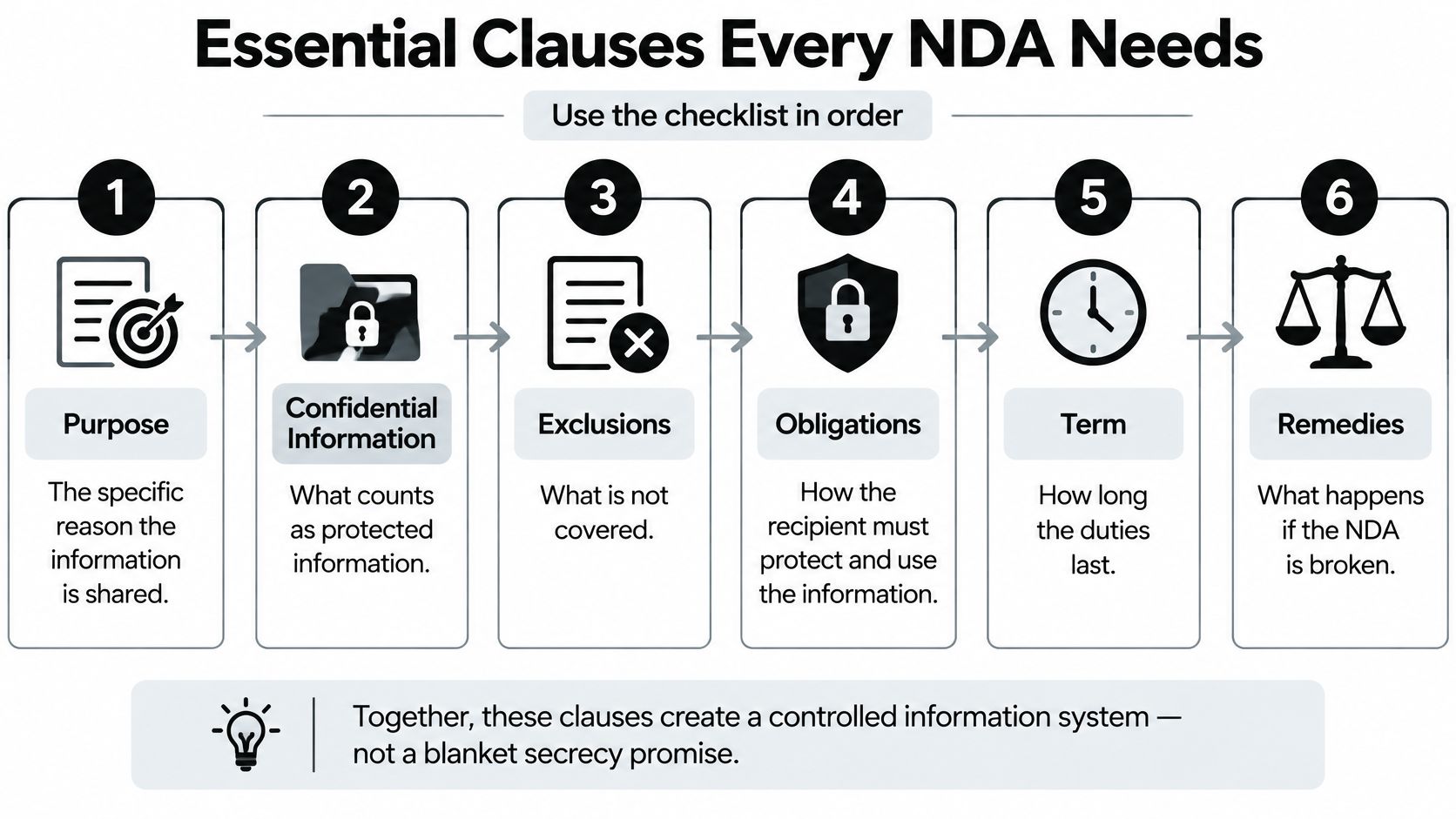
Treat non disclosure agreements as a controlled information system, not a blanket secrecy promise. The UK government's NDA guidance supports defining the disclosure arrangement carefully and expressly addressing governing law and courts for international relationships.
Use this visual checklist as a starting point, then turn each obligation into an operational instruction.
Draft obligations someone can follow
Purpose. Restrict use to the actual engagement.Example wording: The recipient may use the materials solely to evaluate Candidate X for the Senior Backend role.
Protected categories. Name the information rather than labeling everything confidential.Example wording: Protected information includes nonpublic source code, product roadmaps, pricing schedules, and candidate assessment records.
Authorized recipients. Identify permitted roles and require need-to-know access.Example wording: Access is limited to assigned interviewers and recruiting personnel supporting the stated purpose.
Security duties. Translate reasonable protection into concrete controls.Example wording: Store materials only in approved company systems and use managed devices with multifactor authentication.
Return or destruction. Specify a deadline, certification process, and treatment of legally required archives.Example wording: On termination, delete working copies by the deadline stated in the engagement schedule and confirm completion in writing.
Exclusions. Preserve legitimate use of information outside the protected exchange.Example wording: Protection excludes information independently developed, already known, lawfully received from another source, or publicly available.
Term. Separate the agreement's active period from duties that survive termination.Example wording: Confidentiality duties continue for the period assigned to each category in the information schedule.
For another drafting cross-check, consult the essential nondisclosure agreement provisions discussed by Miles Hansford Law Firm. Keep ownership separate: an NDA doesn't substitute for IP assignment for remote contractors.
For a companion explanation of NDA fundamentals, use the following video.
Self-test: Could someone outside the negotiation identify what to protect, why they may use it, and when their duties end?
Scope and Duration by Information Type
Duration should follow the information's sensitivity and useful life. Don't copy a single expiration period across every category just because your template has one blank field.
Distinguish ordinary confidential information from legally protectable trade secrets. A label alone doesn't turn an asset into a trade secret, and keeping information confidential requires operational controls as well as contractual language.
Typical protection terms by information type
These are illustrative negotiating positions, not statutory deadlines or universal market standards.
For example, you could negotiate protection for a pricing model for three years after an engagement ends, while protecting a proprietary algorithm for as long as it qualifies as a trade secret. Those are hypothetical drafting choices, not a conclusion that every pricing model or algorithm merits that treatment.
Candidate information needs a separate retention decision. A confidentiality obligation doesn't authorize indefinite storage of a rejected applicant's résumé, interview recording, or identity documents.
A duty to keep information confidential and permission to retain it are different questions.
Run a ninety-day scope inventory as a planning exercise: list the information each party will see during the hire's first ninety days. Assign an owner, category, permitted system, and proposed term to every item. Have counsel check the resulting schedule before you negotiate it.
Enforceability Across US, UK and Latin American Hiring
A US template won't necessarily travel unchanged. Selecting a familiar governing law doesn't remove mandatory rules in the country where someone works.
Separate governing law, which identifies the intended legal rules, from forum, which identifies where disputes will be heard. Counsel should check both against the worker's location, employment status, and the practical ability to enforce a judgment.
Protect reporting rights explicitly
The US Securities and Exchange Commission's whistleblower guidance states that Rule 21F-17(a) prohibits actions that impede direct communication with the SEC about possible securities-law violations, including enforcing or threatening to enforce confidentiality agreements. The prohibition can also reach internal policies, compliance manuals, training materials, and codes of conduct.
The fix isn't to remove legitimate confidentiality duties. It's to preserve protected disclosures expressly while keeping unrelated business information protected.
Permitted recipients: Address legally protected communications with regulators, law enforcement, courts, and authorized advisers.
Compelled disclosure: Permit compliance with subpoenas, court orders, and mandatory law.
Notice requirements: Require company notice only where legally permitted, never as a prerequisite to protected regulator contact.</li>
Check the worker's country, not just company headquarters
For nearshore hires in Latin America, a US or UK choice-of-law clause may still encounter mandatory local labor rules. Country counsel should review the employment relationship and any Spanish or Portuguese version, including which version controls if wording differs.
For a Mexico hiring workflow, pair contract review with the operational questions in this Mexico hiring compliance guide. A translated template isn't the same as a locally reviewed agreement.
Ask counsel to check the related onboarding handbook too. Correcting the NDA won't solve a conflicting policy that still tells workers they need permission before reporting suspected unlawful conduct.
Signing test: If the document would stop a worker from making a legally protected report to a regulator, rewrite it.
Contractor vs Employee NDAs, Sample Clauses and Red Flags
Employees and contractors need many of the same confidentiality clauses, but the surrounding legal framework differs. Employment duties interact with local labor law; for contractors, spell out contractual scope, permitted subcontractors, and work-product ownership rather than assuming employee-style obligations apply.
Under the Defend Trade Secrets Act of 2016, the relevant employee definition includes independent contractors and consultants, and omitting the required whistleblower-immunity notice from covered agreements can cost an employer access to exemplary damages and attorneys' fees against that individual. The immunity covers specified confidential disclosures to government officials or attorneys to report or investigate suspected legal violations, and filings made under seal.
Have counsel include the statutory notice or an accurate reference to a policy containing it. A generic permission to obey the law isn't an adequate drafting substitute.
Sample starting language
Purpose clause: The Recipient may use Confidential Information solely to perform Services under this Agreement and for no other purpose.
Scope clause: Each party's obligations apply only to information it receives from the other party that is marked or reasonably understood to be confidential.
These are starting points, not complete agreements. The scope clause assumes a mutual exchange and needs coordination with the exclusions and disclosure carve-outs.

Red flags to resolve before signing
Global reuse without review: No country-specific legal check.
Unjustified asymmetry: Worker-only duties despite reciprocal confidential disclosures.
Workplace speech restrictions: A blanket ban on discussing pay or working conditions.
Undefined purpose: No boundary around permitted use.
Universal perpetual protection: Every document treated like a trade secret.</li>
Replace each red flag with a specific purpose, category, term, or protected-rights provision. Don't sign on the assumption that someone will narrow it later.
Keep classification and tax documentation separate, including foreign-contractor documentation questions. For a Singapore engagement, The Lawyer Guide's directory of employment lawyers in Singapore provides a jurisdiction-specific starting point for finding counsel, not a substitute for local advice.
Negotiating NDA Terms With Candidates, Contractors and Partners
Start from your approved template so departures are visible. Expect questions about indefinite duties, expansive definitions, and restrictions that could cover pay or workplace discussions.
Hold the controls, negotiate the mechanics
Hold on a defined purpose, protected-disclosure rights, and workable return or destruction duties. These establish usable boundaries rather than bargaining power.
Be flexible on finite terms for ordinary business information and marking requirements for nontechnical materials. For a mutual partner agreement, define each side's protected categories rather than accepting mirrored boilerplate without checking the exchange.
A useful exclusions counterproposal is:
Confidential Information excludes information the Recipient can show it developed independently, already knew, received lawfully from a third party, or that is public.
Use a controlled negotiation process:
Explain each redline: Add a short reason tied to the actual information flow.
Sequence templates deliberately: Put your draft forward before requesting an alternative, unless procurement requires otherwise.
Maintain the record: Keep dated versions, approvals, and signatories together.
Escalate legal changes: Send governing-law changes and protected-disclosure edits to counsel.</li>
Include the approval path in your recruitment risk-management process. Engineering can confirm access needs, HR can confirm the relationship, and counsel can assess legal restrictions.
Before execution, confirm the exact legal entities and the signatory's authority to bind the company. An approved redline still needs the correct parties and a complete signature record.
Pre-Signing Checklist for a Nearshore Hire
Before granting access, confirm that the signed agreement matches the person, engagement, and information systems involved. Add the following checks to your hiring-manager checklist, with a named owner for unresolved items.
Complete the scope inventory. Assign each anticipated disclosure to an information category and proposed protection term.
Confirm the structure. Choose one-way or mutual based on what each party will disclose.
Finalize purpose and exclusions. Ensure the permitted activity matches the job or engagement.
Check reporting protections. Include the protected-disclosure carve-out and applicable DTSA immunity notice.
Obtain country review. Have local counsel check governing law, forum, worker status, and relevant Spanish or Portuguese wording.
Connect signatures to access. Store the executed copy with its information schedule and authorized-recipient list.
Calendar the lifecycle. Record term-end dates and offboarding actions, including deletion certification where agreed.</li>
Resolve hiring bottlenecks separately
If process capacity is the constraint, our Recruitment Process Outsourcing covers the client's full hiring process with an expert team. We also provide staffing and EOR support for full-time placements that need less compliance exposure.
Before you authorize access, ask: Could a new engineer or partner, reading the NDA alone, know what to protect, for what purpose, and for how long?
GENTY recruitment helps companies hire technical talent and supports full-time placements through staffing and EOR services. If you're planning a nearshore hire, visit GENTY recruitment to discuss your hiring requirements and identify where recruiting responsibilities should connect with your legal and onboarding controls.