

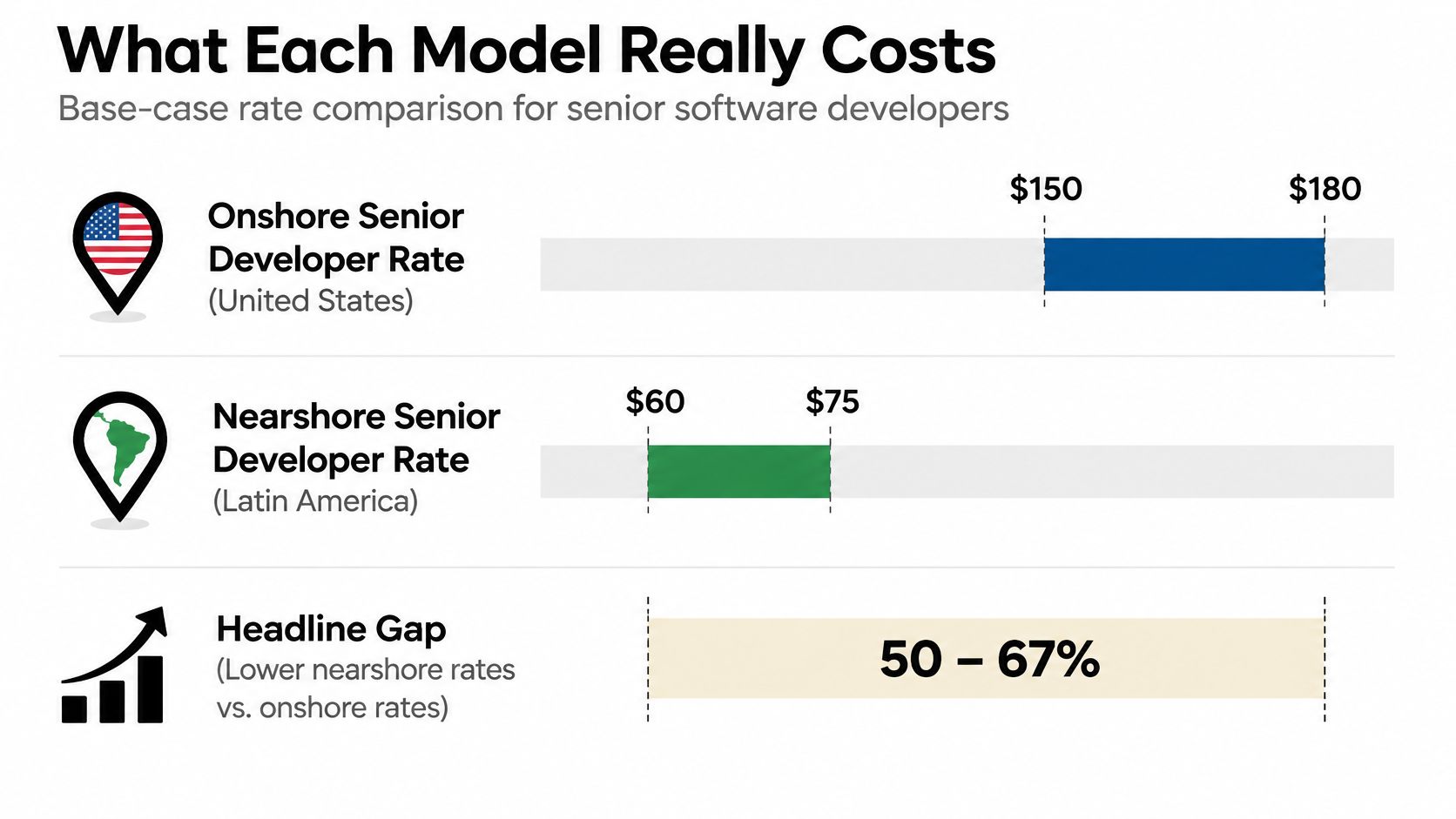
The popular advice that nearshore is “onshore quality for less” skips the decision that matters: what will the team cost to deliver work reliably, and how many hours must it collaborate live? For a Series A–C company, senior US developers are benchmarked at $150–$180 or more per hour, compared with $60–$75 for senior developers in Latin America, a headline gap of roughly 50–67% before overhead. Nearshore can preserve substantial working-hour overlap, but onshore remains the rational choice when jurisdiction, security, or in-person work is a hard requirement.
The hourly rate is a starting point, not a verdict. Compare the models against your team's operating needs, employment structure, and fully loaded cost per outcome.
Nearshore vs Onshore at a Glance
These rate ranges are market benchmarks, not quotes. Seniority, technology stack, country, contracting model, benefits, and vendor margins all affect the price a company pays. The senior developer rate and overlap comparison puts US onshore rates at approximately $150–$180 or more per hour and Latin American nearshore rates at roughly $60–$75, while emphasizing that final costs vary with the role and engagement.
The first row matters if labor spend is the primary constraint. But don't treat a lower hourly rate as savings until you've included recruiting, management, employment infrastructure, and replacement costs. If your binding constraint is regulated data or a requirement for physical presence, the “best fit” row may decide the choice before price enters the discussion.
Need help hiring?
See the next step after this guide
If this topic is relevant to your team, these are the most useful pages to check next.
Decision rule: Start with the constraint that could stop the hire from succeeding. Then compare costs among the models that meet it.
Onshore buys same-country hiring and can simplify work tied to domestic jurisdiction, data residency, security clearance, or mandatory in-person collaboration. Nearshore is a strong candidate for product teams that need repeated live discussions but have room to hire across borders. The following sections test those differences against budget, working hours, role requirements, and legal structure.
What Each Model Really Costs
Start with the headline rates, then calculate the costs that don't appear in the hourly quote. One industry guide estimates senior developer rates at roughly $50–$90 per hour in Latin America and $150–$250 onshore in the United States, and recommends budgeting 30–50% above the headline rate for management, recruiting, employment infrastructure, equipment, travel, compliance, and turnover. Its core warning is practical: salary or hourly rate alone isn't a total-cost model. See the nearshore technology hiring cost guide.
Applying that 30–50% overhead range to the base-case rates in the comparison above gives a rough planning illustration. A nearshore rate of $60–$75 becomes $78–$112.50 per hour when loaded; an onshore rate of $150–$180 becomes $195–$270. Comparing the low end to the low end and the high end to the high end, the gap remains roughly 58–60%. The inputs are estimates, not a guaranteed bill rate, and this arithmetic doesn't replace a role-specific budget.
Compare the structure, not just the rate
For a consistent headcount, model three setups separately: direct hiring through a local employing entity, contractor engagement, and managed outsourcing, which may use an employer of record or vendor. Separate recurring costs, such as payroll, benefits, and ongoing management, from one-time recruiting, onboarding, and equipment costs. Then price the operational effect of a poor hire: replacement means renewed recruiting and onboarding, plus lost delivery time while the team rebuilds context.
Use this checklist on each scenario:
Base rate or salary
Employer taxes and benefits
Employer-of-record or vendor fee
Recruiting fee
Equipment and travel
Management and overlap time
Replacement cost of a poor hire
The same accounting applies to smaller, part-time needs. For example, part-time DevOps contractors in Colombia at 0.5 FTE, about 80 hours per month, are priced at $1,600–$2,800 monthly for entry-level, $2,400–$4,400 for mid-level, and $3,600–$6,800 for senior. Those figures are useful for framing a specific staffing requirement, but the engagement structure and included services still need to be compared.
Onshore can be cheaper in practice for a small, highly specialized team if domain knowledge, coordination, or security requirements dominate labor expense. For repeatable hiring, nearshore may retain a meaningful cost advantage, but only if the team's management and onboarding model makes that capacity productive. GENTY recruitment's cost-to-hire breakdown for LATAM can help frame the costs to include.
Measure the cost per accepted feature or resolved incident, not the price of an hour.
Time Zones and Working-Hour Overlap
Colombia and Peru operate on UTC−5, Mexico and Costa Rica on UTC−6, and Argentina, Brazil, and Chile generally near UTC−3. These offsets put most Latin American engineering hubs within roughly zero to three hours of major US time zones, making live stand-ups, pair programming, incident response, and same-day code reviews easier than overnight handoffs. The country and city examples, including how a New York team's fit differs from a California team's, are laid out in this guide to Latin American engineering time zones.
Onshore US hires give a company full alignment with its own local working hours. Nearshore gives many US teams a large shared window without requiring every engineer to be in the United States. But a country's time zone is only a starting point: a California product team and a New York product team won't get the same working-day fit from every Latin American hub.
Test the actual calendar
Write down the daily hours when your product team must be available for decisions, code reviews, or incident work. Then compare each candidate location against that window, not against a generic claim about “close time zones.” This turns location into a delivery-design decision rather than a sourcing preference.
European buyers should run the same calendar test against their team's working day, since the overlap with Latin American hubs differs from US overlap. The available country comparisons here cover Latin America; validate any Eastern European option separately before assuming it offers the same live collaboration.
For practical examples of how to map overlap to a team schedule, use this time-zone alignment guide for Latin American hiring.
Which Work Needs Live Overlap
Not every engineering task needs a shared workday. Incident response, product discovery, fast-changing requirements, and customer-facing sales engineering benefit from quick clarification and access to decision-makers. A well-specified asynchronous ticket backed by strong automated tests needs less live discussion. The distinction is whether a delay in getting an answer blocks the next meaningful step.

The communication cost of separation is measurable. A 2024 peer-reviewed study of 12,038 employees across 167 cities and 48 countries found that each additional hour of time-zone separation reduced synchronous communication, including calls, meetings, and real-time messages, by an average of 11%. For engineering organizations, that makes a defined overlap window more useful than a location label alone. See the study and its nearshore collaboration implications.
Track review latency, blocked-ticket duration, incident handoff time, and meeting participation. Use these metrics to see whether overlap is helping your workflow or creating a calendar full of meetings without faster decisions. A time-zone advantage improves access to live communication, but it doesn't guarantee good documentation, clear ownership, or strong technical work.
Claims that aligned teams deliver two to four times faster shouldn't be treated as universal causation. Test delivery against your own cycle time and escaped defects, and check whether a shorter feedback loop is improving outcomes.
A useful operating question is how much work stops when the right person isn't available. If an incident commander, product lead, or staff engineer needs to unblock decisions during the same business day, schedule overlap around that person's real responsibilities. If a ticket can move through implementation and automated verification without synchronous input, prioritize clear acceptance criteria and review ownership instead.
Talent Access and English Proficiency
A regional label doesn't tell you how well an individual candidate will communicate. English proficiency varies across Latin American countries, and even within the same market by role, education, and exposure to international teams. Use that variation to prioritize sourcing, then test the candidate directly against the communication demands of the role.
Developer-specific findings add useful context. A report on English proficiency among Latin American developers covering more than 124,000 Latin American software developers found that more than two-thirds had intermediate-or-higher English proficiency, with roughly half of the English-proficient group classified as advanced. That supports a broader sourcing pool, but it remains a group-level measure. It does not tell you whether a senior DevOps engineer can explain an incident clearly to a product lead or whether a staff engineer can challenge an unclear requirement in English.
The practical conclusion is narrow: treat English as a role requirement, not a country filter. A backend engineer working mostly from tickets may need clear written communication and reliable code review participation. A product-facing developer, sales engineer, SDR Team Lead, or incident lead needs live spoken clarity, concise updates, and the ability to push back with context. GENTY recruitment's engineers work in the client's timezone and communicate in fluent English, which can reduce coordination friction for client-facing technical roles, but the hiring process should still test the exact skill the role needs.
For guidance on building a role-appropriate language assessment, see this overview of English proficiency in tech hiring. For staff engineers, product-facing developers, DevOps specialists, and sales engineers, assess spoken communication, technical writing, incident explanations, and whether the candidate can challenge unclear requirements in English. Give candidates an example with real ambiguity: ask them to explain the trade-offs in a proposed change, then describe how they'd communicate a production issue to a product lead.
Keep technical evaluation independent from English screening. Give candidates a role-specific task and review it against the same engineering bar you use onshore. A clear explanation doesn't prove depth in architecture, testing, or operations; a strong technical task doesn't show whether the hire can communicate decisions to stakeholders.
Talent access also depends on how the search is run. GENTY recruitment helps US and EU startups hire vetted nearshore talent in under 2 weeks, with every search starting from a detailed intake session covering the role's tech stack, seniority, team structure, culture, working style, timezone requirements, compensation benchmarks for LATAM markets, and success criteria. Each role is assigned a dedicated consultant matched to the role, with IT or Sales expertise. That structure matters because it turns “find someone in LATAM” into a defined search: the right level, the right communication bar, the right overlap, and a shortlist built around the client's interview process.
Employment Structure and Legal Risk
A contract calling someone an independent contractor doesn't settle their legal status. The IRS guidance on independent contractors and employees says businesses generally withhold federal income tax, Social Security, and Medicare from employee wages, pay the employer share of Social Security and Medicare, and pay applicable unemployment tax. Payments to genuine independent contractors generally don't trigger those payroll withholdings.
The IRS looks at the working relationship, including control and independence. A remote worker may still qualify as an employee under common-law rules if the company controls what will be done and how it will be done. Review these questions before choosing a structure:
Who sets working hours and methods?
Is the worker exclusive, and how many clients do they serve?
Who supervises the work and manages performance?
How closely is the worker integrated into company teams and tools?
Is the engagement ongoing or limited in duration?
How is the worker paid?</li>
</ol>
<table>
<thead>
<tr>
<th>Structure</th>
<th>Worker status and payroll</th>
<th>Compliance exposure</th>
</tr>
</thead>
<tbody><tr>
<td>Direct contracting</td>
<td>Contractor with no federal withholding or employer payroll tax if status holds</td>
<td>High if control tests point to employee</td>
</tr>
<tr>
<td>Employer-of-record</td>
<td>Provider employs the worker and runs payroll under the contract</td>
<td>Medium; review the provider contract and country rules</td>
</tr>
<tr>
<td>Local employing entity</td>
<td>Employee under local law with in-country payroll</td>
<td>Lower misclassification risk, with setup time and cost</td>
</tr>
</tbody>
An employer of record can handle employment and payroll through a provider, while a local entity puts the worker on the company's in-country payroll. Neither option removes the need to understand the applicable rules. Direct contracting may be operationally simple, but classification exposure rises if the actual relationship looks like employment.
If status remains unclear, either party can submit Form SS-8 for an IRS determination. The IRS test governs US employers; European buyers and workers based in Latin America also need to account for local employment law. Confirm the final structure with employment counsel in the relevant country. For full-time placements that need less compliance exposure, GENTY recruitment provides staffing and EOR support; its guide to hiring foreign contractors can help frame the classification questions.
Which Model Fits and What to Do Next
The hourly rate is the starting point, not the decision. A lower LATAM rate can lose its advantage if the team needs four hours of live overlap, heavy context transfer, or a legal structure that adds setup work. Onshore can be the rational choice when domestic jurisdiction, security constraints, or specialized domain knowledge carry more value than cost savings.
The table is a decision filter, not a verdict. Start with the work pattern: a product squad changing requirements through daily stand-ups benefits from nearby time zones, while a small team handling sensitive domain work may pay the onshore premium to avoid repeated handoffs. For repeatable senior engineering hiring, the savings deserve a closer look, since the result depends on interview velocity, compensation alignment, and how much overhead the structure adds.
A mixed model often gives the better operating trade-off. A small onshore core can own architecture and domain decisions, while nearshore engineers add delivery capacity around that core. This keeps senior decision-makers available during the shared workday without requiring every role to sit onshore. Platform-specialist work can follow the same rule: keep decisions close to the product, and use external expertise where it supports the delivery model rather than replacing it. For data-heavy systems, Snowflake data platform consulting fits that support layer.
Before the first vendor call, prepare three things:
Write the daily overlap window your team needs, in hours, and name the decisions that must happen live.
Compare three loaded-cost scenarios for the roles you plan to hire, and define the English and technical assessments each role needs.
Bring those answers to the intake conversation. A useful intake should cover tech stack, seniority and team structure, culture, working style and timezone requirements, compensation benchmarks for LATAM markets, and success criteria and interview process design.</li>
That preparation also shortens the path from role definition to candidate review. GENTY recruitment helps US and EU startups hire vetted nearshore talent in under two weeks, with searches matched to a dedicated consultant who has IT or Sales expertise. For engineering roles, the standard placement fee covers sourcing across LATAM, English proficiency evaluation, motivation and culture-fit screening, hard and soft skills testing, a curated shortlist of interview-ready candidates, and a 3-month replacement guarantee. For a broader view of location and hiring structures, see this guide to global hiring models for Latin American tech recruiting.
Use the shortlist call to test the operating model, not just the candidate. Confirm the engineer can work in the client's timezone and communicate in fluent English, then compare the fee, the employment structure, and the cost of the overlap the team needs. If the role needs full-time hiring with less compliance exposure, staffing and EOR can reduce the administrative load while keeping scaling flexible.
If nearshore looks like the right fit, visit GENTY recruitment to discuss your role, overlap requirements, and hiring structure. We can help you define the search around your technical bar, team setup, and compensation range, then build a shortlist of vetted candidates.