
Two senior engineers apply for one role. Both list Kubernetes and both have six years on the résumé, so your scorecard gives them the same mark. One has owned a service through a failed release and can name the alert that fired first. The other shipped features into a pipeline someone else maintained. Why does a market with this much engineering talent still produce hiring plans that can't tell those two people apart?
A tech talent strategy is the plan that links hiring, skills development, assessment and retention to what your product team has to ship over the next 12 to 24 months. It answers four questions. Which capabilities do you need, where will they come from, how will you test them, and how will you keep them long enough to compound? It also settles something most hiring decks skip: whether a role should be filled by a full-time engineer, developed internally, or accessed for a defined period.
Location belongs in that plan as a sourcing variable, not a quality label. An engineer in the same working day as your team is a coordination decision. Whether they can own a service in production is a hiring decision, and it gets settled with evidence rather than a postcode.
What a Tech Talent Strategy Covers and Why It Matters
A single requisition is one brick. A tech talent strategy is the building plan that says how many bricks you need, which wall goes up first, and what the foundation has to carry. Lay bricks without the plan and every hire turns expensive, slow and hard to defend at the budget review.
Planning a hire?
Talk through the best hiring option
This article usually leads to one practical question: should you use it recruitment or staffing? We can help you choose quickly.
Simple next step
Start with it recruitment and we will help you pick the best hiring setup.
The plan has five moving parts, and skipping any one of them shows up six months later as a missed roadmap commitment.
Workforce planning converts funded product work into named capabilities with priority levels attached.
Sourcing models decide, role by role, whether a capability arrives through in-house recruiting, an agency, an RPO engagement, nearshore staffing or a contract specialist.
Skills assessment tests delivery evidence so a shortlist survives contact with your own technical panel.
Retention practices protect the capacity you already paid for, which is the cheapest engineering capacity you'll ever add.
Nearshore options widen the pool when local supply can't hit the deadline, with trade-offs that belong in the plan rather than in a footnote.</li>
Demand isn't ambiguous. The U.S. Bureau of Labor Statistics projections put software-developer employment growth at 17.9% from 2023 to 2033, against 4.0% across all occupations, roughly 303,700 additional jobs. Roles stay open longer, and your competition for the same engineers includes banks, hospital systems, manufacturers and government agencies.
The most expensive failure isn't a weak sourcing channel. It's headcount applied to a process problem. A team misses its release cadence, leadership approves two more backend engineers, and four months later the cadence hasn't moved because the constraint was release governance, flaky tests or a slow environment pipeline. Engineers can't rescue a delivery system designed to stall.
By the end of this guide you'll have a capability map, a sourcing decision per critical role, a scorecard you can run next week, and four retention practices to hold onto the people those decisions bring in.
Plan Roles Around Capabilities Before You Open Requisitions
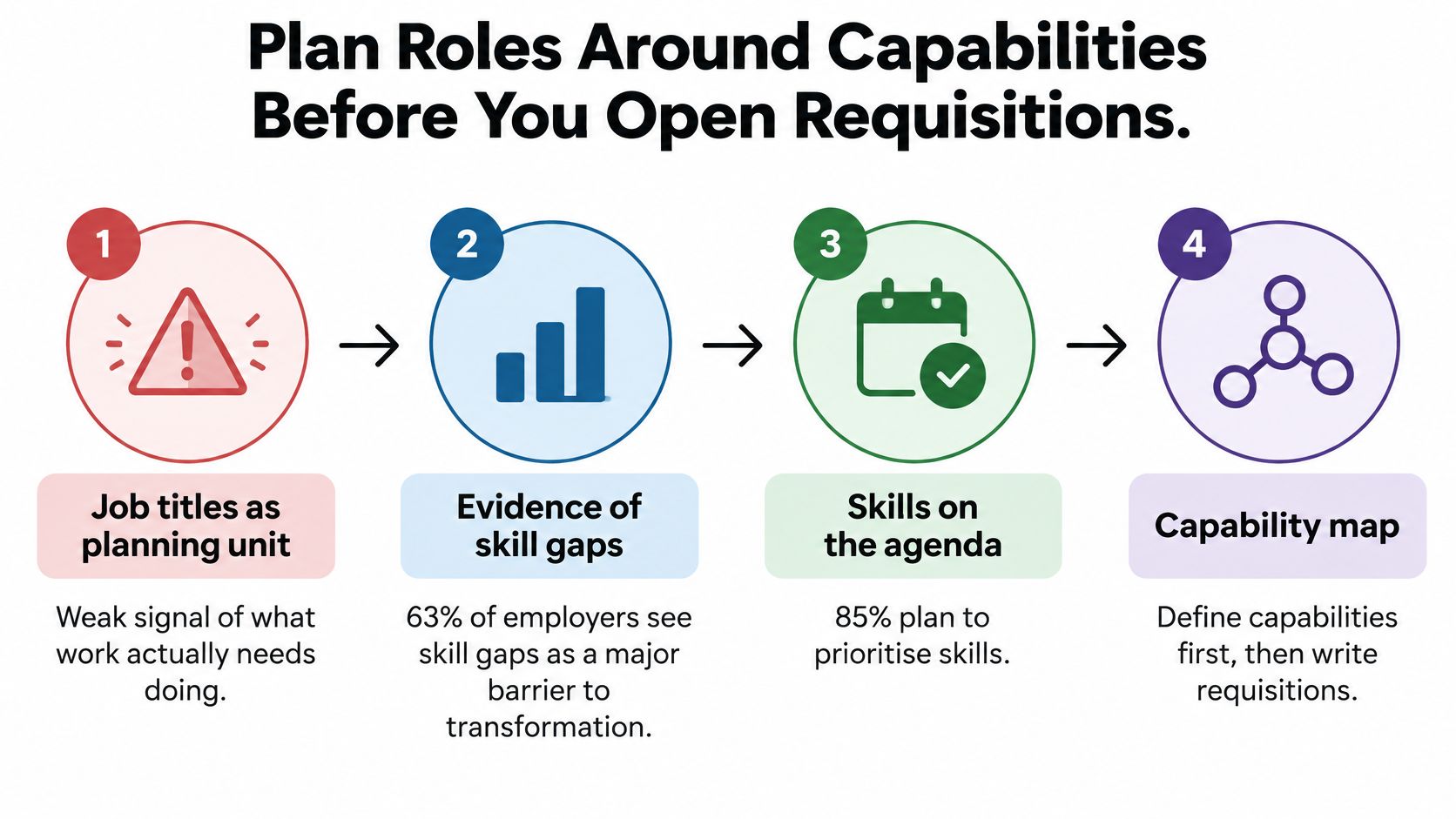
Job titles are a weak planning unit because they hide what you're buying. Two "senior engineers" can mean a payments specialist and a distributed-systems designer, and only one of those takes four months to find.
The World Economic Forum's 2025 Future of Jobs Report, drawing on more than 1,000 companies, found 63% of employers name skill gaps as a major barrier to business transformation. Employers are already responding. 85% plan to prioritise workforce upskilling, 70% expect to hire people with new skills, and the report estimates 39% of workers' core skills will change by 2030. Technical depth alone doesn't cover the map either: analytical thinking remains the most sought-after core skill, with roughly seven in ten companies treating it as essential in 2025.
From initiative list to capability map
List the next 12 months of funded product work. Name the billing migration, the SOC 2 push, the latency rebuild. A map built from last year's roadmap plans for a company you no longer are.
Translate each initiative into named capabilities. "Billing migration" becomes idempotent payment design, ledger reconciliation and PCI scope control. Write capabilities as things a person has done in production, not as logos on a stack diagram.
Rate criticality and fill difficulty. Rank each capability by what breaks without it and how long equivalent candidates take to find. Every search starts with a detailed intake session covering the role's tech stack, seniority, and team structure, plus culture, working style, and timezone requirements, because a capability scarce in one market is available in another.
Choose a route per capability. Permanent hire, internal development, or temporary access. Defaulting to permanent hire for all three is why the plan takes nine months.
Set a time-to-fill threshold and a backup channel. If a critical role passes its threshold, a named second channel activates. A backup channel invented in week ten isn't a channel.</li>
Typical slip: writing a generic "senior engineer" requisition that conceals a scarce capability like distributed-systems design. The posting then attracts volume, the screen filters for the wrong signals, and the role stays open while the roadmap slips. The output you want is one page linking each role to an initiative, a priority level and a hiring route. If you're tightening the numbers underneath it, this walkthrough of headcount forecasting covers tying a hiring plan to delivery capacity, and the small business staffing strategy guide from LeaveWizard is a useful primer on the planning methods before you translate them into requisitions.
Compare Sourcing Models for Engineering Hires
Five models cover most engineering hiring, and the choice goes wrong when teams compare fees instead of failure modes. The table sets out what each one is good at and what it costs you in control.
When RPO is the right call
RPO fits a process constraint. Open eleven roles across three squads with two recruiters and no consistent intake document, and the bottleneck is the funnel itself. Outsourcing execution while you keep process design authority moves faster than hiring a third recruiter. The cost is direct candidate contact, which shows up in offer-acceptance rates when the provider's process is generic.
When nearshore staffing is the right call
Nearshore staffing fits a supply constraint where the work needs daily overlap. It widens access to scarce capability and keeps collaboration inside a working day. It does nothing for onboarding, documentation, or a manager who already has nine reports. Where a team wants the capacity without running the employment relationship, our staffing engagements hire, onboard and manage the professionals so the client keeps building the product. If you're still deciding how much of the work to hand over rather than just how much capacity to add, this comparison of staff augmentation vs outsourcing sets out where control sits in each model.
Title-based planning misdiagnoses both cases. The OECD's mapping of skill shortages found ICT professionals in shortage across member countries during 2019 to 2023, and noted that programming and troubleshooting skills can look broadly balanced while ICT occupations remain undersupplied. Scarcity sits in specialisations, which makes "Kubernetes operations with on-call ownership" a better planning unit than "senior engineer."
Flexible access is already mainstream. In the Randstad tech talent report, 63% of organisations name contract, fractional and contingent specialists as a primary strategy, while 61% of employers say human capabilities such as critical thinking and stakeholder management are harder to source than technical skills. Both figures argue for a decision per role instead of a company-wide preference for full-time hiring.
Apply three questions to each critical role: how scarce is the capability, how urgent is the start date, and how much process control does your team need.
Cost isn't in the table, on purpose. Compare total cost as fee plus internal recruiter hours plus the cost of the role sitting open, measured against the time-to-fill threshold you set per capability.
The output is one line per critical role: capability, chosen model, backup channel, owner.
Assess Demonstrated Skills Instead of Job Titles
DORA's four delivery metrics give an engineering hiring loop something it usually lacks, which is a definition of value that isn't fluent in the interview. Change lead time, deployment frequency, change-fail rate and failed-deployment recovery time measure how a team ships and recovers, and DORA's 2024 research ties each one to engineering practices rather than to individual effort.
The hiring translation is direct. A candidate earns the offer when they can move one of those four numbers. Automated testing lowers change-fail rate. Infrastructure-as-code cuts the provisioning delay inside lead time. Observability plus rollback automation brings recovery time down. Ask which number they moved and how they knew it moved, and the conversation gets specific within four minutes.
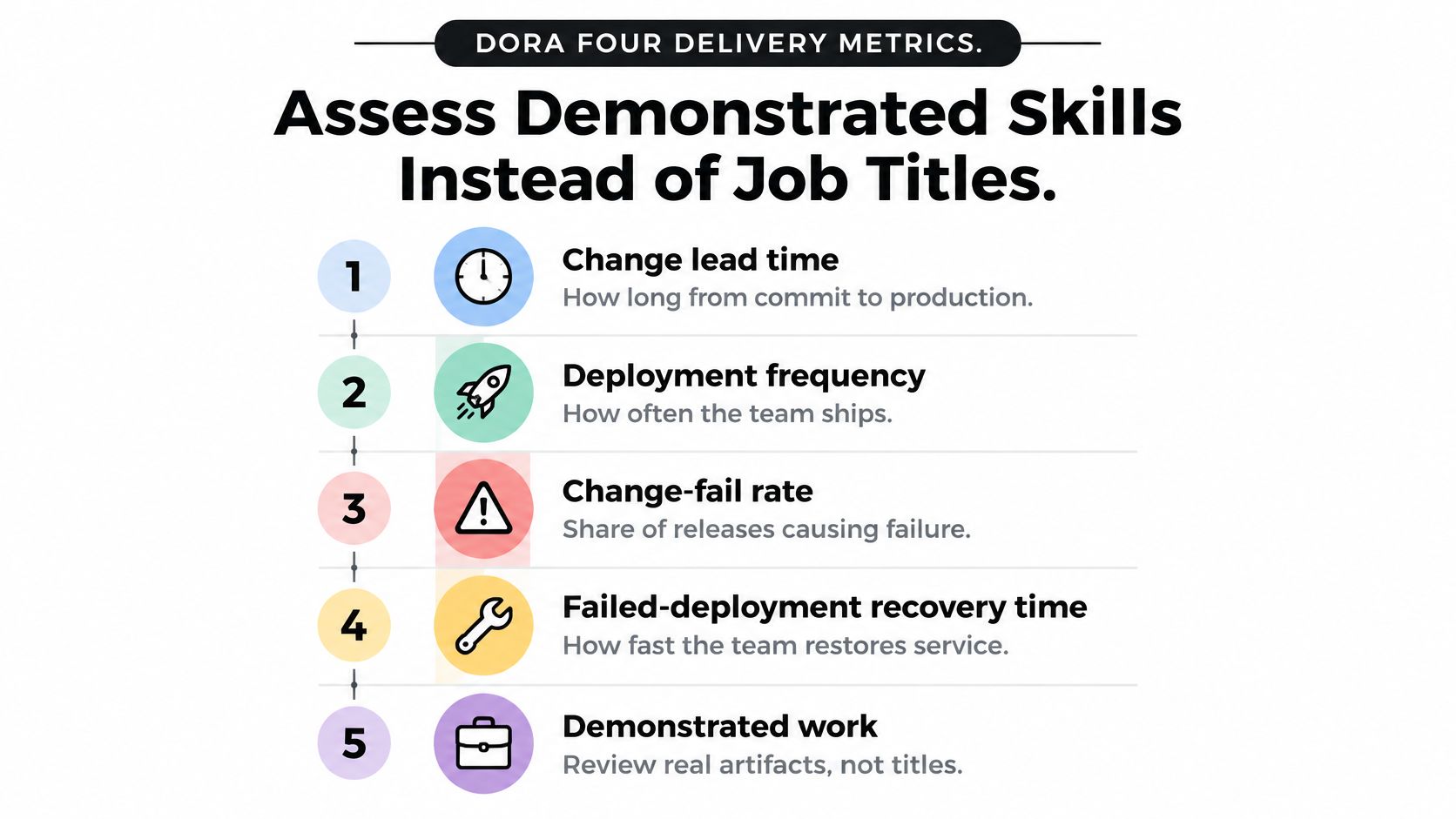
Score four or five criteria from 1 to 4 each, and set the pass mark before the first interview so the bar doesn't drift toward the likable candidate.
Two methods carry most of the weight. Review the take-home for what they cut when time ran short, because that tells you how they'll behave in a sprint. Then call one reference and ask what changed after the candidate's last incident. Our process applies the skills-first hiring model directly, which is why technical screens run on production evidence rather than keyword coverage.
AI tools raise the stakes on all four metrics. In the same DORA research, greater AI adoption coincided with an estimated 1.5% decrease in delivery throughput and a 7.2% reduction in delivery stability, which makes "how would you test AI-generated code before merge" a stability question rather than a philosophy question.
Score the constraint, not the vocabulary. An engineer who says "I'd fix the test suite before adding feature work" and can prove it beats one who names twelve frameworks.
One caution keeps the scorecard honest. DORA metrics belong to a team or a service, never to an individual, because outcomes depend on architecture, platform quality and dependencies the engineer doesn't control. Measure an individual and you get gaming: commits split to inflate deployment counts, releases held back to protect a number. Baseline at team level before and after onboarding, and keep it out of performance reviews. If you're rebuilding the front of the funnel around evidence, skills-first hiring explains how to keep the screen consistent across interviewers.
Retain Engineers With Remote-Ready Operating Practices
Engineers who join from another city rarely leave over the time zone. They leave because decisions happen in meetings they can't attend, nobody writes the outcome down, and their career path exists only inside one manager's memory.
The GitLab remote work report quantifies both the upside and the dependency. Four in five respondents said they would recommend remote work to a friend, and 81% reported satisfaction with their productivity, while employers credited remote work with increased productivity 42% of the time and better documentation and process 20% of the time. Read the documentation line twice. The gain appears when documentation is treated as infrastructure, not as an optional culture project.
A remote engineer's career path is either written down or it doesn't exist. In an office, presence used to substitute for documentation. Distributed, nothing does.
Write decisions down. A short record of what was decided, by whom, and what would reverse it, published where everyone can read it, replaces the corridor conversation a remote engineer never gets to have.
Name an owner and a rotation. Every service gets one accountable engineer and a published on-call rotation with overlap hours for incidents and pairing. Unowned services decay fastest, and the remote hire usually absorbs the blame.
Ship something in week one. A documented 30-day plan with a named buddy and first tasks that end in a real merged change beats a fortnight of onboarding videos. The merge proves access, review habits and documentation all work.
Publish the ladder. Promotion criteria tied to delivery evidence, visible in every location. The moment the criteria include "visibility with leadership," you've written a rule that favours head office.</li>
Two management risks sit underneath. A manager carrying too many distributed reports won't notice disengagement until the resignation lands, so cap the span and review work rather than presence. And build depth inside each region, because a team whose only senior engineer is one person has a succession problem disguised as a hiring win. This month, audit your last three remote hires against these four practices and fix the weakest one first. For a deeper look at the recognition and culture side, this breakdown of how to retain remote LATAM talent covers the processes that hold up over time.
Nearshore LATAM Hiring Criteria to Check First
Nearshore hiring solves one problem well and several problems not at all. Start with what it fixes. If your platform team needs same-day pairing, a nine-hour offset adds a day to every question, and engineers across Latin America, including Argentina, Brazil, Mexico, Chile, Colombia and Peru, keep you inside a shared working day.
What it doesn't fix is onboarding, documentation, manager bandwidth and retention. A nearshore hire dropped into an undocumented codebase with no named owner leaves at the same rate as anyone else, and the region gets blamed for a management failure.
The pressure driving the decision is real. In the Randstad tech talent report, 86% of organisations report growing technology teams, even as capability gaps persist in AI security and risk management, AI operations and monitoring, and AI-workload cost optimisation. Growth and gaps arrive together, which is why the checklist below matters more than a salary comparison.
What to verify before you commit
Overlap hours with the core product team. Count real collaboration hours, not clock difference. Two hours of shared morning is workable for pairing; one hour wrapped around a stand-up isn't.
English and stakeholder communication. Test it twice, once in a live call and once in a written status update, because written clarity is what survives in a distributed team.
Production ownership evidence. Ask for the last service they were on call for and what broke.
Incident-response maturity. One concrete outage story, with their role in detection, mitigation and the follow-up change.
Data-security controls. Access management, device policy, and how quickly access is revoked when someone leaves.
Succession depth in the region. If one engineer is your entire capability there, you've built a single point of failure with a nicer invoice.
Compensation benchmarks that hold up. Benchmark by seniority, local market, specialisation, employment model and currency movement. A single "average developer salary" for the region tells you nothing about a senior SRE in São Paulo.</li>
Apply the test at the end: if the role needs daily real-time collaboration with a product team in your time zone, nearshore fits. If the work is deep, asynchronous and independently scoped, delivery evidence matters more than region, and you should hire wherever the strongest evidence is. The trade-off between offshore and nearshore models comes down to overlap and coordination cost, not talent quality.
Build Your First 90-Day Talent Plan
Ninety days is enough to put the plan in motion and not enough to finish it. The output at day 90 is a set of decisions, not a fully staffed org chart.
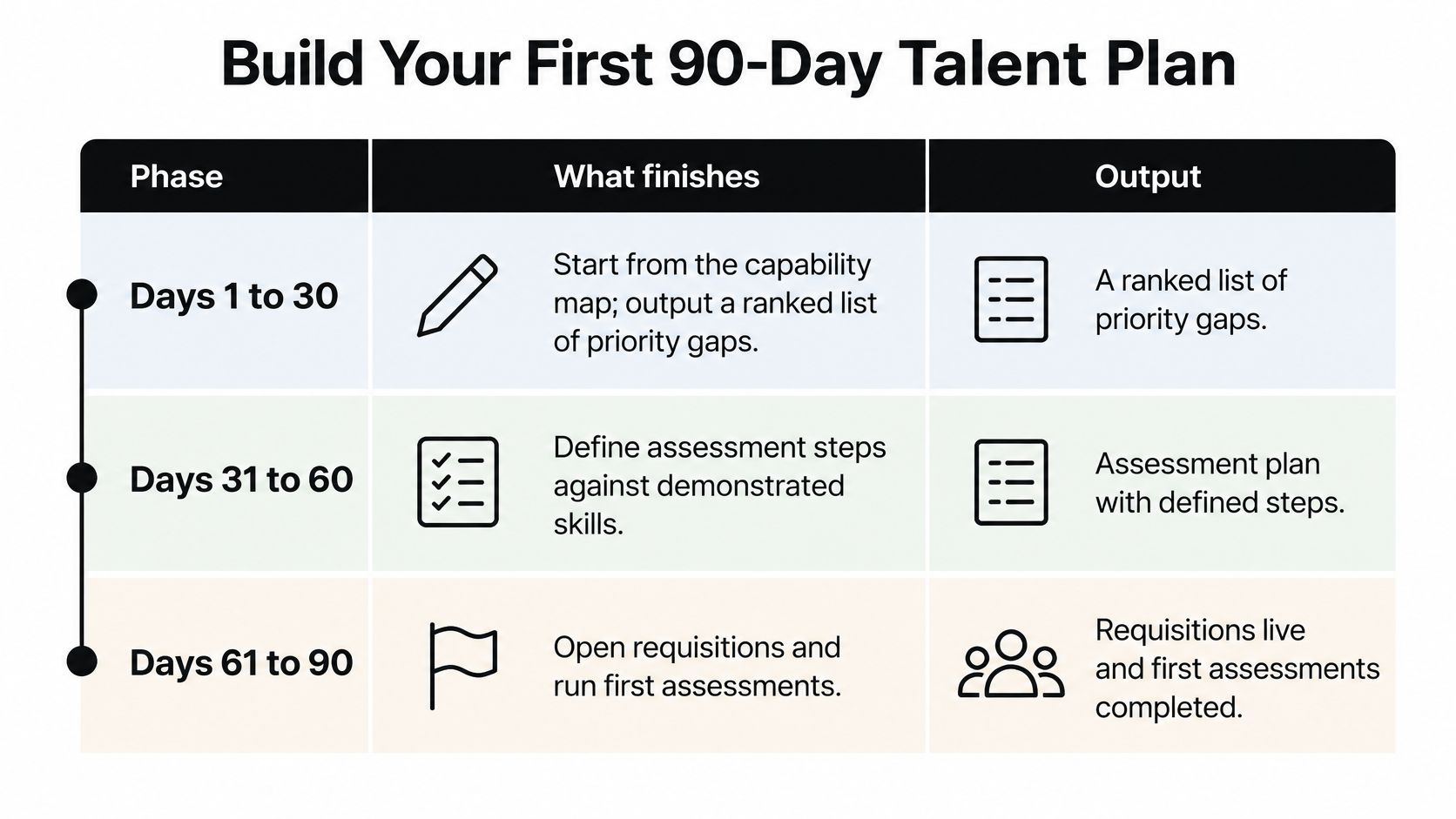
Two things go wrong in this window. Teams open requisitions in week one, then discover in week three that the capability map reorders everything, and the first three interviews were spent on the wrong capability. Or they design scorecards and never run them against a live candidate, so the criteria stay theoretical and the panel falls back on gut feel by the second interview. Run one real candidate through the scorecard before you trust it.
If you'd rather run the first searches with outside help, our IT recruitment service covers engineering and product roles, with shortlists built against the capability map rather than a keyword match.
Pick the one critical role you can't afford to leave open this quarter and name it at your next planning meeting. One role, one owner, one date.
GENTY recruitment works with US and European tech companies to source, vet and place engineers, DevOps and cloud specialists, data and AI people, and technical leads across Latin America, with a skills-first process and fixed-fee pricing that starts from $2,999. If the capability map you built has a gap that needs filling this quarter, we can run the first search and give you a shortlist instead of a stack of résumés, often within days rather than months. Visit GENTY recruitment to book a free consultation and start with the one role that's holding up your roadmap.