

A US company generally does not issue a Form 1099-NEC to a foreign contractor who performs all the work outside the United States. The form follows the payee’s tax status, not their address: a US citizen contracting from Buenos Aires or London still gets a 1099-NEC, while a Brazilian or Colombian national working from home generally gets a W-8BEN on file and no 1099. For CTOs and founders building remote engineering and sales teams in Latin America, getting this one distinction right at onboarding prevents most of the paperwork problems that show up in January and March.
This guide walks through the decision, the forms, the 2026 thresholds and deadlines, the recordkeeping, and the local-country risks that matter more than the IRS forms once you hire in Argentina, Brazil, Mexico or Colombia.
TL;DR
- Form 1099-NEC is for US persons (citizens, green card holders, resident aliens), wherever they live. A foreign national working entirely outside the US generally does not receive one.
- Collect a W-9 from US persons and a W-8BEN (individuals) or W-8BEN-E (entities) from foreign contractors before the first payment.
- For payments made in 2026, the 1099-NEC threshold is $2,000, due January 31 of the following year. Form 1042-S, when it applies, is due March 15.
- Where the work is physically performed decides the income’s source. Work done inside the US by a nonresident can trigger 30% withholding.
- IRS compliance is only half the picture: classification and employment rules in the contractor’s own country can matter more.
The rule in one sentence: US person or foreign person
The IRS asks whether the payee is a US person or a foreign person. A 1099-NEC reports payments to people who are not employees for services performed for your trade or business, and the instructions list situations where it is not required. Practitioners read the foreign-contractor exception this way: if the contractor is a foreign person and performs services outside the US, a 1099-NEC is generally not required, even above the dollar threshold.
The consequence for a US startup hiring in Latin America:
What do you need?
Choose the hiring path that fits
After reading "1099 Contractors Abroad: What US Companies Must File", most teams compare these options before deciding how to hire.
The last row is the one that hurts. If you cannot tell whether the payee is foreign or a US person, the presumption rules require you to treat them as a non-exempt US person and apply backup withholding. Paperwork collected up front is what keeps you out of that default.
Address and bank account do not settle the question. A foreign mailing address or bank account does not establish tax status, and a US address does not prove someone is a US person. Use the tax form, not geography.
US citizens and green card holders living in Latin America
Latin America has a sizable community of American remote workers, and they are the exception to the “no 1099 for foreign contractors” rule. A 1099 is required for US persons, including citizens, green card holders and resident aliens, and a US citizen living in London should receive a 1099-NEC. The same applies to a US citizen living in Medellín, Mexico City or Florianópolis.
In practice:
- Ask every contractor for citizenship and tax status during onboarding, not after the first invoice.
- Collect a W-9 with a taxpayer identification number from anyone who is a US person.
- Report their payments on a 1099-NEC if they reach the threshold, using the US-person rules regardless of the country where they live.
The contractor, for their part, owes US self-employment tax as a US citizen abroad. That is their filing, not yours, but it explains why a US-citizen contractor will usually ask for the 1099 promptly.
W-8BEN: the form that documents a foreign contractor
For a Latin American contractor who is not a US person, the document you want is Form W-8BEN. A US company can obtain it to determine whether the contractor is a US person, and it captures citizenship, tax status and treaty benefits. Keep it in your records; do not mail it to the IRS. Individuals use W-8BEN. When the contractor invoices through a company, collect W-8BEN-E instead.
Three practical points:
- Collect before the first payment. A form received after you have already paid a contractor leaves a gap in your file for the earlier payments.
- Track validity. A signed W-8BEN or W-8BEN-E stays valid through December 31 of the third calendar year after signing, so a form signed in 2026 covers payments through the end of 2029. It becomes invalid if the contractor moves to the US or gets a green card, so ask contractors to tell you about changes in status.
- Set a renewal reminder. Put the expiry date in your contractor tracker next to the contract end date.
We cover the form field by field, including common errors on the treaty section, in our guide to W-8BEN for contractors.
Where the work is performed decides the source of income
The 1099 question is usually the easy one. The more consequential question is where the contractor sits when they do the work. The source of income for independent services is determined by where the services are performed, and foreign-source income paid to a nonresident alien is not subject to US withholding or reporting.
For a developer in Córdoba, Argentina who never leaves Argentina, that means foreign-source income and, generally, no US withholding and no 1042-S. The reverse also holds. Payments to independent nonresident alien contractors for personal services may be subject to 30% withholding unless a treaty or the law provides a lower rate, and Form 1042-S is required even if no tax was withheld.
This matters in three common scenarios:
- A contractor visits your US office for a sprint. Days worked in the US can produce US-source income for those days. Ask for a simple workday log.
- A contractor relocates mid-contract. A move to the US invalidates the W-8BEN and changes the analysis.
- A team offsite in Miami or Austin. Paid work performed there is the case that creates reporting and potential withholding. Agree in advance how that time is handled and invoiced.
If a treaty applies, the contractor can claim it. A valid W-8BEN claiming the treaty benefit can reduce or eliminate the 30% rate on US-sourced payments, and nonresident individuals can give the payer Form 8233 to claim exemption from withholding under a treaty. Treaty availability differs by country, so confirm it with your tax advisor before you rely on it for a specific hire.
2026 thresholds and deadlines
The numbers changed for payments made in 2026. The 1099-NEC threshold rose from $600 to $2,000 for payments made after December 31, 2025, under Public Law 119-21, with inflation indexing starting in 2027. That applies to your US-person contractors only.
For the 1042-S side, Form 1042-S and Form 1042 are due March 15 of the year after payment, with an automatic 30-day extension for the 1042-S via Form 8809 and a six-month extension for Form 1042 via Form 7004. The same source lists late-filing penalties per 1042-S that start at $60 within 30 days and reach $340 after August 1, with intentional disregard costing more. Confirm current penalty amounts on the IRS site when you file.
Recordkeeping that survives an audit
For each contractor abroad, keep one folder with:
- the signed W-8 or W-9
- the contractor agreement
- invoices and payment confirmations
- a travel or workday log showing where and when services were performed, plus any Form 8233 and treaty support
On retention, guidance for onboarding global contractors suggests keeping tax records at least four years after the tax is due or paid, with seven years from the end of the engagement as a practical default. Seven years is easy to adopt as a policy and removes guesswork.
A pre-payment checklist
- Confirm citizenship and tax residence in writing.
- Collect W-9 (US person) or W-8BEN / W-8BEN-E (foreign person).
- Record the country where services will be performed.
- Add a contract clause requiring notice of relocation or US travel for work.
- Add the form’s expiry date to your calendar.
- Check classification and IP terms in the contractor’s home country (next section).
The local-country side: classification, IP and permanent establishment
Missing the IRS forms is a fixable error. Misclassifying a full-time Brazilian developer can cost far more, because the contractor’s home country applies its own test. A US company should check the IRS common-law test and the home country’s framework, which applies independently and may be stricter. It should also check mandatory contract terms, IP ownership rules and permanent establishment risk. A related caution from practitioners: US companies engaging foreign contractors have no IRS reporting duty for work done abroad, yet may still owe obligations to the countries where those contractors live and work.
For a Latin America team, that translates into questions to answer for each country before you sign:
- Brazil: Is the person effectively working like an employee, with fixed hours, your tools and exclusivity? Contractors there commonly invoice through their own company, which is a W-8BEN-E case.
- Argentina: How do local rules treat long-term, single-client relationships? Ask local counsel before a contractor model becomes permanent.
- Mexico and Colombia: Does the engagement look like a standing role? If so, consider whether an employer-of-record or local-entity structure fits better.
- All four: Who owns the code? Contractor IP assignment needs to hold up locally; see our note on fixing contractor IP assignment for LATAM hires.
A contractor agreement that mentions scope, deliverables, own tools and the freedom to serve other clients is easier to defend than one that mirrors an employment contract. Have a lawyer qualified in the contractor’s country review the template once, then reuse it.
Timezone overlap is a reason contractors become long-term
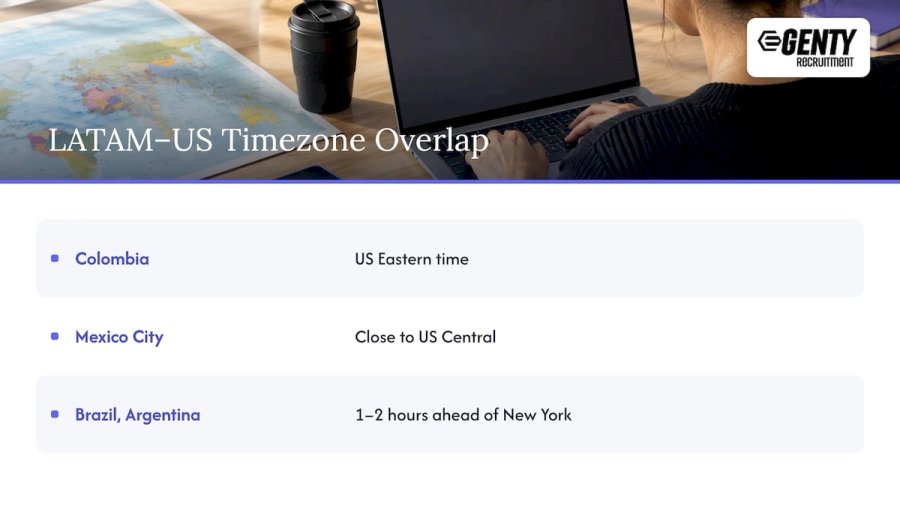
Latin America’s practical advantage is that the workday lines up with US hours. Colombia sits on US Eastern time for much of the year, Mexico City is close to Central, and Brazil and Argentina sit one to two hours ahead of New York depending on daylight saving. That overlap with US EST and PST schedules means standups, code reviews and incident response happen live, which tends to turn a short project into a multi-year relationship.
That is exactly when classification risk grows. A contractor who works your hours, in your Slack, on your roadmap for three years looks more like an employee each month. Decide early whether the role is a true project engagement or a permanent team seat, and choose the structure to match. Our guides on hiring remote developers and onboarding remote employees cover how to set that up.
Our perspective on contractors abroad
Most compliance trouble we see starts at hiring, not at tax time. A founder finds a strong engineer in Mexico or Brazil, agrees on a rate, and starts paying before anyone has asked whether the person is a US person, where they will work, or how the role will look in two years.
We build the process the other way round. Our recruiters work only in Latin America, with dedicated recruiters per vertical, so the shortlist you receive already reflects each candidate’s country, seniority and preferred engagement type. That lets you decide between contractor and staffing models before the offer, and request the right W-8BEN or W-9 on day one.
Our view: treat paperwork as part of hiring quality. A skill-first process, a clear engagement model and a clean file for each contractor is how a US startup scales a LATAM team without surprises.
Eugene
How GENTY recruitment fits in
We do not file your taxes, and the forms above are for you and your tax advisor. What we do is shorten the front end: a skill-first process with triple-vetted shortlists of Latin American engineers, DevOps and data specialists, and sales talent. Fixed-fee recruitment starts from $2,999 one-off per hire, with no upfront payments and a 3-month replacement guarantee. If you prefer not to manage the contracting yourself, our staffing model starts from $99 per month per employee.
Explore IT recruitment for engineering and DevOps roles, sales recruitment for SDR and AE teams, or see all services on GENTY recruitment.
Frequently asked questions
Do I send a 1099-NEC to a developer in Brazil or Argentina?
Usually not. If the developer is a foreign person and performs all services outside the US, a 1099-NEC is generally not required. Collect a W-8BEN to document their status and keep it with your contractor records. The answer changes if the developer is a US citizen or green card holder.
What if my contractor is an American living in Mexico?
Treat them as a US person. Collect a W-9 and issue a 1099-NEC if payments for 2026 reach the $2,000 threshold. Living abroad does not remove the reporting requirement.
Do I need to withhold taxes when paying a foreign contractor?
Not for services performed entirely outside the US by a nonresident alien, because that income is foreign-source. If the contractor performs services inside the US, the default withholding rate is 30% unless a treaty reduces it, and you report on Form 1042-S. Ask your tax advisor how this applies to a specific case.
How long should I keep a contractor’s W-8BEN?
A W-8BEN stays valid through December 31 of the third calendar year after signing unless the contractor’s circumstances change. Keep it, along with invoices and agreements, for at least four years after the related tax is due or paid. Many companies adopt seven years from the end of the engagement.
Is a contractor in Latin America safe from misclassification risk if I file correctly in the US?
No. US filings and local classification are separate questions. The contractor’s country may apply its own test, so have local counsel review the agreement, especially for long-term, full-time engagements.
Sources
- IRS: Forms and associated taxes for independent contractors
- 1099online: 1099-NEC for international contractors
- TCW Global: Do you issue a 1099 to a foreign contractor?
- Tipalti: 1099 for foreign contractors
- WGCPAs: US tax obligations related to hiring foreign independent contractors
- Greenback Tax Services: Form 1099 for foreign contractors
- UCLA Central Resource Unit: Sources of income
- Worksuite: Hire international independent contractors
- Commenda: IRS Form 1099-NEC filing requirements
- Cloudacc: Paying contractors abroad
- Omnivoo: Onboarding a global contractor checklist
- Bean, Kinney & Korman: The risks of engaging foreign independent contractors