

SaaS sales salaries in Latin America run well below US levels. Published data points to roughly $18,000–$30,000 base for a remote business development rep and about $1,400–$6,100 a month in base pay for Mexican account executives, depending on seniority. A US account executive, by comparison, has a median base of $100,000. This guide shows what the numbers look like by role and country, how base and variable pay split, and how to build an offer that attracts strong sellers while your team keeps a working overlap with US Eastern and Pacific hours.
TL;DR
- Remote LATAM SDR/BDR packages sit in the tens of thousands of dollars per year, against a US median SDR OTE of $85,000.
- Mexican account executive base pay runs from about $1,389 to $6,111 per month between junior and enterprise level, with the highest pay in Mexico City, Monterrey and Guadalajara.
- Variable pay matters: quota attainment is falling in the US (48% of reps hit quota), so design plans that pay for achievable targets.
- Mexico and Colombia sit in or next to US Central and Eastern time, and Argentina and Brazil are one to two hours ahead of Eastern, so live pipeline reviews and demos fit the US workday.
- Salary is only part of cost: employer charges and contractor structures differ by country and change your total spend.
What SaaS sales roles pay in Latin America
The region has no single salary scale. Pay depends on country, city, seniority, English level and whether the seller is employed locally or contracted by a foreign company. Three published reference points show the shape of the market.
Business development reps. A 2026 remote BDR posting for a bootstrapped B2B SaaS company offers a 70/30 base-to-variable split, with an estimated base of $18,000–$30,000 per year and OTE of roughly $24,000–$40,000, depending on country and experience. That is a useful floor for a lean company. Funded companies that compete for bilingual outbound talent often pay above it.
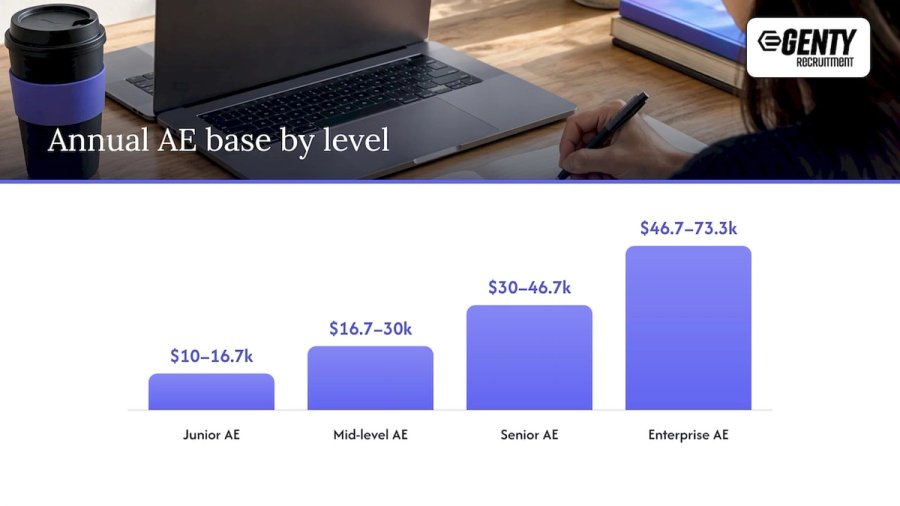
Account executives in Mexico. Payroll Mexico’s 2026 guide lists gross monthly base pay in pesos, converted at MXN 18 per USD:
Before you start hiring
Check location, salary, and hiring fit
If you are moving from research to action, start with the market basics so your hiring plan is clearer.
The annual column is our arithmetic (monthly USD × 12), base only, before variable pay. The same guide notes that smaller Mexican markets typically run 15% to 25% lower than the three big tech cities.
Brazil, Argentina, Colombia, Chile. Brazil is the largest market and pays in reais, with SMB, mid-market and enterprise AE tiers that roughly double at each step, and Brazilian Portuguese is a real requirement for domestic accounts. Colombia and Mexico have the deepest pools of bilingual outbound reps thanks to years of B2B outsourcing and sales academies. Argentina offers strong senior talent whose costs are shaped by currency volatility, so many companies contract in dollars. Chile tends to price higher for mid-level reps than its neighbors. Treat these as directional and confirm current figures per role with a salary benchmark before you publish a range.
SDR and AE pay by seniority
Seniority changes the package in two ways: the base rises, and the variable share and its volatility rise with it. The pattern holds in every market.
- Junior SDR (0–1 year). Mostly base, with a smaller bonus tied to meetings booked. Good English and coachability matter more than a track record.
- Mid SDR or BDR (1–3 years). Meetings held and pipeline created become the variable metric. This is the level where playbook experience with sequencing tools pays off.
- Mid-market AE. Variable pay becomes a large share of OTE, and quota carrying is real.
- Senior and enterprise AE. The highest base and OTE, longer cycles, and heavier dependence on multi-threading and discovery skills.
For a deeper breakdown on the entry level, see our guide to SDR salary in Latin America.
Base versus variable: how plans are split
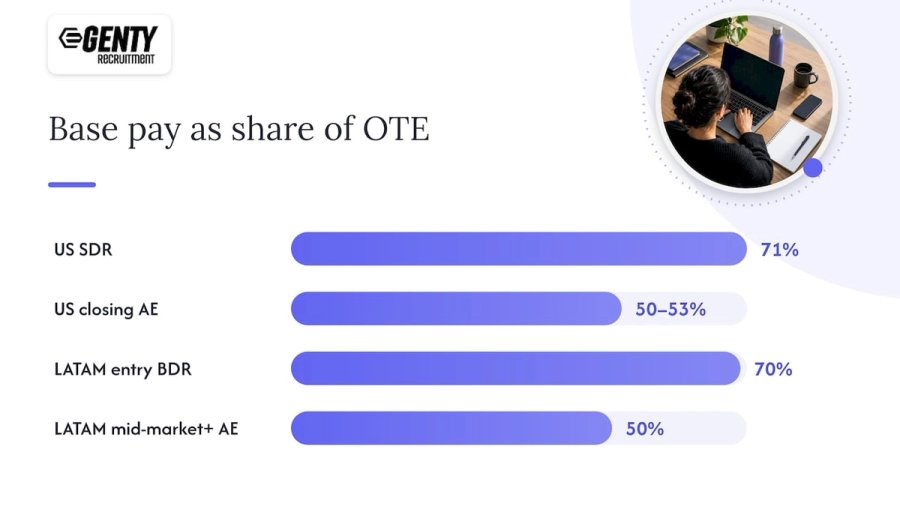
In the US, RepVue’s 2026 sales salary guide reports a median SDR base of $60,000 with median OTE of $85,000, so SDRs keep about 71% of OTE as base. Median AE base is $100,000 against median OTE of $200,000, and across closing AE roles base lands between 50% and 53% of OTE.
The remote LATAM BDR posting above uses 70/30 at the entry level, which mirrors the US SDR pattern. For AEs, a 50/50 split is the common starting point for mid-market and above, and it works in LATAM when the quota is credible. Our guide to LatAm SDR compensation plans walks through the plan mechanics.
Set quotas the team can reach
The Bridge Group 2026 State of Sales study, as reported in Brazilian media, found that only 48% of reps hit their annual quota, down from 51% in 2024. It also puts the median US SaaS quota at $960,000, a 4.6x ratio to OTE, up from 4.2x in 2024.
For your LATAM offer, that has a direct consequence. If you copy a US quota-to-OTE ratio onto a seller with a lower OTE, you may ask for pipeline the market cannot produce. Start from the territory, the average deal size and the sales cycle, then set the quota, rather than the reverse.
RepVue makes a related point: AEs have the lowest quota attainment of any sales role, at 40.6%, and the share of reps hitting quota falls at each step from SMB to mid-market to enterprise. A high OTE on paper is not the same as high realistic income, and sellers in LATAM know it. Candidates compare the guaranteed base and the attainment history of the plan.
LATAM versus US compensation
The comparison below uses the published figures above. US numbers are medians from RepVue, and the LATAM numbers are the lean-company BDR example and Mexican base pay.
A like-for-like gap on base is therefore large, and it is the source of the savings our clients seek. Note that US AE figures cover all segments, while the Mexican rows split by seniority, so compare the closest tiers rather than the headline rows. At GENTY recruitment, we position LATAM hiring as saving up to 40% against US or European hiring on total cost, which is a more conservative figure than raw salary gaps suggest, because it accounts for the full package rather than base alone.
What you actually pay: beyond the salary
A salary range is not a budget. The total cost of a LATAM seller includes gross pay, employer social charges or contractor fees, tools, management time and ramp-up. Employer charges vary substantially by country: they are heavy in Brazil and Argentina for locally employed staff, lower in Mexico, and structured differently again when you contract an individual or use an employer-of-record.
Before you offer, decide on the engagement model:
- Contractor. Fastest and simplest, with tax and classification rules that differ by country. Confirm the local rules with counsel.
- Employer of record. A local entity employs the seller on your behalf, and you pay salary plus a service fee.
- Your own entity. Best for teams of ten or more in one country, with the highest setup effort.
On our side, staffing starts from $99 per month per employee, and recruitment starts from $2,999 one-off per hire, with fixed fees by seniority level and no upfront payments.
Timezone overlap and why it affects the offer
Timezone is a compensation lever, not just a convenience. Sellers who work your pipeline calls, demos and Monday forecasts in your hours do not need a night-shift premium, and your managers can coach in real time.
- Mexico and Colombia: aligned with US Central and Eastern hours, with full overlap for East Coast teams (Mexico City follows Central time year round, so overlap with Pacific teams is two hours behind on Eastern terms, and one hour ahead of Pacific).
- Argentina and Brazil (São Paulo): one to two hours ahead of US Eastern depending on daylight saving, still giving a full EST workday overlap and a solid half day with PST teams.
- Chile: shifts by season, with a similar overlap profile to Argentina.
For SDRs calling US prospects, hours that cover 9 to 5 Eastern and 9 to noon Pacific are the practical standard, and all four main LATAM markets reach it.
Checklist: building a competitive LATAM sales offer
- Pick the country and city first, because pay differs by up to 25% between major hubs and smaller cities.
- Set the base against local mid-market tech pay, and state the currency (USD or local).
- Choose a base/variable split by role: about 70/30 for SDRs, about 50/50 for mid-market and enterprise AEs.
- Make quota derive from territory and cycle length, and write the ramp period into the plan.
- Add the full cost: employer charges or EOR fee, tools, management time.
- Specify English level, selling methodology and CRM experience in the job description.
- Confirm overlap hours with the candidate in the first call.
- Benchmark every role with current data. Our guide on how to do salary benchmarking shows the method.
Our perspective
We see the same mistake in sales hiring across Latin America: teams price the role from a US spreadsheet divided by a currency rate. It produces offers that either overpay for junior talent or lose senior sellers to local employers who understand the market.
The better approach is to start with the seller you need. A mid-market AE who has closed US deals in English, runs structured discovery and can work your hours is a different hire from a generalist, and the package should reflect it. Our recruiters work only in Latin America, with dedicated recruiters per vertical, so every shortlist is triple-vetted on skills, English and sales process before it reaches you.
Our fixed-fee model is designed to keep incentives simple: you pay per hire by seniority level, with no upfront payment and a 3-month replacement guarantee. Our process is built to deliver a curated shortlist within 7 days, which matters because strong LATAM sellers rarely stay on the market long.
If you are planning a first LATAM sales team, hire the first AE or SDR lead in Mexico or Colombia for overlap, then add Brazil and Argentina as your playbook matures.
Eugene
Hire LATAM sales talent with GENTY recruitment
GENTY recruitment places SDRs, AEs and sales leaders with US and European SaaS companies, with fixed-fee pricing from $2,999 per hire and a 3-month replacement guarantee. Our sales recruitment service covers the full process, from salary benchmarking for your target country to curated shortlists. If you are sizing the market first, our Tech Sales Hiring Guide is a good next step.
To discuss your role and country, start at the GENTY recruitment home page.
FAQ
How much does a SaaS SDR earn in Latin America?
A published 2026 remote BDR posting for a B2B SaaS company estimates a $18,000–$30,000 base and $24,000–$40,000 OTE per year, depending on country and experience. Packages tend to run higher in funded companies hiring bilingual reps in Mexico City, Bogotá or São Paulo. Confirm the range for your country and level before posting.
How much does a SaaS account executive earn in Mexico?
Mid-level account executives earn MXN 25,000–45,000 per month in base pay, roughly $1,389–$2,500 at an MXN 18 per USD rate, according to Payroll Mexico’s 2026 guide. Senior AEs earn MXN 45,000–70,000, and enterprise AEs MXN 70,000–110,000. Variable pay comes on top of these base figures.
Should LATAM sellers have the same base/variable split as US sellers?
The structure can match: about 70/30 for SDRs and 50/50 for mid-market and enterprise AEs. The amounts should be calibrated to local pay and to a quota the territory can produce. Bridge Group data shows only 48% of reps hit quota, so unrealistic targets hurt retention.
Do LATAM sales hires work in US hours?
Yes. Mexico and Colombia share US Central and Eastern hours, and Argentina and Brazil are one to two hours ahead of Eastern, so teams get a full EST workday overlap and a solid half day with PST.
Sources
- Account Executive Salary in Mexico 2026, Payroll Mexico
- Business Development Representative (Remote, Latin America), Wellfound
- Sales Salary Guide: What Sales Reps are Earning in 2026, RepVue
- Bridge Group 2026 quota and SDR data, Bot AI Hub