

Latin America is one of the few regions where a US or European company can hire production-minded AI engineers at a meaningful discount and still work the same business day. The strongest markets are Brazil, Chile, Colombia, Mexico and Argentina, the demand for the profile is rising faster than local supply, and the companies that win these hires define the role precisely and move quickly. At GENTY recruitment we place pre-vetted remote talent from these countries with US and European tech companies, and this guide covers what a CTO or founder needs to know before opening the search.
TL;DR
- Chile, Brazil and Uruguay lead the region’s AI index, with Colombia, Ecuador, Costa Rica and the Dominican Republic next. Mexico and Argentina are deep engineering markets worth searching alongside them.
- AI Engineer is the most sought-after profile in the region, and employers compete hard for people who can run models in production, not only train them.
- US base pay for AI roles sits far above Latin American pay for the same seniority, and timezone overlap with EST and PST is a built-in advantage.
- Define the business outcome first, then test for production skills: RAG pipelines, fine-tuning, vector databases and MLOps.
- Move fast. Strong candidates are in demand locally and from other foreign employers, so a slow process loses them.
Why Latin America is worth a serious look for AI hiring
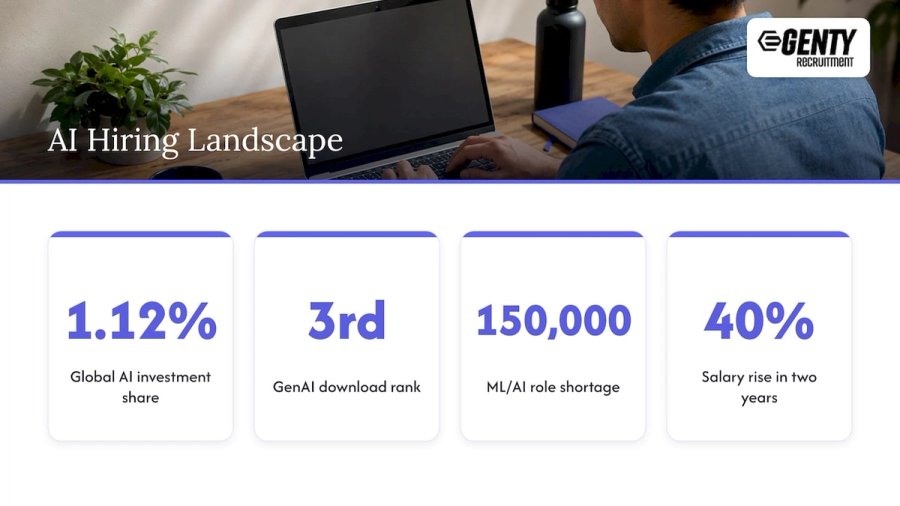
The region is not a late arrival to AI. The Latin American Artificial Intelligence Index (ILIA 2025), prepared by Chile’s CENIA with ECLAC, reports that the 19 countries it covers receive only 1.12% of global AI investment, yet the region ranks third worldwide in downloads of generative AI applications. Usage is high, capital is thin, and that gap explains much of the opportunity: there are capable engineers building products for a large user base while the funding that would let local companies outbid foreign employers has not arrived at the same scale.
Demand is real on the employer side too. An analysis of 15,000 job offers between 2023 and 2025 identified AI Engineer as the most sought-after profile in the region, with the work centered on operating and integrating AI models more than training them from scratch. That matches what US product teams usually need: someone who can connect a language model to a codebase, a data layer and a deployment pipeline, and keep it reliable.
The supply picture explains why the search takes method. Numoru Strategy’s April 2026 report on enterprise AI estimates a shortage of about 150,000 ML and AI engineering positions in the region, salaries up 40% in two years, and a skills gap of roughly 45% in data and AI engineering roles that remain unfilled. For a hiring manager, the practical reading is that good candidates get several conversations at once, and compensation expectations move quickly. Offers need to be competitive in dollars, and your process needs to be quick.
Need help hiring?
See the next step after this guide
If this topic is relevant to your team, these are the most useful pages to check next.
Which countries to search first
There is no single “best” country. The right one depends on the seniority you need, the stack, and the hours you want to share with your team. ILIA 2025 gives a useful national-level lens: it classifies Chile, Brazil and Uruguay as AI pioneers with more than 60 points, and Colombia, Ecuador, Costa Rica and the Dominican Republic as adopters between 35 and 60 points. More than one-third of the 19 countries are still explorers with incipient ecosystems.
The index measures national ecosystems, not individual hiring pools, so combine it with what you know about engineering communities. Here is how we frame the main markets for a US or European buyer:
For teams on the East Coast, Colombia is the easiest fit because standard hours line up almost exactly. For West Coast teams, Mexico gives the most shared hours. Brazil and Argentina work well for teams that can accept a morning-heavy overlap with US Eastern and Pacific. In every case the real advantage over offshore hiring in other regions is that stand-ups, code reviews and incident response happen live, without a team member working overnight.
How to choose between countries
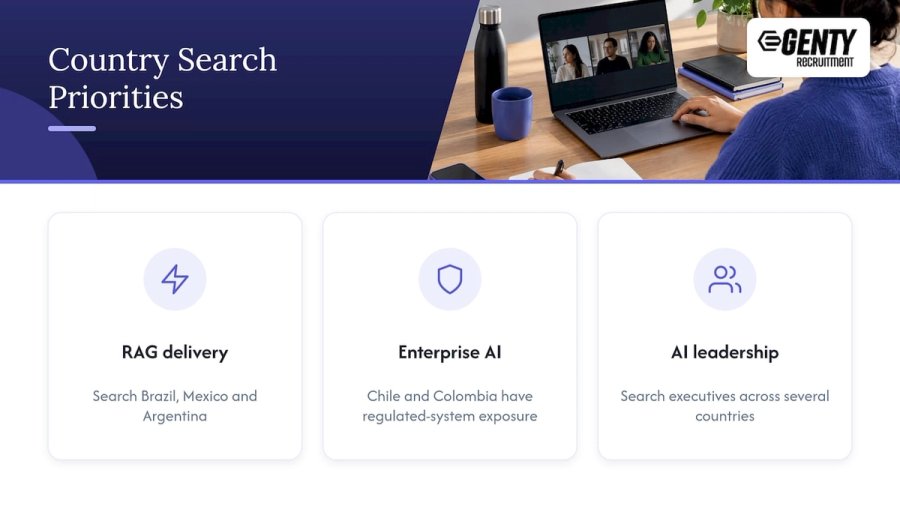
Start from the work, not the flag. If your roadmap is retrieval-augmented generation (RAG) for a customer-facing product, you need engineers who have shipped backend services, so search broadly across Brazil, Mexico and Argentina. If it is enterprise AI integration inside regulated systems, Chile and Colombia have strong exposure to banks and large corporates. If you need leadership for an AI team, executive search across several countries beats a single-country search.
Hiring in the same country as a nearby team member also helps retention, because candidates are often more comfortable with a peer in their own city. Mixed-country teams are common and manageable, but plan how you will handle local holidays and payroll differences from day one.
What an AI engineer is, and what to test for
The title covers very different jobs, and many hiring failures start with a vague posting. Before you write it, decide which of these you actually need:
- AI engineer (applied): integrates models into products, builds RAG pipelines, handles evaluation, latency and cost. This is the most common request and the profile the regional job data points to.
- ML engineer: trains and tunes models, manages experiments and pipelines, works closely with data scientists.
- MLOps or platform engineer: deploys, monitors and scales models and data infrastructure. Our IT recruitment team often scopes this role together with DevOps hiring.
- Data engineer: builds the pipelines and warehouses that every model depends on.
A practical assessment guide notes that AI engineering roles may involve LLM fine-tuning with PEFT and LoRA, RAG pipeline construction, vector database configuration and MLOps deployment. Treat that as a menu, not a requirement list. A product team shipping a support assistant needs RAG and evaluation depth. It may never need fine-tuning.
Start with the business outcome
Write one sentence on what the hire must deliver in six months: “reduce support ticket handling time by routing and drafting replies with an LLM,” or “move our fraud model from batch to real-time scoring.” Then derive the scorecard from it. Candidates can tell when a role has been scoped by someone who understands the problem, and senior engineers screen out vague postings quickly.
A scorecard you can use
Use this checklist to score every candidate on the same criteria:
- Production evidence: a model or LLM feature they shipped, who used it, and what broke after launch.
- Evaluation habits: how they measure quality, handle hallucinations, and decide when a change is an improvement.
- Data handling: chunking, embeddings, vector store choices, and how they keep indexes fresh.
- Software fundamentals: testing, API design, observability, and code review discipline.
- Cost and latency awareness: how they reduce token spend and response time without hurting quality.
- Communication in English: can they explain trade-offs to product and non-technical stakeholders in real time.
In interviews, ask for a walkthrough of a real system rather than a puzzle. “Tell me about the last time a retrieval pipeline returned bad answers and how you found out” separates people who have run production AI from people who have followed tutorials. Strong answers name specific metrics, specific failures and what they changed afterward.
Tools matter less than judgment, but hardware and environment questions come up for hands-on roles. For engineers who prototype and test models locally, preconfigured AI workstations are one option teams consider when equipping a remote developer.
What AI engineers cost in Latin America compared with the US
The US benchmark is high. The Bureau of Labor Statistics puts the median annual wage for computer and information research scientists at $140,300 as of May 2025, and the same source shows well-funded US employers posting base pay in the low-to-mid six figures for AI engineer roles, before equity. Total compensation at large tech companies runs higher again.
Latin American pay for comparable seniority is meaningfully lower, which is where the savings come from. We see clients save up to 40% compared with US or European hiring on an all-in basis once the role is filled by a pre-vetted LATAM engineer. Savings vary by country, seniority and how competitive your offer is, and the same Numoru report that documents a 40% salary rise over two years is a reminder that rates are moving up.
For a current country-by-country breakdown of ranges by seniority, see our guide to AI engineer salaries in Latin America. It is the page to check before you set a budget, because ranges for Brazil, Mexico, Argentina and Colombia differ and shift as demand changes.
A worked cost example
Suppose you are hiring one senior applied AI engineer. Compare three numbers, not one:
- Salary or contractor rate: what the engineer takes home, set by country and seniority.
- Employment cost: benefits, local contributions, equipment and, if you use an employer-of-record or contractor structure, the provider fee.
- Hiring cost: recruiter fee, your team’s interview hours and the cost of a vacant seat while you search.
The third line is where many teams lose the savings. A role open for four months because the posting was generic, or because a strong finalist accepted a competing offer during a slow process, costs real product time. A fixed recruiter fee is predictable. At GENTY recruitment, recruitment starts from $2,999 one-off per hire, with no upfront payments and a 3-month replacement guarantee.
Hiring and managing remote AI talent across borders
The legal and operational side deserves attention before the offer goes out. Your options generally fall into three types: direct contractor agreements, an employer-of-record arrangement, or a local entity. Each has different implications for tax, benefits and misclassification risk, and the rules differ by country. Have your own counsel or tax adviser confirm the structure for the specific country before you sign, and settle intellectual property assignment and confidentiality terms in writing from the start, because AI work involves proprietary data and models.
If you want ongoing support after the hire, our staffing service starts from $99 per month per employee.
Make timezone overlap work for you
Overlap is the reason nearshore hiring beats distant alternatives for AI work, where iteration is constant and debugging a model failure is easier live. Set a core window of four to five shared hours with your US team, usually mid-morning to mid-afternoon Eastern or late morning to early afternoon Pacific, and keep the rest flexible. For Pacific teams, favor Mexico. For Eastern teams, Colombia, Chile, Brazil and Argentina all work.
Onboard like a product team, not a vendor
Give new engineers access to the codebase, data and evaluation sets in the first week, and a real, small production task by the second. Pair them with a named owner. The engineers worth hiring in this market have options, and the ones who feel like part of the team stay.
A hiring process that holds up for AI roles
- Scope the outcome and the stack. One page, with the deliverable, the data you have, and the systems it touches.
- Pick two or three countries. Based on timezone and the profile in the table above.
- Source actively. The best applied AI engineers are rarely applying to job ads. Our candidates search playbook explains the approach for LATAM roles.
- Screen on production evidence. A 30-minute call using the scorecard above.
- Run one practical exercise. A scoped task that mirrors your problem, capped at a few hours, ideally paid for senior candidates.
- Decide within days. Offers sent after a slow process lose to competing offers. Our write-up on AI hiring processes that lose candidates covers the common delays.
- Offer in dollars, with clear terms. Be explicit about contract type, equipment, time off and review cadence.
What it means for AI teams specifically
The region’s weakness is also its upside. Numoru Strategy argues that internal upskilling works because it is faster to teach ML to a software engineer than to teach software engineering to a data scientist. For a US hiring manager, that points to a useful sourcing idea: strong backend or platform engineers in Brazil, Mexico or Argentina with recent hands-on LLM work can be better fits for applied roles than candidates with a purely research background, and they are often easier to find.
Our perspective
We hire for AI roles the same way we hire for every technical role: skill first. A resume that lists every framework tells you little. A candidate who can explain how they evaluated a RAG system, what it cost per query and what they would change tells you almost everything.
Latin America gives US and European teams a rare combination: engineers working in real-time overlap with your team, strong English, and costs that let you build a larger AI team within the same budget. The constraint is not the quality of the talent. It is speed and focus, because the best engineers are in demand and rarely respond to generic postings.
That is why we run dedicated recruiters per vertical, deliver triple-vetted shortlists within 7 days, and price on a transparent fixed fee per seniority level, so your cost does not grow with the candidate’s salary. Our work spans FinTech, AI, SaaS and Web3, and we cover Argentina, Brazil, Mexico, Colombia, Chile and more. If you are hiring your first AI engineer in the region, define the outcome with us and we will build the shortlist around it.
Eugene
Hire AI engineers in Latin America with GENTY recruitment
GENTY recruitment is a specialized IT and sales recruitment agency focused on Latin America. We deliver curated, pre-vetted shortlists within 7 days, charge a fixed fee with no upfront payments and back every placement with a 3-month replacement guarantee. For AI roles, start with our AI recruitment agency page, or go to IT recruitment if your search also covers software engineers and DevOps.
For leadership roles such as a head of AI or VP of engineering, our executive search service covers searches across the region.
FAQ
Which Latin American country is best for hiring AI engineers?
There is no single winner. Chile, Brazil and Uruguay lead ILIA 2025 as AI pioneers, while Colombia is the simplest fit for East Coast timezone overlap and Mexico for the West Coast. Brazil and Argentina offer the deepest general engineering pools. Choose by the role, the stack and the hours you need to share.
Are AI engineers still in demand in Latin America?
Yes. An analysis of 15,000 job offers from 2023 to 2025 found AI Engineer to be the region’s most sought-after profile, and a 2026 industry report estimates a shortage of about 150,000 ML and AI engineering positions. That is why speed and a competitive dollar offer matter in your process.
How long does it take to hire an AI engineer in Latin America?
It depends on how precisely the role is scoped and how fast you decide. With a clear scorecard and a fast interview loop, a shortlist can arrive within days: GENTY recruitment delivers curated shortlists within 7 days. Delays after that point usually come from slow feedback on your side.
How much can I save compared with hiring in the US?
Clients of GENTY recruitment save up to 40% compared with US or European hiring. The exact figure depends on country, seniority and your offer. Our salary guide for AI engineers shows the ranges to plan around.
Sources
- Latin American Artificial Intelligence Index ILIA 2025
- La IA no reemplaza pero sí redefine el empleo en América Latina
- State of enterprise AI in Latin America 2026
- AI Engineer Assessment Design Guide
- AI engineer salary in 2026: pay by role and company
- AI workstations