
Most of Latin America sits within one to four hours of the continental US, so a remote engineer in Bogotá, Buenos Aires, São Paulo or Mexico City can share most of the working day with a team in New York, Austin or San Francisco. How much depends on two things: which US zone your team is in, and the time of year, because the US changes its clocks and most of Latin America does not. At GENTY recruitment we place engineers, DevOps specialists and sales reps across the region, and overlap is one of the first filters we apply when a US or European company defines a role.
TL;DR
- For 09:00 to 17:00 local schedules during US daylight time, Bogotá or Lima overlap 7 hours with Eastern, 8 with Central and 6 with Pacific.
- Colombia, Peru, Ecuador, Brazil, Argentina and most of Mexico keep the same clock all year, so the gap to the US moves by one hour on the US change dates.
- Mexico has four zones, and its northern border municipalities still follow the US daylight saving schedule.
- Decide the overlap you need (stand-ups, pairing, on-call, interviews) before you pick a country, then hire inside that window.
What time zone alignment means for a US team
Time zone alignment is the number of working hours your team and a remote hire have in common each day. It is not the same as being in the same zone. A developer two hours ahead of you who starts at 8:00 a.m. their time can still give you a full afternoon of live collaboration, while a developer in your own zone who works a night schedule gives you none.
For an engineering leader, overlap buys three concrete things: live code review and pairing, a short feedback loop on blocked tickets, and the ability to hand an incident to someone who is awake. For sales leaders it buys something simpler: SDRs and account executives who can call US prospects during US business hours and join pipeline reviews live. This is the core nearshore advantage over offshore hiring in Asia or Eastern Europe, where overlap with a US team is often a few hours at the edge of the day. If you are weighing the term itself, our guide to nearshore versus near shore explains how it is used.
Latin American time zones at a glance
Latin America spans several offsets, but the hiring hubs cluster into a few useful groups.
Planning a hire?
Talk through the best hiring option
This article usually leads to one practical question: should you use staffing or country guide? We can help you choose quickly.
Simple next step
Start with staffing and we will help you pick the best hiring setup.
- Colombia, Peru, Ecuador (UTC-5): the same clock as US Eastern Standard Time. Bogotá and Lima do not observe daylight saving.
- Mexico City (UTC-6): the same as US Central Standard Time. Mexico abolished daylight saving time for most of the country in 2022, excluding border areas.
- Argentina and most of Brazil (UTC-3): Buenos Aires and São Paulo are two hours ahead of Eastern Standard Time and one hour ahead of Eastern Daylight Time. Brazil’s last daylight saving change was in 2019, and its clocks do not change in 2026.
- Chile: Santiago sits in the UTC-4 and UTC-3 band depending on the season, so confirm its offset for the exact dates you schedule.
Brazil also has zones west of São Paulo, such as Manaus, which uses a different offset. If a candidate lives outside the main hub, confirm their city rather than assuming the country’s capital time.
Overlap hours by US zone and LATAM city
Assume a standard 09:00 to 17:00 local schedule on both sides. During US daylight time, the same retrieved comparison from Programming Insider reports these shared hours:
The same source reports that Bogotá and New York overlap 8 hours in US winter and 7 in US summer, while Buenos Aires and New York overlap 6 in winter and 7 in summer. The direction of the change is the part to remember: Colombia gets closer to New York in winter, and Argentina and Brazil get closer in summer.
Reading the table by team location
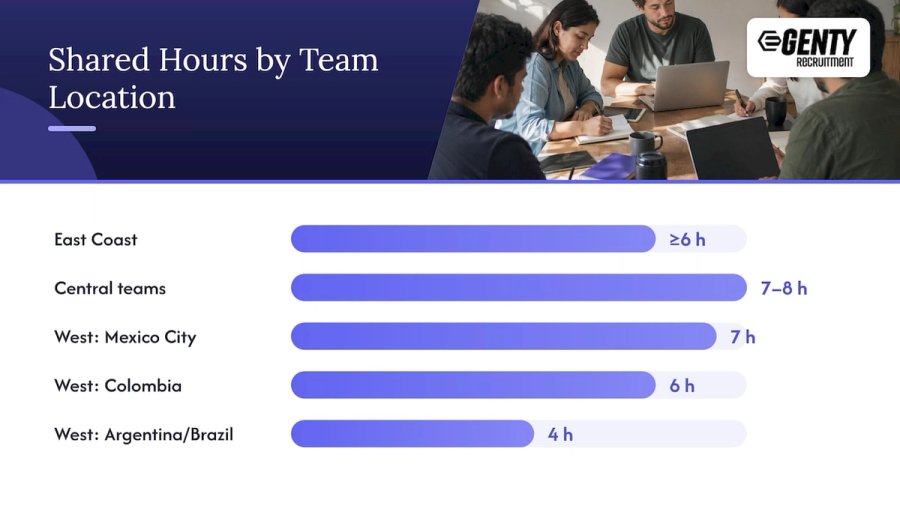
East Coast teams (New York, Boston, Miami, Atlanta). Every major hub gives you at least six shared hours. Colombia is the cleanest match, since its clock equals yours for the winter months. Argentina and Brazil work well for teams that run stand-ups before noon Eastern.
Central teams (Chicago, Austin, Dallas). Colombia and Mexico City are the strongest fits, with seven to eight shared hours. Mexico City is on the same clock as you for most of the year, so there is almost no mental conversion.
West Coast teams (San Francisco, Seattle, Los Angeles). Mexico City and Colombia remain workable at seven and six hours respectively. Argentina and Brazil drop to four hours, which still supports a daily sync and an afternoon of shared work if your hire starts early. For Pacific teams hiring in the Southern Cone, plan on a structured handoff rather than constant live collaboration.
Daylight saving: why your overlap changes twice a year
The US moves its clocks. Per NIST, daylight saving time begins at 2:00 a.m. on the second Sunday of March and ends at 2:00 a.m. on the first Sunday of November. Hawaii and Arizona (outside the Navajo Nation) do not observe it.
Most of Latin America does not follow. In 2026, Mexico, Colombia, Peru, Ecuador, Panama, Brazil and Argentina keep the same time all year, so the difference with the US shifts by one hour on the US change dates. Your engineer in Bogotá has not changed schedule; your calendar has.
Three practical consequences:
- Recurring meetings drift. A stand-up set at 10:00 a.m. Eastern in July lands at 9:00 a.m. in Bogotá. In November it lands at 10:00 a.m. Decide in advance which side holds the fixed time.
- Shift weeks are the risky ones. The US changes clocks in March and November, while some countries change on other dates, so a week or two can show a different gap than the rest of the year. Avoid scheduling critical releases or interviews in those weeks.
- Protect peak hours. When the window shrinks by an hour, the first thing to go is usually focus time. Frameworks for protecting peak working hours help teams decide which hours go to meetings and which stay free for deep work.
Mexico is the exception to check
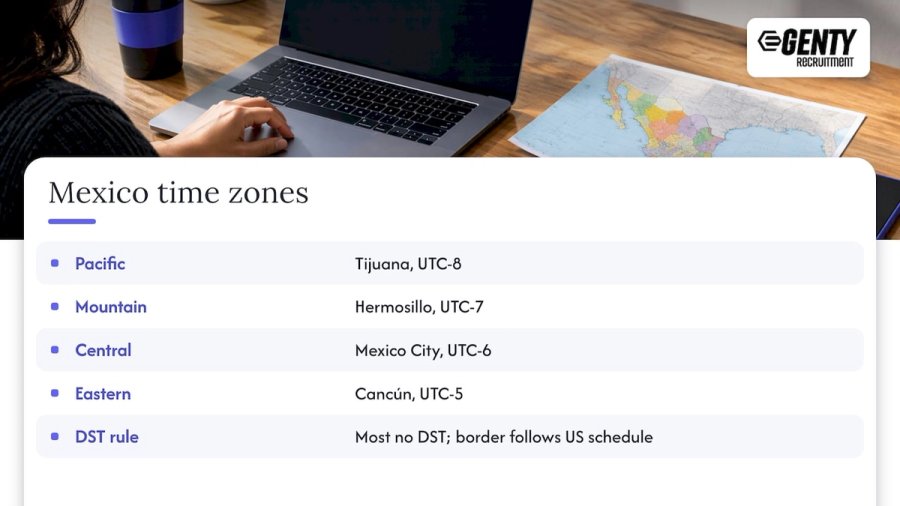
Mexico has four standard zones, mirroring the contiguous US: Pacific (Tijuana, UTC-8), Mountain (Hermosillo, UTC-7), Central (Mexico City, UTC-6) and Eastern (Cancún, UTC-5). Since the 2022 reform, most of the country has no daylight saving, but northern border municipalities still follow the US schedule. A hire in Tijuana therefore tracks Pacific time with the seasonal change, while a hire in Monterrey or Guadalajara holds Central Standard Time year-round. Teams comparing local versus remote app teams should add this city-level check to their scheduling plan.
How to schedule interviews across time zones
Hiring is where time zones cause the most avoidable friction, because a candidate who gets an invite at a bad hour reads it as a signal about your culture. A process that works:
- Write the time in both zones, with city names. “10:00 a.m. Eastern / 9:00 a.m. Bogotá” removes ambiguity better than “EST” or “ET”, which candidates misread during daylight time.
- Send a calendar invite, not a text time. Calendar tools convert to the candidate’s own zone automatically.
- Offer slots inside the candidate’s business hours. Because the overlap for most hubs is six hours or more, there is no reason to ask a LATAM candidate to interview at 7:00 a.m. or after 6:00 p.m. their time.
- Cluster interviews into two or three blocks per week. For Pacific teams hiring in Brazil or Argentina, the best slots are late morning to early afternoon Pacific, which is early evening there, so offer the earliest Pacific slots you can.
- Confirm the candidate’s city. A “Brazil” candidate may be in Manaus, and a “Mexico” candidate may be in Tijuana or Cancún.
- Keep the loop short. Fewer rounds with clear windows keep strong candidates engaged. Our remote hiring playbook for LATAM tech covers how to structure the stages.
On shortlists, GENTY recruitment delivers curated, pre-vetted candidates within 7 days, so the scheduling work starts with people whose location and availability are already known.
Work schedules that make the most of shared hours
Overlap is a resource, so spend it on the work that needs it.
- Core hours, then flex. Set a fixed shared block, for example 10:00 a.m. to 3:00 p.m. Eastern for an East Coast team with a Colombia or Argentina hire, and keep meetings inside it. Outside the block, people work independently.
- Put synchronous work first in the window. Stand-ups, design reviews, pairing and sprint planning go in the first two shared hours. Heads-down coding goes in the remaining hours.
- Use the morning gap for async handoffs. A US team that finishes a pull request late in the day can have it reviewed by a teammate in Latin America who starts earlier, and the reverse works too.
- Assign on-call by time of day. With hires in two zones, incident coverage extends without anyone working overnight.
- Pick the country by role. Roles that need heavy collaboration (staff engineers, tech leads, product-adjacent roles) belong in the hubs with the most overlap for your zone. Independent roles such as data pipelines or infrastructure automation tolerate a thinner window.
- Sales teams follow the prospect. SDRs calling US prospects should be inside the US zone where most of your accounts are. For West Coast outbound, Mexico City and Bogotá cover the calling day best.
A quick checklist before you commit to a country
- Which US zone do most of your meetings and customers sit in?
- How many shared hours do you need daily, and for which activities?
- Does your hire’s city, not just country, match the table above?
- What does the overlap look like in both US winter and summer?
- Who owns the fixed time for recurring meetings when clocks change?
- Do you have a written handoff routine for the hours you do not share?
Time zone is one factor in total cost
Alignment matters most because it lets you hire at LATAM salary levels without trading away collaboration. GENTY recruitment’s own estimate is that clients save up to 40% compared with US or European hiring while keeping nearshore alignment and strong English proficiency. For benchmarks by country and role, see our breakdown of the cost to hire in LATAM, the React developer salary guide and our overview of US tech employers hiring in Latin America. If you are comparing countries, developer contractor rates in Argentina show how much cost can differ inside one overlap band.
Our perspective
We start every search with the schedule, not the résumé. Before we write a job brief with a client, we ask where the team sits, which hours are non-negotiable for collaboration and whether the role is pairing-heavy or independent. That answer narrows the countries within minutes: Colombia and Mexico City for most Central and Pacific teams, Colombia and Argentina or Brazil for the East Coast.
Our recruiters each focus on one vertical, so a DevOps search and an SDR search are run by people who know how those roles actually work across Latin America. Our process is skill-first, our shortlists are triple-vetted and arrive within 7 days, and the fee is fixed with nothing paid upfront. If a placement does not work out, the 3-month replacement guarantee applies.
Time zone alignment is the reason nearshore works. It is also easy to get wrong when you hire alone, because the details, such as Manaus versus São Paulo or Tijuana versus Monterrey, sit at city level.
Eugene
Hire LATAM talent in your time zone with GENTY recruitment
GENTY recruitment recruits software engineers, DevOps and data specialists, and sales teams across Argentina, Brazil, Mexico, Colombia, Chile and more. IT recruitment and sales recruitment start from $2,999 one-off per hire, and staffing starts from $99 per month per employee. Tell us your US zone and the overlap hours you need, and we shortlist candidates who work inside them.
FAQ
How many hours of overlap do I get with Colombia?
With a 09:00 to 17:00 schedule on both sides, Bogotá overlaps 8 hours with New York in US winter and 7 in US summer. Colombia does not change its clocks, so only the US side moves. Central-time teams get 8 hours during US daylight time.
Which LATAM country is best for a West Coast team?
Mexico City and Colombia work best for Pacific teams, at 7 and 6 shared hours respectively during US daylight time. Argentina and Brazil fall to 4 hours in the same period. If you need constant live collaboration, choose Mexico or Colombia, and use Argentina or Brazil for roles that work well with a daily sync and async handoffs.
Does Latin America observe daylight saving time?
Mostly no. In 2026, Mexico, Colombia, Peru, Ecuador, Brazil and Argentina keep the same time year-round, while the US changes clocks in March and November. Mexico’s northern border municipalities still follow the US schedule, so check the city.
How should I write interview times for LATAM candidates?
Give the time in both zones with city names, such as “10:00 a.m. Eastern / 9:00 a.m. Bogotá”, and send a calendar invite so the candidate’s tool converts it. Offer slots inside their business hours, and avoid the weeks around US clock changes for important interviews.
Sources
- Nearshore Staffing, Measured in Hours (Programming Insider)
- Daylight Saving Time Rules (NIST)
- Time Zones in Mexico (timeanddate.com)
- Mexico Abolishes DST (timeanddate.com)
- Time differences between the US and Latin America (World Meeting Sync)
- Brazil’s Guide to DST (Connect Brazil)
- Daylight saving time in the Americas (Wikipedia)
- Energy Management vs Time Management (Inspire Wellness)
- Local vs Remote App Teams (Digital Fractal)