

AI engineers in Latin America typically earn between roughly $25,000 a year at the junior end and more than $130,000 at the senior end, with lead roles climbing higher. The exact figure depends on seniority, specialization, the country and whether the engineer is on payroll or invoicing as a contractor. This guide gives you the ranges by level, shows how Argentina, Brazil, Mexico, Colombia and Chile differ, compares them with US pay, and explains how to turn a salary into a realistic hiring budget.
TL;DR
- One published 2026 estimate puts monthly AI engineer pay across Latin America at $2,125–$4,400 for junior, $3,400–$7,150 for mid-level, $5,525–$11,000 for senior and $8,500–$16,500 for lead roles.
- The US benchmark is far higher: the Bureau of Labor Statistics reports a May 2025 median of $140,300 a year for computer and information research scientists, the occupation closest to AI research work.
- Specialization moves pay as much as country does. In Chile, AI team leads earn about twice what generative AI engineers earn.
- A salary is not a budget. Employer contributions, benefits, equipment and recruitment fees sit on top of it.
- LATAM time zones overlap with US Eastern and Pacific hours, so you can pay less without giving up daily collaboration.
What AI engineers earn across Latin America
No single official survey covers AI engineer pay across the region, so the useful approach is to read several sources and treat them as a band, not a point. The most complete 2026 regional estimate we found is a salary page from Vacantes Digitales, which lists monthly AI engineer pay for Mexico, Argentina, Colombia, Chile, Brazil, Peru, Costa Rica and Uruguay. The page labels its numbers as estimates, not live offers, so use them to frame a budget conversation, not to set an offer.
Here are those monthly figures, with our annualized equivalents (monthly pay multiplied by 12):
Two patterns stand out. First, the spread inside each level is wide, often a factor of two. A senior in a mid-sized market who works for a local company sits at the bottom of the band, while a senior with production LLM experience who is already working for a US company sits near the top. Second, the top of the lead band approaches what many US startups pay, which tells you where the real competition for the best people comes from: other US and European companies hiring remotely, not local employers.
What do you need?
Choose the hiring path that fits
After reading "AI Engineer Salaries in Latin America: 2026 Ranges by Level", most teams compare these options before deciding how to hire.
How salaries differ by country
Country matters, but less than most hiring plans assume. The big four markets for AI work are Brazil, Mexico, Argentina and Colombia, with Chile a strong fifth for applied AI and data roles. Here is how we would think about each when you are building a shortlist.
Brazil
Brazil has the largest engineering population in the region and the deepest bench of machine learning engineers, in part because of its large fintech and e-commerce sector. Hiring there usually means a choice between a formal CLT employment contract and PJ contractor invoicing, and the choice changes the cost structure significantly. Our Brazil developer salary guide breaks down 40+ technical roles if you want the software engineering baseline that AI roles sit on top of.
Mexico
Mexico is the easiest market for companies that want full overlap with US Central, Eastern and Pacific working hours, and it has strong demand from US firms already hiring nearshore. That demand keeps senior pay in Mexico City and Monterrey firmly toward the upper half of regional ranges.
Argentina
Argentina has a long tradition of strong computer science education and high English proficiency among engineers, and many Argentine engineers already work for foreign companies in USD. Peso volatility means local employers struggle to hold senior talent, which helps US and European companies that pay in dollars. An OECD-linked 2025 study of Argentina’s 2023 Sysarmy survey found that software workers who used generative AI tools heavily or very little earned about a 20% premium over non-users, after controlling for age, experience, role, contract type and education. The authors caution that this may reflect productivity gains, earlier adoption by higher-paid workers, or both, and it is not a direct AI engineer benchmark. It does show that comfort with AI tooling is already priced into Argentine software pay.
Colombia
Colombia offers a growing pool in Bogotá and Medellín, in the Eastern time zone with no daylight saving shift, so overlap with US East Coast teams is exact for much of the year. Pay generally runs below Brazil and Mexico at equivalent seniority, which makes it a good market for building out mid-level machine learning capacity.
Chile
Chile publishes the most granular local pay data of any market in this group. A 2026 report from Gerencia.cl puts monthly pay for AI team leads at 5.5 to 6.8 million Chilean pesos and for generative AI engineers at 2.8 to 4.7 million pesos. Those are local-market figures, so remote roles for US employers often price above them. The takeaway is the ratio: leadership and architecture experience commands a clear premium over hands-on generative AI implementation work, and the same logic holds in every market in the region.
Why specialization changes the number
“AI engineer” covers at least four different jobs, and they are priced differently:
- Applied ML engineers build and ship models into production systems. They sit near the middle of the bands above.
- Generative AI and LLM engineers build retrieval pipelines, agents and evaluation harnesses. Demand is growing quickly; Deel reports that AI training positions grew 283% worldwide in 2025, with Chile at 209%.
- MLOps and platform engineers overlap with DevOps. If you are scoping that side of the team, see our DevOps salaries in Latin America breakdown.
- AI leads and architects own technical direction. If the role also manages people, compare it with our engineering manager salary data for LATAM.
A practical rule: price the role by what the person will own in the first six months, not by the title. An engineer who has taken an LLM feature from prototype to production, with evaluation and monitoring in place, belongs in the senior band even if the previous title was “developer.”
How LATAM pay compares with the US
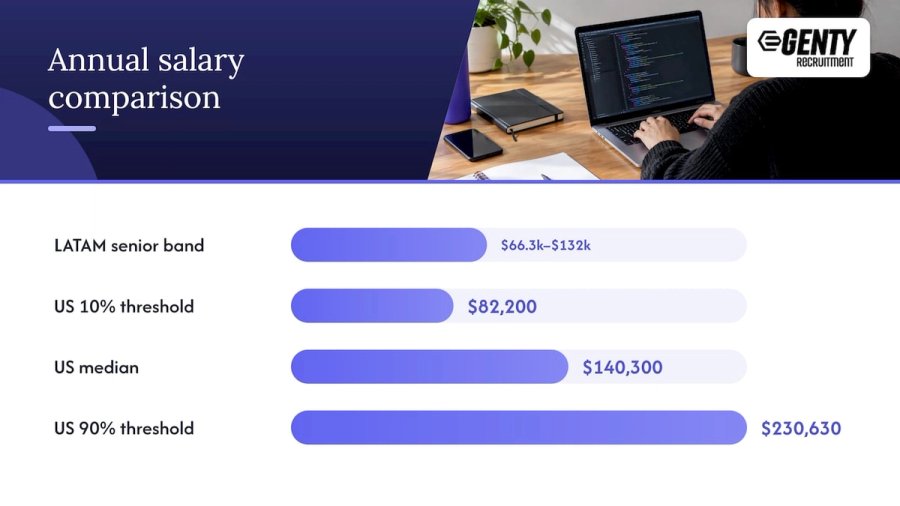
The US Bureau of Labor Statistics reports a May 2025 median of $140,300 for computer and information research scientists, with the lowest 10% below $82,200 and the highest 10% above $230,630. BLS notes that pay varies with experience, responsibility, performance, tenure and geographic area. For software developers, QA analysts and testers, the May 2024 median was $131,450.
Set those next to the regional senior band of roughly $66,300 to $132,000 a year and you see the gap. The median US research scientist earns about the same as the very top of the Latin American senior band, and well above its middle. Mid-level and senior hires in the region often cost a fraction of that. GENTY recruitment’s own position is that clients can save up to 40% against US or European hiring once recruitment fees are included, and for specialist AI roles the salary gap alone can be wider than that.
Salary comparisons also hide a US cost that people forget. BLS data for June 2026 shows wages and salaries were 68.5% of total employer compensation for full-time private-industry workers, with benefits making up 31.5%. A US salary figure is therefore not the cost of the employee, and the same is true in Latin America, which brings us to the budget.
From salary to a real hiring budget
When you see a number on a salary page, ask what is inside it. Use this checklist before you approve a budget:
- Gross or net? Most published bands are gross annual pay in USD.
- Employee or contractor? Contractors in Brazil, Argentina and Colombia often invoice a higher monthly rate and cover their own social contributions. Employees cost less in headline pay but add statutory employer contributions.
- Who is the employer of record? If you have no local entity, you will use an employer of record or a contractor agreement, and either one adds a monthly fee.
- Benefits and bonuses. Many senior engineers expect a year-end bonus (the aguinaldo in Argentina and Mexico, the 13th salary in Brazil), health coverage and equipment.
- Equity. Startups can offer options, but Latin American candidates often prefer a higher cash component, so model both.
- Recruitment fee. A one-time cost per hire, separate from salary.
- Tooling. AI roles add model API and compute spend that does not exist for other engineers.
For the full picture across the region, our cost to hire in LATAM guide walks through each line item, and what US tech employers pay when hiring in Latin America adds the employer-side view.
A worked example
Suppose you are hiring a senior applied ML engineer in Mexico. You take a mid-range senior band of $90,000 gross a year. You add employer contributions and benefits that vary by engagement type, a year-end bonus, equipment, and the one-time recruitment fee, which GENTY recruitment publishes as from $2,999 per hire. Even after adding all of that, the first-year cost remains well below the BLS-reported US median for a comparable research role, and the following years drop the one-time fee entirely. Your exact figure will differ, which is the reason to build it line by line instead of working from a regional average.
Timezone alignment is part of the value
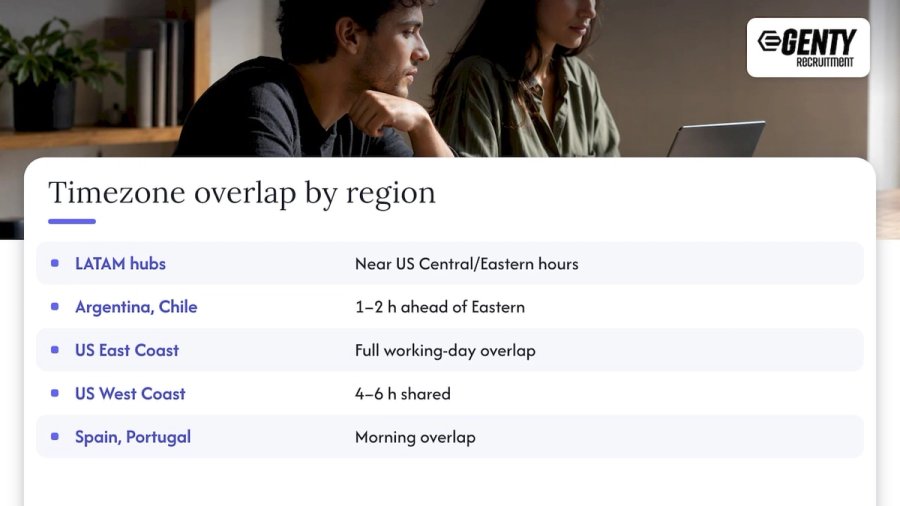
Salary is only half the case. Engineers in Mexico City, Bogotá, Lima and most of Brazil’s tech hubs work in or close to US Central and Eastern hours, and Argentina and Chile sit one to two hours ahead of Eastern for much of the year. That means a US East Coast team gets a full working day of overlap, and a West Coast team still shares four to six hours with the region. For AI work, where model behavior, evaluation and prompt changes benefit from fast review and pairing, this is a bigger advantage than it sounds. A European team in Spain or Portugal gets a morning overlap with the whole region.
Perspective: price the person, not the region
We see companies make the same mistake again and again: they pick a country first and a candidate second. Regional averages are useful for planning, but they are weak guides for offers. A senior engineer in Bogotá who has shipped LLM features to production can cost more than a generalist senior in São Paulo, and rightly so.
Our approach at GENTY recruitment is to start with the skills the role needs, build a shortlist from our recruiters who focus on one vertical each, and bring salary data to the conversation before offers go out. That is why we publish fixed fees by seniority and run salary benchmarking for clients, so the number you take to your CFO matches what the market will accept.
Our advice: set your band using the local market for the specific role, leave room at the top for exceptional candidates, and decide early whether you want an employee or a contractor. Those two choices explain most of the difference between a hire that closes in a few weeks and a search that drags.
Eugene
How to hire an AI engineer in Latin America
A workable process looks like this:
- Write the scope as outcomes. For example: “Own retrieval quality for our support assistant” is better than “AI engineer, 5+ years.”
- Set a band by level and country. Use the ranges above as a start and check them against current offers.
- Screen on skills. Use a practical exercise tied to your stack, such as designing an evaluation plan for a RAG system, over a trivia round.
- Decide the engagement model. Employer of record, local entity or contractor.
- Move quickly. Strong candidates in the region are often fielding several remote offers.
- Plan the first 90 days. Overlap hours, a named mentor and access to data and compute.
If you want a view of the wider engineering market, our software engineer recruiting guide covers the sourcing side, and our AI recruitment agency page describes how we approach AI roles specifically.
Hire pre-vetted AI talent with GENTY recruitment
GENTY recruitment places software engineers, data specialists and AI talent from Argentina, Brazil, Mexico, Colombia, Chile and other Latin American markets with US and European tech companies. Our process is skill-first, we deliver curated shortlists within 7 days, and our fixed fee starts at $2,999 per hire with no upfront payments and a 3-month replacement guarantee.
If you want a salary range for a specific AI role before you commit, start with our IT recruitment service or talk to us about salary benchmarking. For longer-term capacity, our staffing model starts from $99 per month per employee.
FAQ
What is a realistic salary for a senior AI engineer in Latin America?
One 2026 estimate puts senior AI engineer pay at $5,525 to $11,000 a month across the region, which is about $66,300 to $132,000 a year. Where a candidate lands depends on country, specialization and whether they already work for a US company. Treat the range as a planning tool and benchmark the specific role before you make an offer.
Which Latin American country is cheapest for AI engineers?
Colombia generally prices below Brazil and Mexico at the same seniority, but the gap between a strong and an average candidate is usually larger than the gap between countries. Choose the country for the talent pool, time zone and engagement model first, and treat price as the tiebreaker.
Do I pay AI engineers in USD?
Many remote engineers in the region, especially in Argentina, are paid in dollars, and US companies commonly quote offers in USD. Contract and payroll rules differ by country, so confirm the structure with your employer of record or legal adviser before you sign.
How does a US AI engineer salary compare?
The BLS reports a May 2025 median of $140,300 for computer and information research scientists, with the top 10% above $230,630. That figure excludes employer benefits, which BLS data shows make up roughly a third of total compensation in private industry.
Sources
- Salario AI Engineer LATAM 2026, Vacantes Digitales
- Inteligencia artificial: sueldos de profesionales en Chile, Gerencia.cl
- Voces del cambio: la IA generativa y la transformación del trabajo en América Latina, OECD.AI
- Contratación en Latinoamérica: reporte 2026, Deel
- Computer and Information Research Scientists, US Bureau of Labor Statistics
- Computer and Information Technology Occupations, US Bureau of Labor Statistics
- Employer Costs for Employee Compensation, June 2026, US Bureau of Labor Statistics