

A DevOps engineer in Mexico typically earns somewhere between MX$37,000 and MX$82,000 per month in total pay in Mexico City, with a median near MX$64,000, according to Glassdoor’s Mexico City salary data. At an illustrative 18 pesos per dollar, that is roughly $2,050 to $4,550 per month, or about $3,550 at the median. The number you actually plan around as a US or European hiring manager is higher, because the engineers who work with US teams, speak fluent English and run production Kubernetes clusters sit at the top of the local range, and because employer costs add to the base.
This guide breaks down pay by seniority, explains why published averages mislead, shows the true cost of a Mexican hire against a US one, and covers how timezone overlap changes the value of the salary.
TL;DR
- Mexico City DevOps total pay runs about MX$37,000 to MX$82,000 per month (median MX$64,000), while the national figure is lower, with a median near MX$43,000 per month.
- For a bilingual engineer who works US hours and owns cloud infrastructure, plan for the upper half of local ranges, not the national average.
- Budget about 25% on top of base salary for employment costs in Mexico, and the US equivalent still costs around 46% more at the median.
- Mexico City sits one to two hours behind New York and one to two hours ahead of California, so real-time collaboration with both coasts is routine.
- GENTY recruitment places pre-vetted DevOps engineers from Mexico and across Latin America on a fixed fee from $2,999 per hire.
What DevOps engineers earn in Mexico in 2026
Public salary sites disagree, and the reason is who they sample. Aggregators that include local-only employers, outsourcing shops and junior roles pull the average down. Data restricted to a single city with a tech cluster pulls it up. Here is how the main sources compare.
The gap between the national and Mexico City medians is about 50%. That gap is the first thing to understand before you set a budget. A company hiring a remote DevOps engineer to join a US team is competing in the Mexico City, Guadalajara and Monterrey market for engineers who already hold offers from international employers, not in the national median.
Need help hiring?
See the next step after this guide
If this topic is relevant to your team, these are the most useful pages to check next.
Converted at the same illustrative 18 pesos per dollar, the Mexico City median of MX$64,000 per month works out to about $42,700 per year, and the national median of MX$43,000 per month to about $28,700. Exchange rates move, so recalculate with the current rate before you commit to an offer.
Salary by seniority
Salary sites rarely publish clean level-by-level data for remote work, so treat the following as the structure we use when scoping a search, built on the Mexico City range above rather than as a quoted statistic:
- Junior (0 to 2 years): the bottom of the Mexico City range. Fine for supervised CI/CD maintenance, but few juniors have production Kubernetes or Terraform experience.
- Mid-level (3 to 5 years): around the Mexico City median. These engineers own pipelines, infrastructure as code and monitoring with limited oversight.
- Senior and platform/SRE: the upper end of the range and above it. Remote offers from US companies for senior engineers frequently exceed what local employers pay, which is why the top of published data matters more than the average.
A regional survey supports the same pattern. The 2025 Tech Salaries and Benefits Trends in Latin America report found that LATAM engineers’ expected annual salary held at $72K while current salaries held at $60K, a gap of about 20% for several engineering roles. In practice, that means candidates expect a raise when they move, and an offer at their current pay rarely closes.
Why the average understates what you will pay
A founder who reads “MX$43,000 per month” and builds a budget around about $2,400 will lose candidates in the first round. Three things push real offers higher.
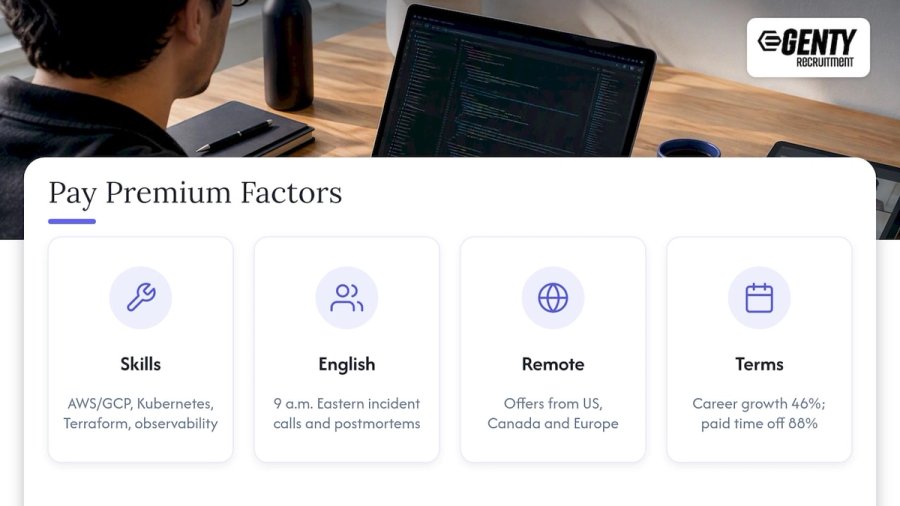
Skills the average does not capture. Generalist “DevOps” titles in Mexico include sysadmins managing on-premise servers and engineers maintaining legacy Jenkins jobs. A US startup usually wants AWS or GCP, Kubernetes, Terraform, observability and on-call ownership. That is a narrower, better-paid pool.
English and timezone fluency. An engineer who can join an incident call at 9 a.m. Eastern and write clear postmortems carries a premium over one who works only in Spanish for a local company.
Competition from other remote employers. Remote work is universal across surveyed LATAM tech roles, according to the same 2025 regional survey, so your offer sits next to offers from companies in the US, Canada and Europe. The survey also suggests non-monetary terms matter: defined career growth paths (46% importance) and paid time off (88% importance) were notable factors in securing talent.
The practical rule: set the budget for a senior, US-facing DevOps engineer in Mexico near or above the upper half of the Mexico City range, and treat the national median as a floor for junior or local-only roles.
The real cost of hiring in Mexico
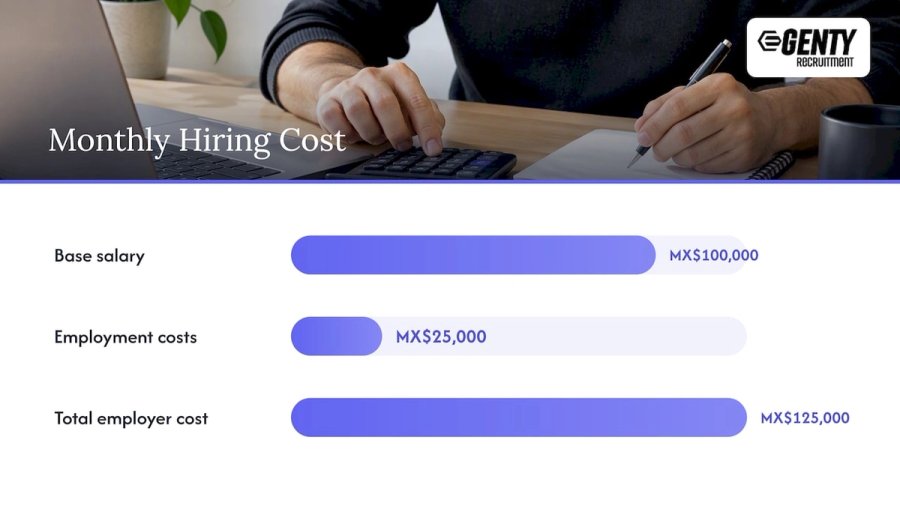
Base salary is only part of the budget. LeadDev’s 2025 Remote Engineer Report is the dataset behind the figure we use for planning: employment costs in Mexico add approximately 25% on top of base salary, and US-based hiring remains about 46% more expensive at the median even after counting those costs.
Here is a worked example for a senior DevOps engineer, using the illustrative 18 pesos per dollar and a hypothetical base of MX$100,000 per month, a figure inside the upper part of the Mexico City range that we chose for the example, not a quoted market salary.
Compare that with the US. The Bureau of Labor Statistics reports a median annual wage of $135,980 for software developers in May 2025, a category close to DevOps work, before benefits, payroll taxes or recruiting costs. DevOps and platform roles in major US metros often pay above that median. Even with a senior Mexican hire priced toward the top of the local market, the saving against a comparable US hire is substantial, which is why the savings case for LATAM holds up under scrutiny.
Two cautions keep the comparison honest:
- Employment costs depend on how you hire. A direct local entity, an employer-of-record arrangement and an independent contractor structure each carry different taxes, benefits and legal exposure. Talk to a Mexican employment lawyer or tax advisor before choosing, because misclassifying an employee as a contractor is a real risk.
- Cost is not the only variable. A cheap hire who leaves in four months costs more than a well-matched senior engineer who stays for years.
Timezone alignment is part of the salary calculation
Mexico City runs one to two hours behind New York, depending on the time of year, and one to two hours ahead of California. That puts most of an East Coast or West Coast workday inside the engineer’s working hours, so standups, deploy windows and incident response happen live.
For DevOps this matters more than for most roles. Infrastructure work has a high on-call and coordination component: a failing pipeline or a degraded cluster cannot wait for the next overnight handoff. Engineers in Eastern Europe or Asia can be excellent, but a team there loses most of the shared day. With a Mexican engineer, EST and PST overlap is close to complete, and code review turnaround stays within hours.
Mexico is also well positioned in terms of talent profile. LeadDev’s findings, as summarized in our research, indicate Mexico, Colombia and Chile as regional leaders in tech talent, and Mexico stands out for an even distribution across full-stack, backend and frontend skills. For a DevOps hire, that mix suggests engineers who understand the applications they deploy, which helps at a startup where the infrastructure person is also in the product conversation.
How Mexico compares with other LATAM markets
Mexico is not the only option, and a good search often spans several countries. Our approach is to compare on four criteria rather than on salary alone:
- Talent depth for your stack. Mexico has strong AWS and Kubernetes communities in Mexico City, Guadalajara and Monterrey. Argentina has a deep senior engineering bench and a strong English-speaking cohort. Brazil is the largest market, though Portuguese is the working language for many local employers. Colombia has grown quickly in FinTech and SaaS.
- Timezone. Colombia sits on Eastern time without a daylight shift, and Mexico City is on Central time, so both work for US teams. Argentina and Brazil are two to three hours ahead of New York at most times of the year, which narrows overlap but still leaves a solid half day.
- Compensation expectations. Candidates who have worked for US companies tend to anchor to dollar pay. Those pricing in local currency are cheaper but may be less experienced with US-style on-call.
- Hiring structure. Each country has its own contractor rules, social contributions and holiday customs. Mexico’s mandatory year-end bonus and vacation premium, for example, are costs you should model from the start.
For more country-by-country detail, see our guide to DevOps salaries in Latin America, and for a peer data point on a different role, our Mexico frontend developer pay breakdown.
What we see: a perspective from GENTY recruitment
We place engineers in Mexico and across Latin America every week, and three patterns repeat.
First, the best DevOps candidates are rarely on job boards. They are employed, moderately happy, and respond to a specific message about a specific stack and a specific team. A passive posting attracts generalists and a long tail of mismatched applications. That is why we run dedicated recruiters per vertical and screen on skills first: we want to see how a candidate handles a broken Terraform plan or a Kubernetes rollout that stalled, before we see a polished CV.
Second, companies that anchor on the national average lose candidates in the final round. The remedy is to decide your range before sourcing, using Mexico City and remote-for-US benchmarks, and to be clear on what the engineer owns. Total ownership of infrastructure, a defined path to staff or principal level, and generous paid time off often move a candidate more than another 5% on base pay.
Third, the cost advantage is real but not infinite. A Mexican senior engineer costs materially less than a US one, and the 25% employment overhead still leaves a wide margin. The companies that get the most value are those that treat the savings as a way to hire a stronger engineer or an extra engineer, not as a reason to lower the bar.
— Eugene
A checklist before you make an offer
Use this before you open a DevOps search in Mexico:
- [ ] Decide the scope: platform/SRE, cloud infrastructure, CI/CD, or security-focused DevOps.
- [ ] List the must-have stack (for example AWS, Kubernetes, Terraform, GitHub Actions) and separate it from the nice-to-haves.
- [ ] Set a salary range using Mexico City and remote-for-US data, not the national average.
- [ ] Add about 25% for employment costs and model the aguinaldo (year-end bonus) and vacation premium.
- [ ] Choose the hiring structure with a Mexican employment lawyer or tax advisor.
- [ ] Confirm required overlap hours with EST or PST and on-call expectations.
- [ ] Test English in a technical conversation, not a generic interview.
- [ ] Define the career path and paid time off you can offer.
Will AI reduce the demand for DevOps engineers?
Not on current evidence. The Bureau of Labor Statistics projects employment for software developers to grow 17.9% from 2023 to 2033, with AI increasing the need for engineers who can build and maintain data infrastructure and AI systems. Automation changes the daily work of a DevOps engineer, with more time on platform design and less on manual provisioning, but companies running AI workloads need more people who can operate that infrastructure reliably. Experienced DevOps engineers are therefore likely to stay in demand, and Mexican salary expectations for the top tier will keep rising.
Hiring a DevOps engineer from Mexico with GENTY recruitment
If you would rather not run a months-long search yourself, GENTY recruitment sources, screens and shortlists pre-vetted DevOps engineers from Mexico, Argentina, Brazil, Colombia and Chile. Our DevOps engineer hiring page shows how the shortlist works, and our IT recruitment service starts from $2,999 per hire as a one-off fixed fee, with no upfront payments and a 3-month replacement guarantee. If you want to compare staffing structures first, our remote staffing model starts from $99 per month per employee.
For a step-by-step view of the process on your side, read our DevOps engineer hiring playbook.
FAQ
What is a good salary for a DevOps engineer in Mexico?
For a US-facing role, a good salary sits in the upper half of the Mexico City range, which Glassdoor puts at MX$37,000 to MX$82,000 per month in total pay. The national median is lower, near MX$43,000 per month, but it includes junior and local-only roles. Senior engineers with Kubernetes, Terraform and fluent English should be priced above the Mexico City median.
Are engineers paid well in Mexico?
By local standards, yes: DevOps pay is well above typical Mexican wages, and remote work for foreign employers pushes it higher. By US standards, salaries are much lower. The BLS median for US software developers was $135,980 in May 2025, and LeadDev’s data shows US hiring costs about 46% more at the median even after Mexico’s employment costs.
How much does it cost to employ a DevOps engineer in Mexico on top of salary?
Plan for approximately 25% on top of base salary, based on LeadDev’s 2025 remote engineer report. The exact figure depends on your hiring structure, so confirm it with a Mexican employment lawyer or tax advisor before you finalize the budget.
Does Mexico’s timezone work for US companies?
Yes. Mexico City is one to two hours behind New York and one to two hours ahead of California, so engineers can join standups, code reviews and incident calls during normal US business hours.
Is AI replacing DevOps engineers?
No evidence points that way. BLS projects software developer employment to grow 17.9% between 2023 and 2033, partly because AI systems need engineers to build and maintain the infrastructure under them.
Sources
- Glassdoor: DevOps salaries in Mexico City
- Glassdoor: DevOps salaries in Mexico
- PROSFY: DevOps engineer salary in Mexico
- 2025 Tech Salaries and Benefits Trends in Latin America
- LeadDev 2025 Remote Engineer Salary Insights Report
- BLS Occupational Outlook Handbook: Software Developers
- BLS: AI impacts in employment projections