

Executive search fees in Latin America generally follow the US model: a percentage of the hire’s first-year cash compensation, billed either in retained installments or on placement. The percentage is rarely the whole story. Expenses, guarantee terms, the salary base the percentage applies to and the way a search is staged decide what a US or European company actually pays for a CTO in São Paulo, a VP of Sales in Mexico City or a Head of Data in Buenos Aires.
This guide breaks down the fee models you will meet, shows the arithmetic on a sample search, points to regional salary data and lists the questions to ask before you sign an engagement letter.
TL;DR
- Most executive search firms price on a percentage of first-year compensation. Published market guides commonly quote roughly 25% to 35% for retained search and somewhat less for contingency, but terms vary by firm and role.
- Retained search is paid in stages whether or not the search closes. Contingency and success-based models are paid only on a hire, which shifts risk to the firm.
- Always confirm the fee base (base salary only, or bonus and allowances too), the expense policy and the replacement guarantee. They move the final invoice more than a few percentage points do.
- Hiring several leaders in the region gives you leverage to negotiate a sliding scale.
- GENTY recruitment runs executive search for LATAM roles on custom quotes, and publishes fixed-fee pricing from $2,999 per hire for IT and sales recruitment below the executive level.
How executive search fees are structured
Two models dominate, and a third hybrid sits between them.
Retained search
You engage one firm exclusively and pay in installments tied to milestones: kickoff, shortlist delivery, and offer acceptance. The fee is owed even if you do not hire from the shortlist. Retained firms justify this with dedicated researchers, discreet outreach to people who are not looking, and assessment depth. It fits roles where confidentiality matters, such as replacing a sitting regional GM, or where the candidate pool is small enough that mapping the market takes weeks.
Before you start hiring
Check location, salary, and hiring fit
If you are moving from research to action, start with the market basics so your hiring plan is clearer.
Contingency and success-based search
You pay only when a candidate you accept starts work. The firm carries the cost of every search that fails, so it tends to work several searches in parallel and favors roles it can fill quickly. For mid-senior engineering or sales leadership roles in a large talent market like Brazil or Mexico, this model is often a sound fit. For a confidential CFO replacement it is usually not.
Hybrid and fixed-fee models
Some firms charge a modest engagement fee up front and a reduced percentage on success. Others quote a flat fee per seniority band, which removes the link between the candidate’s salary negotiation and the firm’s revenue. Our own explainer on fixed recruiting fees walks through why a flat fee changes incentives, and our overview of executive recruiter models and costs compares the structures side by side.
What percentage should you expect?
The headline range quoted in market guides for retained executive search is a band of roughly one quarter to one third of first-year compensation, with contingency often quoted a few points lower. Treat those as orientation, not a price list. A practitioner thread among executive recruiters discussing fees in Mexico and wider LATAM shows the same pattern we see: firms pitching US-style percentages to LATAM-based clients, and clients pushing back on the base they apply to. The same thread notes that firms will sometimes step a percentage down, for example from 22% on a first hire to 20% on later ones, to win a multi-role relationship.
Three factors push the percentage up or down:
- Seniority and scarcity. A CTO with fintech scaling experience and fluent English is a smaller pool than a regional sales director.
- Exclusivity. An exclusive mandate usually earns a lower rate than an open assignment shared with other firms.
- Volume. Three searches in one year, or an RPO arrangement, justifies a lower rate than a single one-off hire.
What the fee is calculated on
This is where invoices diverge. Ask whether the percentage applies to:
- Base salary only.
- Base plus target bonus.
- Total cash, including guaranteed allowances, 13th-month payments and signing bonuses.
- Equity value at grant.
LATAM compensation is structured differently from US pay. In Brazil, employers pay mandatory extras such as the 13th salary. In Mexico, the aguinaldo year-end bonus is a legal minimum. If a firm writes “total compensation” into the contract without defining it, the fee base can swell by a month or two of salary. Define it in writing as annual gross cash compensation as stated in the offer letter, and decide separately whether equity counts.
A worked example
The numbers below are an illustration of the arithmetic, not a quote from any firm and not a benchmark. Suppose you are hiring a VP of Engineering in Brazil with an annual gross cash package of $150,000.
Now add the variables. If the contract defines the base to include a 20% target bonus, the same 30% fee applies to $180,000 and becomes $54,000. If the firm bills expenses on top, add travel and assessment costs. If the guarantee covers replacement for only 90 days, your risk window on a leadership hire is shorter than the time it often takes to see whether the person can build a team. The sticker percentage is the smallest of these effects.
What executives cost in the region
The fee scales with salary, so you need a reliable read on local pay before you choose a model. A few regional data points:
- Chile. A January 2026 report on technology C-level pay in Chile, published by PressLatam, puts monthly net salaries for these roles in a range running up to 18 million Chilean pesos, with the CEO position at the top of that category.
- Brazil. A survey of about 2,000 Latin American executives, covered by VEJA, mapped executive pay between October 2024 and February 2025. It is a useful anchor for CEO and director-level expectations in Brazil.
- Colombia. Portafolio reported in 2025 that about 60% of Colombian organizations use specialized firms to find senior executives, which tells you the local market for retained search is mature and competitive.
The broader point for US hiring managers: technology leadership pay in Brazil, Mexico, Argentina, Colombia and Chile is generally well below comparable US packages, but the gap narrows at the C-level, where candidates benchmark against multinational and dollar-denominated offers. Plan a cost advantage, not a bargain. Our research on what US tech employers pay when hiring in Latin America and our salary benchmarking tools comparison give you a way to set a band before you brief any firm.
Global brands, boutiques and specialist firms
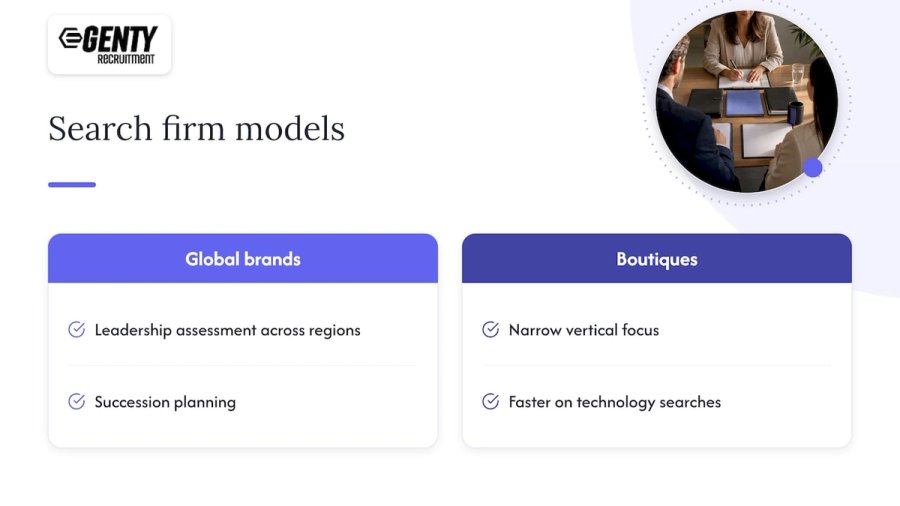
The largest search brands bring leadership assessment and succession planning across regions. Hunt Scanlon’s annual rankings reported that fee revenue at the 50 largest executive search firms in the US and Americas jumped 11% in the latest year, which signals healthy demand and little pressure on firms to discount. At the same time, boutiques with a narrow vertical focus are winning share by moving faster on technology searches.
For a US company opening an engineering or sales hub in LATAM, the question is whether you need global brand infrastructure or deep sector coverage. If you are hiring a VP of Engineering for a fintech team in Mexico City or a CRO for Latin America, a specialist who already knows who built payments infrastructure in Brazil and who runs outbound teams in Colombia will often shorten the search more than a global brand’s name will.
Perspective: how we think about executive search pricing
We see two recurring mistakes from US and European founders pricing a LATAM leadership hire. The first is anchoring on a percentage and ignoring the fee base, the guarantee and the process behind it. The second is treating executive search as a separate world from the rest of the hiring plan.
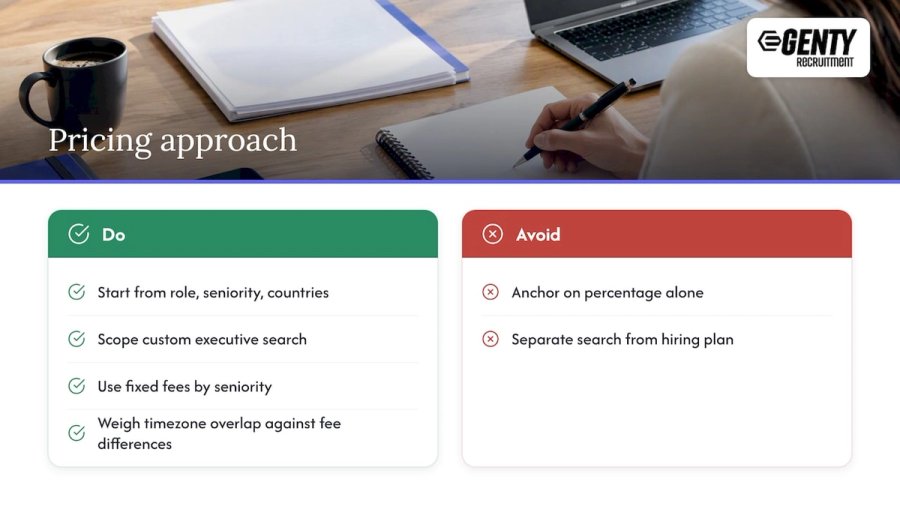
Our approach at GENTY recruitment starts from the role, the seniority and the countries involved. We run recruiters by vertical, so the person who briefs a Head of Data search in Argentina has also placed data engineers there. For leadership roles we scope custom executive search rather than apply a template, because a confidential CTO replacement and a first VP of Sales for a new Latin America market have little in common. For the engineers and sales reps who report to those leaders, we use fixed fees per seniority level, no upfront payments and a three-month replacement guarantee, so the budget for the whole team stays readable.
Timezone matters in this math as well. A leader in Colombia, Mexico or Brazil can overlap with US Eastern and Pacific working hours, which means your new VP can run standups and sit in leadership meetings live. That is worth weighing against any fee difference of a few points.
— Eugene
Checklist: questions to ask before you sign
Use this list in every fee conversation, whichever firm you speak with.
- Is the fee retained, contingency or hybrid, and what exactly triggers each payment?
- What is the fee base: base salary, target bonus, allowances, 13th-month or aguinaldo payments, equity?
- Are expenses capped, itemized and pre-approved?
- What is the replacement guarantee, how long does it run, and what happens if the hire leaves for reasons the firm cannot control?
- Who will actually run the search, and have they placed this role in this country before?
- How many shortlisted candidates will be assessed, and how are they vetted?
- Is there a sliding scale for a second or third hire?
- Will the firm’s researchers contact candidates currently employed by your partners or suppliers?
- In which currency will you be invoiced, and who bears exchange-rate swings on installments?
- How does the candidate’s timezone overlap with your core team’s hours, and how is that tested in the process?
Negotiating the fee
The levers that actually work:
- Bundle searches. If you will hire a VP of Engineering, a Head of Data and two engineering managers, say so up front and ask for a sliding scale.
- Narrow the fee base. Base salary plus a defined target bonus is cleaner than an open definition of total compensation.
- Tie money to milestones you control. Staged payments tied to a delivered shortlist and an accepted offer keep the firm accountable.
- Extend the guarantee. For leadership hires, ask for a window that covers at least the first six months of ramp, if the firm will give it.
- Choose the model to match the risk. If the role is not confidential and the market is deep, a contingency or fixed-fee structure transfers risk away from you.
Do not negotiate the percentage down to the point where the firm has no reason to prioritize your search. A search that is slow because it is the least profitable on a recruiter’s desk costs you more in vacancy time than the points you saved.
When fixed fees and staffing beat a leadership search
Not every senior hire needs an executive search mandate. A tech lead, a staff engineer or a senior account executive can be hired through a skills-first recruitment process at a predictable flat price. For these roles, GENTY recruitment publishes IT recruitment and sales recruitment pricing from $2,999 per hire, with curated shortlists delivered within 7 days, no upfront payments and a 3-month replacement guarantee.
If you want a LATAM-based employee on your team without setting up a local entity, remote staffing and EOR starts from $99 per employee per month. And if you are building a team of ten or more over the year, recruitment process outsourcing can lower the cost per hire compared with running separate searches.
For how all of this fits into a hiring plan, see our guides on hiring remote talent from Latin America and what a CTO should know about tech recruiters.
Scope a leadership search with GENTY recruitment
If you are planning a CTO, VP of Engineering, VP of Sales or country-lead hire in Argentina, Brazil, Mexico, Colombia or Chile, our team scopes executive search on a custom quote based on the role, the seniority and the markets involved. Executive search pricing is not published, so bring your role brief and compensation band, and we will propose the structure, the fee base and the guarantee in writing before work begins.
FAQ
How much do executive search firms charge in Latin America?
Most firms price as a percentage of the hire’s first-year cash compensation, and market guides commonly cite a range of roughly 25% to 35% for retained search. Contingency rates are often quoted lower, and some firms use flat fees. Get the percentage, the fee base and the expense policy in writing, because all three decide the final invoice.
Is retained or contingency search better for LATAM hires?
Retained search suits confidential, senior or hard-to-map roles where you want exclusive commitment. Contingency suits roles with an active candidate pool, such as VP-level engineering or sales hires in Brazil or Mexico, because you pay only when someone starts. Match the model to the role’s risk rather than defaulting to one.
Can I negotiate executive search fees?
Yes, especially when you hire several people. Practitioners report that firms may reduce the percentage on follow-on hires, for example from 22% to 20%. Bundling searches, narrowing the fee base and extending the guarantee are the most effective levers.
Does GENTY recruitment publish executive search prices?
No. Executive search is quoted per engagement. For IT and sales recruitment below the executive level, fees start from $2,999 per hire, and staffing starts from $99 per employee per month.
Sources
- Recruitment fees in LATAM, specifically Mexico (recruitmentcompanies.com)
- Sueldos de cargos C-Level llegan hasta 18 millones de pesos (PressLatam)
- Pesquisa revela os salários de presidentes e diretores de empresas no Brasil (VEJA)
- Búsqueda de altos ejecutivos: el 60% de empresas va a firmas especializadas (Portafolio)
- Executive Search Review rankings 2026 (Hunt Scanlon)