

Most tech founders and hiring managers treat recruitment as a synonym for engineering hiring. They pour budget into sourcing developers, run technical assessments, and benchmark salaries for backend and frontend engineers with precision. Meanwhile, their sales team is understaffed, their customer success function is overwhelmed, and their finance department is held together by a few overworked generalists. The assumption that recruitment means IT recruitment is one of the most costly blind spots in high-growth tech companies, and it quietly stalls FinTech and SaaS businesses at exactly the moment they need to scale.
Table of Contents
- Defining non-IT recruitment in tech companies
- Core methodologies: How non-IT recruitment works
- Key challenges and pitfalls in remote non-IT recruitment
- Practical tips for hiring remote non-IT talent in LATAM
- Why non-IT recruitment is the real catalyst for FinTech and SaaS growth
- How GENTY helps you hire pre-vetted non-IT talent in LATAM
- Frequently asked questions
Key Takeaways
Defining non-IT recruitment in tech companies
After understanding why recruitment is not only about IT, let’s define what non-IT recruitment means in your organization and why it matters strategically.
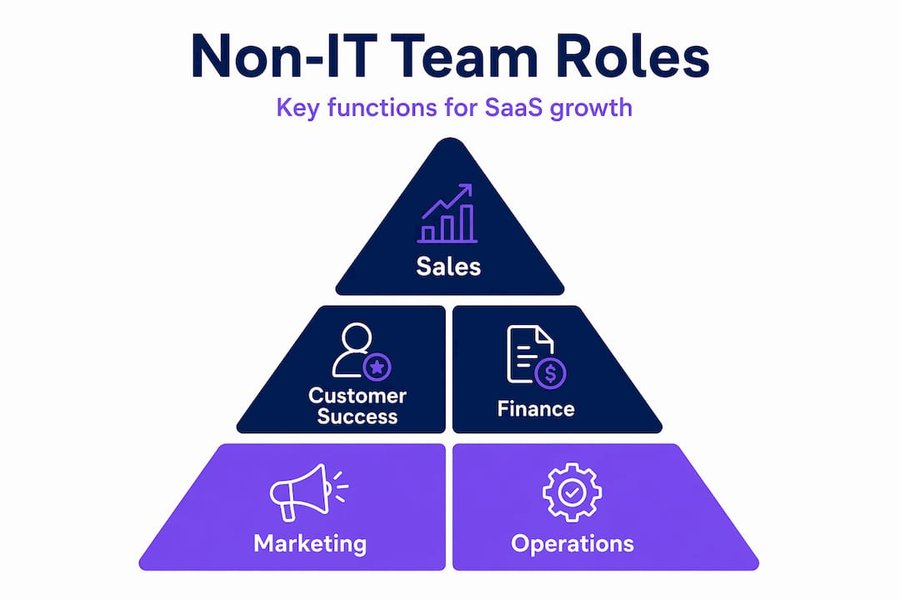
Non-IT recruitment refers to the process of identifying, evaluating, and hiring talent for roles that do not require software engineering or programming as a core competency. In a FinTech or SaaS company, this encompasses a wide range of functions that are just as critical to business performance as the engineering team.
These roles typically include:
- Sales and business development representatives and managers who drive pipeline and close revenue
- Marketing professionals covering content, demand generation, performance, and brand
- Customer success and support specialists who manage retention, onboarding, and user satisfaction
- Finance and accounting professionals including controllers, analysts, and FP&A specialists
- Human resources and people operations covering talent acquisition, compensation, and culture
- Operations and project managers who coordinate cross-functional work and keep delivery on track
- Legal and compliance officers, especially critical in regulated FinTech environments
Each of these functions directly supports product adoption, revenue growth, regulatory compliance, and the organizational infrastructure needed to scale. A SaaS company without a properly staffed customer success team will churn users faster than its engineering team can ship features. A FinTech firm without a strong compliance function faces regulatory exposure regardless of how sophisticated its technology stack is.
Need help hiring?
See the next step after this guide
If this topic is relevant to your team, these are the most useful pages to check next.
Non-IT recruitment also draws on fundamentally different screening methods compared to developer hiring. While IT hiring focuses heavily on coding tests, system design evaluations, and technical depth interviews, skills-based hiring for non-IT roles incorporates financial modeling assessments, cognitive problem-solving tasks, and interpersonal skills evaluations such as communication and leadership. Companies that understand this distinction build more targeted, effective hiring processes for each department rather than running all candidates through a one-size-fits-all funnel.
It is also worth noting that tracking the financial and operational health of your recruiting process matters. Tools like accounting solutions for recruitment agencies can help leaders monitor cost-per-hire, agency spend, and budget allocation across IT and non-IT pipelines, providing clearer visibility into where resources are going. For a broader view of how IT recruitment trends are shaping hiring expectations across the board, understanding the contrast between tech and non-tech pipelines becomes even more valuable.
“The most effective organizations don’t treat non-IT recruitment as secondary. They treat it as a parallel discipline with its own methodologies, timelines, and success metrics.”
Core methodologies: How non-IT recruitment works
Now that we’ve clarified what non-IT recruitment entails, let’s get practical. Here is how effective non-IT hiring works day to day, and how to build a process that consistently delivers high-quality candidates.
A structured non-IT hiring framework typically follows these steps:
- Role definition and success profiling — Write a role profile that goes beyond a job description. Define the KPIs the hire will own, the behaviors that predict success, and the level of English proficiency and remote-work experience required, especially for LATAM hires.
- Sourcing and talent mapping — Identify where top candidates in LATAM are active, whether that is LinkedIn, specialized local job boards, alumni networks, or referrals from within the industry.
- Structured screening — Use standardized questions and scorecards so every recruiter evaluates candidates against the same criteria, reducing subjective bias.
- Skills assessments — Select assessment tools appropriate to the role. Finance candidates complete modeling tasks, sales candidates run through a mock discovery call, and customer success candidates handle a simulated escalation scenario.
- Behavioral and culture interviews — Evaluate interpersonal fit and remote collaboration capabilities alongside functional competence.
- Offer calibration and remote onboarding — Use market data to structure competitive offers and design structured onboarding that helps remote hires integrate quickly and perform faster.
The table below compares three recruitment approaches for common non-IT roles:
The blended approach consistently outperforms the other two for remote non-IT hiring in LATAM because it accounts for both functional capability and the soft skills that predict success in distributed team environments.
Effective interview formats for remote non-IT roles include asynchronous video screening, live competency interviews via video call, written case studies submitted ahead of the interview, and role-play scenarios conducted in real time. According to skills-based hiring research, methodologies that combine technical assessments with behavioral and interpersonal evaluations produce significantly stronger predictive validity than traditional interviews alone.

Pro Tip: Customize your assessment mix by role and business model. A B2B SaaS sales hire needs a different evaluation than a customer success manager at a consumer FinTech firm. Resist the temptation to standardize assessments across all non-IT roles just for operational convenience.
For founders looking to accelerate their timelines, speeding up recruitment without sacrificing quality is possible when process design is strong from the start. And understanding recruiters’ role in growth helps frame why investing in a rigorous non-IT process pays back quickly in performance and retention.
Key challenges and pitfalls in remote non-IT recruitment
Understanding effective methods is half the battle. Let’s get ahead of the classic mistakes made in this space, especially when hiring remotely across LATAM.
Remote non-IT recruitment introduces a specific set of challenges that differ from both in-person hiring and IT hiring. Here are the most common pitfalls:
- Time zone misalignment — Teams spread across multiple countries need to establish clear communication windows from day one. Without this, collaboration breaks down and new hires feel disconnected from the core team faster than with technical roles, where async work is more normalized.
- Unclear role expectations — Non-IT roles often carry ambiguous success metrics at early-stage companies. A sales hire brought on without a defined quota, territory, or sales playbook will underperform not because of talent, but because of poor role design.
- Overreliance on gut instinct — Process drift is common under time pressure. Hiring managers skip structured assessments and revert to “this person just felt right” evaluations, which are unreliable predictors of performance, especially across cultural contexts.
- Compensation misalignment — Many US and European companies either overpay relative to market, creating internal equity issues, or underpay because they underestimate local standards. Both outcomes damage hiring outcomes and employer brand.
- Cultural communication gaps — LATAM professionals often have different communication styles and professional norms. Without awareness and structured calibration, these differences can be misread as lack of confidence or ambiguity rather than cultural context.
As skills-based hiring frameworks demonstrate, systematic evaluation combining cognitive, technical, and interpersonal assessments consistently outperforms informal hiring approaches, particularly when cultural context adds additional variables.
Pro Tip: Always calibrate your compensation expectations with verified market data before opening a role. What you paid for a similar role in Eastern Europe or Southeast Asia does not translate directly to Buenos Aires or Bogotá. Local market research and LATAM-specific salary benchmarking will save you from losing great candidates late in the process.
Leveraging HR tech in recruitment can help teams manage structured assessments at scale without creating administrative bottlenecks, and reading a solid global recruitment guide provides the strategic context needed to approach cross-border non-IT hiring with confidence.
Practical tips for hiring remote non-IT talent in LATAM
Having tackled the pitfalls, let’s end with hands-on best practices for sourcing and onboarding remote non-IT talent from Latin America.
Follow these steps to build a reliable non-IT hiring engine for your LATAM team:
- Define the role with precision — Document the exact responsibilities, ownership areas, KPIs, and performance expectations before sourcing begins. Ambiguous roles attract mismatched candidates and waste everyone’s time.
- Set KPIs before day one — Align with the hiring manager on what success looks like at 30, 60, and 90 days. This gives candidates clarity and gives you a benchmark for evaluating offer-stage conversations.
- Use validated screenings matched to the function — For sales, run a mock call. For finance, assign a modeling task. For customer success, simulate an escalation scenario. Assessments from the skills-based hiring playbook, which includes situational judgment tests, role-plays, and case studies, are proven to improve hire quality.
- Verify English proficiency rigorously — For roles that require client communication or cross-functional collaboration with US or European teams, English fluency is non-negotiable. Test it explicitly rather than assuming it from a resume or brief call.
- Design a structured remote onboarding plan — New hires in LATAM joining remote-first US or European companies often struggle with cultural integration in the first 30 days. A structured onboarding plan with clear milestones, assigned buddies, and regular manager check-ins dramatically improves ramp time and retention.
The table below summarizes key requirements and sourcing approaches for common non-IT roles in LATAM:
Pro Tip: Build employer branding that resonates with what LATAM professionals actually value. Career growth opportunity, international exposure, project stability, and learning investment are top motivators. Candidates in Argentina, Mexico, Colombia, and Brazil consistently rank these above base salary when comparing offers from global companies. Your employer brand should speak to those values explicitly, not just promote your product or company stage.
For direct access to pre-vetted LATAM candidates across all these functions, explore hiring remote LATAM talent through a structured, technology-supported process built specifically for US and European tech companies.
Why non-IT recruitment is the real catalyst for FinTech and SaaS growth
With all the practical steps in hand, here is some perspective drawn from the front lines of FinTech and SaaS growth, and it challenges some deeply held assumptions.
Many founders allocate 80 to 90 percent of their hiring energy to engineering and product roles, treating non-IT positions as secondary hires that can wait until the product is “ready.” This logic seems reasonable on the surface. Build the product first, then worry about sales. Hire the engineers before you invest in operations. But this sequencing creates a structural trap that is very difficult to unwind.
The uncomfortable truth is that sales teams, customer success functions, and finance operations are not downstream of product development. They are parallel enablers. A FinTech product without a skilled compliance and legal hire is a regulatory liability. A SaaS platform without a customer success team loses users at a rate that no feature release can recover. A startup without a strong RevOps or sales hire generates leads it cannot convert into pipeline. These gaps compound over time, and they show up as churn spikes, missed revenue targets, and organizational chaos that engineering talent cannot fix.
Companies that professionalize non-IT recruitment early, those that apply the same rigor to hiring a sales director as they do to hiring a senior backend engineer, consistently achieve faster go-to-market velocity and stronger customer retention metrics. They do not just hire faster. They hire people who ramp faster because the hiring process itself sets clearer expectations.
There is also a talent arbitrage argument that is often underutilized. LATAM is widely recognized for strong engineering talent, but the region produces exceptional finance professionals, bilingual sales leaders, and highly skilled operations managers who remain significantly underrepresented in global remote hiring pools. Companies that discover this pool early and build systematic non-IT recruitment capabilities in LATAM gain a compounding advantage that is very hard for competitors to replicate. The insight from unlocking growth through recruitment is simple: the teams that surround your engineers determine whether your technology actually reaches and retains customers at scale.
How GENTY helps you hire pre-vetted non-IT talent in LATAM
If you’re ready to move beyond theory into action, here is how GENTY can help you find and hire the non-IT talent that powers FinTech and SaaS growth.
GENTY specializes in connecting US and European tech companies with pre-vetted, English-speaking non-IT professionals across Latin America, covering sales, finance, operations, HR, and customer success. Every candidate goes through structured assessments before reaching your team, so you evaluate finalists rather than sorting through unscreened volume.
Whether you need to build a LATAM sales recruitment pipeline from scratch or fill a critical finance or customer success role quickly, GENTY’s process is built to deliver quality at speed. If you are ready to scale your non-IT team with top LATAM talent, explore what it means to hire in LATAM with a partner who understands both the market and the methodology.
Frequently asked questions
What is considered a non-IT role in tech companies?
Non-IT roles include positions like sales, marketing, customer success, finance, HR, and operations. These functions drive company growth but do not require coding or engineering skills, and they are assessed using interpersonal and business skills rather than technical tests.
Why is non-IT recruitment important for startups?
Non-IT recruitment builds the teams that drive revenue, product adoption, and user retention, all of which determine whether a startup scales or stalls. Without these functions staffed effectively, financial modeling and communication skills gaps will limit growth even when the product is strong.
How is non-IT recruitment different from IT recruitment?
Non-IT recruitment evaluates broader business, people, and process competencies rather than programming ability or system design skills. As skills-based hiring research confirms, this means using behavioral interviews, case studies, and role-plays rather than coding challenges.
What are the most effective assessments for non-IT candidates?
Behavioral interviews, situational judgment tests, and role-specific case studies consistently deliver the strongest predictive results. According to validated hiring methodologies, combining these formats outperforms single-method approaches for selecting high-performing non-IT professionals.
What unique challenges does remote non-IT hiring in LATAM present?
Remote LATAM hiring requires deliberate cultural alignment, verified English proficiency, and market-calibrated compensation to avoid mismatched expectations and early attrition. Cognitive and interpersonal assessments help screen for the collaboration skills that predict success in distributed team environments.