
There is no single notice period in Latin America. Brazil requires 30 to 90 days of prior notice, Argentina one to two months, Chile 30 days in company-needs terminations, while Mexico and Colombia require no advance notice for most employer-initiated exits but attach heavy financial consequences to getting the process wrong. For a CTO or founder used to the US two-week courtesy, the practical rule is to price the exit before you sign the hire. That is easiest when the hiring partner builds the country’s rules into the search from day one, which is how GENTY recruitment approaches placements across Argentina, Brazil, Mexico and Colombia.
TL;DR
- Notice rules are set country by country: Brazil adds 3 days per year of service up to 90 days, Argentina steps from one to two months at five years, and Chile requires 30 days or a substitute payment.
- In Mexico there is no minimum advance notice for dismissal, but a missing written notice of the cause makes the dismissal unjustified and triggers statutory severance.
- In Colombia an employer firing without just cause owes no minimum notice, while fixed-term contracts need 30 days’ notice before expiry or they renew automatically.
- Employees also owe notice: 30 days in Brazil, 15 days in Argentina, and graduated notice in Venezuela.
- Budget notice, severance, vacation and the 13th-month bonus together. Every LATAM time zone overlaps with US Eastern and Pacific hours, so the savings from hiring there are worth protecting with clean contracts.
Why US employers get notice periods wrong in Latin America
In the US, at-will employment makes a two-week notice a professional courtesy. In much of Latin America it is a legal mechanism with a price tag. A Fic Law guide for US HR managers notes that outside Brazil and Mexico, terminations are generally permitted only for cause or with large indemnity payments, typically one to three months’ salary plus a seniority bonus.
That changes how you plan a team. A senior backend engineer in Buenos Aires, a DevOps lead in Bogotá and an account executive in Mexico City each sit under a different statute, a different authority and a different cost to exit. The same guide gives a Buenos Aires example of a three-year employee who costs three months’ notice, three months’ severance, unused vacation and an annual bonus.
None of this makes LATAM a poor hiring market. Engineers there work in US-compatible hours, with Argentina, Brazil and Chile near Eastern time and Mexico and Colombia lining up with Central, Eastern and Pacific schedules, and companies commonly save up to 40% against US salaries. The point is that the savings only hold when the contract is built correctly from the start.
Need help hiring?
See the next step after this guide
If this topic is relevant to your team, these are the most useful pages to check next.
Notice periods by country at a glance
The table covers the employer-side rule for a dismissal without just cause, which is the situation founders most often face when a role is cut or a hire does not work out.
The sections below explain where each figure comes from and where the traps are.
Brazil: 30 to 90 days, and the exit date moves
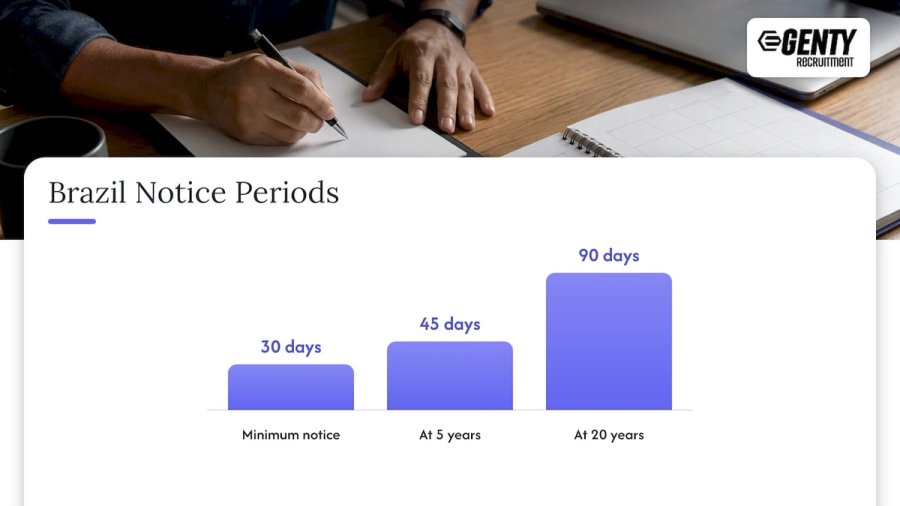
Brazil has the most formula-driven rule. Under the CLT, minimum prior notice for dismissal without just cause is 30 calendar days, and Law 12,506/2011 adds 3 days for each full year of service, capped at 90 days, as explained in this overview of Brazilian labor law. A developer with five years of tenure therefore earns 45 days of notice. The cap is reached at 20 years of service.
The employer may pay in lieu of notice, and severance pay falls due within 10 days of the contract ending. A common mistake is treating pay in lieu as a clean cut. Indemnified notice still counts toward length of service, so the projected end date can add a further twelfth of the 13th salary and vacation accrual. Your payroll partner should calculate it that way.
On the employee side, a resigning employee must give 30 days’ notice or ask to be released from working it. If they skip it, the employer may deduct 30 days’ salary from the severance. For a startup replacing a senior engineer, this means a Brazilian resignation gives you a month to run a handover, which is generous compared with the US norm.
Argentina: one or two months, and trial periods
Argentina’s Law 20,744 sets the rhythm: 15 days’ notice in the probation period, one month under five years of service and two months above five years, with payment in lieu permitted, according to the OECD’s employment protection indicators. Without-cause severance is one monthly salary per year of service or fraction over three months.
The same OECD document records a recent change. Under the Ley Bases reform, severance may be replaced by monthly unemployment-fund contributions of up to 8% of wages, or an employer-funded private capitalization system, subject to sectoral collective agreements. Check whether a collective agreement applies to your hire’s sector before relying on the new route.
For the Fic Law example above, the Buenos Aires hire with three years of service costs notice of one month and severance of three monthly salaries, before vacation and bonus. That is the figure to compare with your US severance practice when you model the true cost of an Argentine team.
Chile: 30 days or a substitute payment
Chile is unusually well documented by its own regulator. The Dirección del Trabajo states that the employer must give at least 30 days’ prior written notice when terminating for company needs, unless it pays the substitute indemnity. For other just-cause terminations, written notice must be delivered within three business days after separation, and within six business days for force majeure or bankruptcy cases.
Severance sits on top. For a company-needs termination, and unless an agreement provides a greater amount, the employer pays 30 days of the last monthly remuneration per year of service and fraction over six months, capped at 330 days. This is compatible with the substitute notice payment. A Chilean engineer with four years of service therefore costs one month in lieu of notice plus four months of severance.
Mexico: no advance notice, but the paperwork is the risk
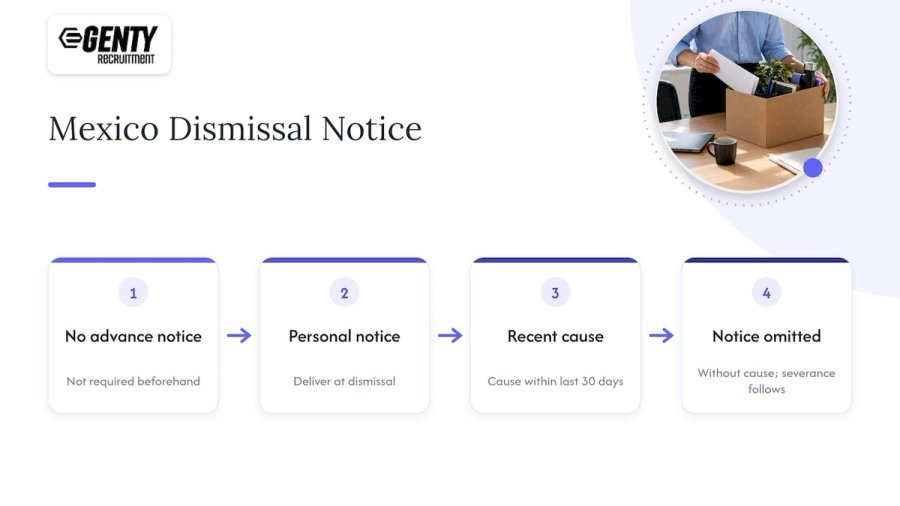
Mexico flips the logic. According to CMS’s expert guide to dismissals, there is no obligation to serve advance notice before a dismissal. What the employer must do is deliver personal notice at the moment of dismissal stating the just causes, which must have occurred in the last 30 days. If that notice is not delivered, the termination is deemed without cause and statutory severance follows.
A cross-country summary by Derecho Fácil adds that disputes are now heard by Labor Tribunals after the 2017 constitutional reform. In practice, a founder in Austin or Berlin who ends a Mexican hire over a Zoom call, without a properly documented written cause, has created a without-cause dismissal by default. For sales teams in Mexico City, where SDR turnover is high, a standard documented process matters as much as the contract.
Colombia: two rules that surprise US employers
The Legal 500 comparative guide states that an employer terminating without just cause is not required to give a minimum advance notice period. That does not mean a free exit, because a dismissal without just cause carries its own compensation. Two other rules from the same source catch teams out:
- For just-cause terminations in specific statutory cases, the employer must notify at least 15 days in advance.
- For fixed-term contracts, the employer must notify at least 30 days before expiration, or the contract renews automatically for the same period.
The second rule is the one that costs money. A founder who hires a Colombian DevOps engineer on a one-year fixed-term contract and forgets the 30-day window finds the contract renewed for another year. Put the notice date in your calendar when the contract is signed.
Venezuela and Costa Rica: special cases
Venezuela places the notice duty on the worker. Under article 81 of the LOTTT, a resigning employee gives one week’s notice after one month of service, two weeks after six months and one month after one year. Employers may terminate without notice for a justified reason, but subject to the dismissal-authorization procedure, which the same report describes as slow in practice. Most US employers meet this as a compliance reason to keep Venezuela hiring limited.
In Costa Rica, if a termination for cause is properly supported, neither notice nor severance is owed, but outstanding wages, unused vacation and proportional aguinaldo (the year-end bonus) must still be paid.
What a notice period really costs: a worked example
Take a mid-level engineer with three years of service whose role is eliminated. The notice component alone looks very different by country:
- Brazil: 39 days of notice (30 plus 3 per year), worked or paid, plus the severance elements triggered by the contract type.
- Argentina: one month of notice, plus three monthly salaries of severance.
- Chile: 30 days’ notice or its substitute, plus three months of severance.
- Mexico: no advance notice, but written cause required, otherwise statutory severance applies.
- Colombia: no minimum notice without just cause, but compensation for an unjust dismissal.
The lesson is that notice is the smaller line item. Severance, vacation, the 13th-month salary and procedural penalties set the true cost. Our breakdown of the cost to hire in LATAM puts these obligations next to salary so you see the full picture before you open a requisition.
A pre-hire checklist for notice and termination risk
The Fic Law guide recommends practices that apply across the region. Adapted for a US or European tech employer, they become this checklist:
- [ ] Write the notice period into the contract, and confirm whether payment in lieu must be allowed by contract in that jurisdiction.
- [ ] Identify mandatory bonuses, such as the 13th-month pay required in most Latin American countries, and include them in payroll.
- [ ] Keep written employment records and run a documented disciplinary process before any for-cause termination.
- [ ] Confirm pension and social-insurance contributions are current, since labor inspectors can fine procedural violations.
- [ ] Check whether a collective agreement extends to your hire’s sector.
- [ ] Diary every fixed-term expiry and its notice window, especially in Colombia.
- [ ] Plan reductions in force well ahead of the date you need the saving.
The Derecho Fácil summary makes the same point from another angle: because each country has a different statute and a different supervising authority (Argentina’s Ministry of Labor, Chile’s Dirección del Trabajo, Mexico’s Labor Tribunals), every figure should be verified by country before you act. Engage local employment counsel for any actual dismissal.
Where GENTY recruitment fits
Notice periods are a hiring decision as much as a legal one. Choosing between a Brazilian and a Colombian senior engineer should account for exit cost, not only salary. Our fixed-fee IT recruitment starts from $2,999 one-off per hire, with triple-vetted shortlists delivered within 7 days, no upfront payments and a 3-month replacement guarantee. Sales recruitment for SDR and AE teams is also from $2,999 per hire.
If you would rather not run payroll and contracts yourself, remote staffing in LATAM starts from $99 per month per employee. For a wider view of the process, see our guide on how to hire remote talent from Latin America, or talk to us through the main site.
Our perspective
Most of the notice-period problems we hear about began before the hire. A founder picks a country because the salary looks right, signs a template contract, and learns about a 30-day fixed-term window or a written-cause requirement only when something goes wrong.
We think the better order is to decide the country, the seniority and the exit cost together. That is why our recruiters work by vertical and by LATAM market: an IT recruiter who places engineers in Argentina and Brazil every week knows which questions to put to a candidate about notice, current obligations and availability.
Our fixed-fee model, with no upfront payment and a 3-month replacement guarantee, is built so the cost of the search is known on day one. We recommend you pair it with the same discipline on the employment side: a written notice clause, a clear bonus schedule and a calendar for every fixed-term date.
Timezone alignment makes this worth the effort. A team in Colombia or Argentina works in your Eastern or Pacific overlap, speaks strong English and costs up to 40% less than a comparable US hire.
Eugene
FAQ
How long is the notice period in Brazil?
The minimum is 30 days for dismissal without just cause, plus 3 days for each full year of service, capped at 90 days. The employer can pay in lieu of working the notice. An employee who resigns owes 30 days.
Do I need to give notice before dismissing someone in Mexico?
There is no minimum advance notice, but you must give the employee written notice of the just causes at the moment of dismissal. Without it, the dismissal is treated as without cause and statutory severance applies. Use local employment counsel for the drafting.
Can I pay in lieu of notice in Argentina and Chile?
Yes, in both. Argentina permits payment in lieu of its one- or two-month notice, and Chile allows a substitute indemnity in place of 30 days’ written notice. In Chile that payment sits alongside severance of 30 days’ pay per year of service.
What happens if a Colombian fixed-term contract is not ended in time?
If the employer does not give at least 30 days’ notice before expiry, the contract renews automatically for the same period. Track expiry dates from signing. A recurring calendar reminder at 45 days prevents it.
Who should check notice rules before I hire?
Employment counsel in the hire’s country should review the contract. We help you choose the market and the candidate, and you can start through GENTY recruitment.
Sources
- Fic Law: Global Employment Law Guide for U.S. HR Managers
- Mixvale: Brazilian labor law notice rules
- Lexology: Termination of employment in Brazil
- Law Firm Alliance: Employment contract Brazil
- OECD: Argentina employment protection indicators
- Dirección del Trabajo, Chile: termination formalities
- SUSESO: Código del Trabajo
- CMS: Dismissals and termination of employment in Mexico
- Derecho Fácil: Preaviso de trabajo por país
- Legal 500: Colombia employment guide 2025
- ICLG: Employment and labour laws, Venezuela 2026
- AG Legal: Termination for cause in Costa Rica