

For a US or European company hiring engineers and sales talent, the top tech hubs in Latin America are São Paulo, Mexico City, Bogotá, Santiago and Buenos Aires, with Medellín, Monterrey, Guadalajara and Rio de Janeiro as fast-rising second tier. Each hub fits a different hiring profile. Mexico City and Monterrey suit teams that need deep US-hours overlap, Buenos Aires and Santiago suit senior engineers with strong English, São Paulo suits scale, and Bogotá and Medellín suit fintech and product teams that want Eastern-time alignment. This guide ranks the hubs on the numbers that matter to a CTO or founder: size of the tech workforce, ecosystem maturity, salaries, English and time zone. It then shows how to pick the right one for your next hire.
TL;DR
- São Paulo is the region’s largest and most mature startup ecosystem, while Mexico City has the largest tech workforce, at 320,000 specialists in 2024.
- Median annual gross developer salaries across Brazil, Argentina, Colombia, Chile and Costa Rica sit in a $46,000 to $51,000 band, so the hub you pick matters less for cost than for fit.
- For US hours, Chile matches Eastern time, Colombia is one hour behind it and Argentina one hour ahead, and Mexico’s cities share the US working day.
- Argentina has the strongest English of the large markets, so it is a natural fit for senior roles that lead meetings and mentor US-based colleagues.
- Match the hub to the role: fintech in São Paulo, Mexico City and Bogotá, SDR and AE teams in Mexico City and Bogotá, and senior backend and DevOps in Buenos Aires and Santiago.
How the top hubs rank
No single ranking settles this, because each index measures something different. Startup ecosystem indexes score funding, startup density and business environment. Workforce reports count specialists. A hiring manager needs both: a hub with enough people to recruit from, and an ecosystem that has trained them on real products.
StartupBlink’s 2026 analysis ranks the top 10 Latin American startup cities as São Paulo, Mexico City, Bogotá, Santiago, Buenos Aires, Medellín, Rio de Janeiro, Curitiba, Belo Horizonte and Porto Alegre. São Paulo is the global number 24 in that ranking, and its score is nearly three times Mexico City’s. Startup Genome’s GSER 2025 report names a similar top five, adding Santiago-Valparaíso and Rio de Janeiro, and notes that São Paulo is the region’s only ecosystem in the global top 40. It also ranks Mexico City second in the region on funding, talent and experience, and performance.
The workforce view looks different. CBRE’s Scoring Tech Talent 2025 report counts tech specialists in 11 Latin American markets, 1,042,951 in total in 2024:
What do you need?
Choose the hiring path that fits
After reading "Top Tech Hubs in Latin America for Hiring in 2026", most teams compare these options before deciding how to hire.
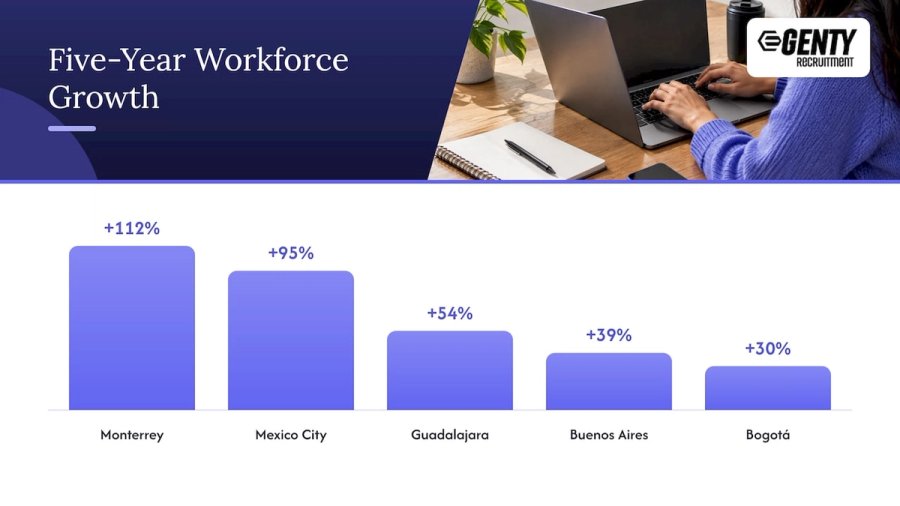
Two patterns stand out. Mexico’s three hubs are growing fastest, with Monterrey more than doubling its tech workforce in five years. And the mid-sized hubs, Buenos Aires and Bogotá, each have over 100,000 specialists, enough depth to build a team of ten without exhausting the market.
São Paulo: scale and fintech depth
São Paulo is the default answer to “biggest hub” for good reason. Real Instituto Elcano values its ecosystem at US$113 billion with 11 unicorns, and describes a sophisticated business environment serving a consumer market of 215 million. In StartupBlink’s 2025 report it ranked fifth worldwide in fintech and first in Latin America.
For hiring, that means engineers who have worked on payments, lending, risk and high-volume transaction systems at companies operating at real scale. Brazil as a country has an estimated 500,000 software developers according to Alten Capital’s 2025 data, by far the largest pool in the region, with a median gross developer salary of $50,000.
What to plan for: Brazilian engineers work in Portuguese by default, and the same Alten data ranks Brazil 75th in the EF English index, well below Argentina. Screen for spoken English early, and for roles that need daily US stakeholder contact, define the English level in the job brief. São Paulo also runs one to two hours ahead of US Eastern time depending on the season, which still leaves a full working-day overlap with the East Coast and a solid afternoon overlap with the West Coast.
Worth a look beyond São Paulo: Curitiba, Belo Horizonte, Porto Alegre and Rio de Janeiro all appear in StartupBlink’s top 10, and each grew its score by double digits in the latest analysis. Campinas, home to a major university cluster, has 22,060 tech specialists in the CBRE count.
Mexico City, Guadalajara and Monterrey: the US-hours advantage
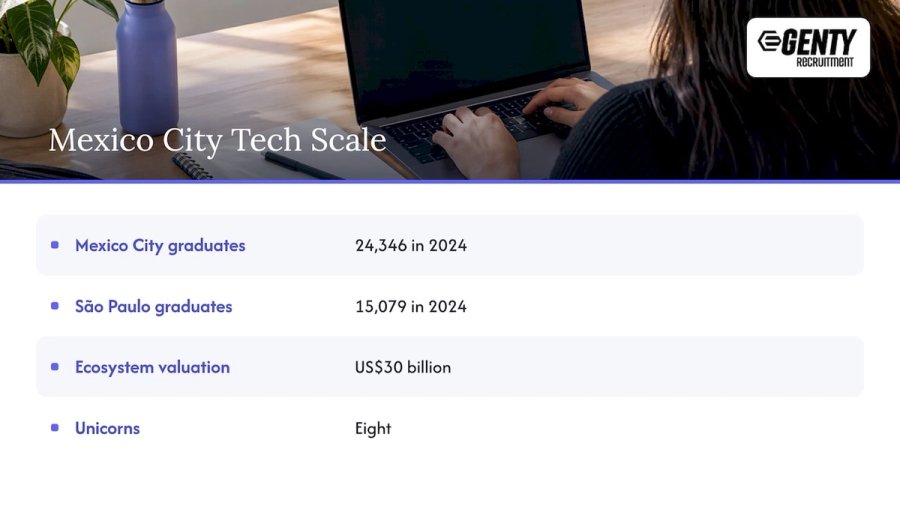
Mexico City has the largest tech workforce in Latin America and the most graduates. CBRE reports it produced 24,346 tech graduates in 2024, ahead of São Paulo’s 15,079. Elcano describes it as a magnet for US and Canadian digital talent, and values its ecosystem at US$30 billion with eight unicorns.
The cost picture is useful for budgeting. According to CBRE, software developer salaries in Mexico City rose 43% from 2019 to $48,058 in 2024, and five-year tech salary growth of 45% compares with 26% in the US. Salaries are rising quickly, which makes hiring sooner rather than later a practical advantage.
Mexico’s real edge for US companies is the calendar. Mexican cities share the US working day, so a standup at 9 a.m. Pacific or Eastern works without anyone starting at dawn or staying late. That matters most for sales teams: SDRs calling US prospects and AEs running demos need to be online when buyers are, and Mexico City is where many US companies build those teams first. Our sales recruitment service is built around exactly this profile.
Guadalajara, with 61,644 specialists and 54% growth, has long been a hardware and software outsourcing center. Monterrey, up 112% to 49,798 specialists, is Mexico’s industrial and corporate capital, and the surrounding northern states have a growing business-services market, including digital marketing agencies in Saltillo that support regional growth. Funding follows the same direction: The StartupVC’s 2026 overview reports that Mexican startups overtook Brazil in the second quarter of 2025 for the first time in 13 years, and that Brazil and Mexico together captured 78.5% of regional venture capital.
Bogotá and Medellín: Eastern-time alignment and product talent
Bogotá ranks third in both StartupBlink’s 2026 table and Startup Genome’s top five. Elcano values the ecosystem at US$13 billion and credits it as the birthplace of Rappi. StartupBlink’s 2025 report placed Bogotá first in Latin America in transportation tech.
The time-zone fit is hard to beat. Alten lists Colombia at one hour behind US Eastern time, and since Colombia does not shift its clocks, the overlap with East Coast teams stays predictable through the year. Colombia counts about 62,000 software developers and a $46,000 median gross developer salary in the same dataset, the lowest of the five countries it compares, which makes it a strong value hub for mid-level product and full-stack roles.
Medellín is the climber. Its score grew 31.1% in StartupBlink’s 2026 analysis, the fastest among the top six, and the 2025 report credits the city’s innovation agency Ruta N and the World Economic Forum’s Centre for the Fourth Industrial Revolution. GEIAL’s 2026 regional report adds a notable data point for AI hiring: its new AI-adoption indicator ranks São Paulo and Medellín first, both above 70 points.
Buenos Aires and Santiago: senior engineers with strong English
Buenos Aires gave the region MercadoLibre and Globant, per Elcano, and its ecosystem is valued at US$12 billion. Its tech workforce grew 39% over five years to 118,138 specialists. Argentina ranks 26th in the EF English index in Alten’s comparison, the best of the five countries covered, and sits one hour ahead of US Eastern time. For a US engineering leader who wants a senior backend engineer or tech lead to run code reviews and talk directly to product managers, that combination is the main reason to look here. Córdoba is a second Argentine city worth watching: Startup Genome reports 9% growth in its ecosystem value.
Santiago is the stability pick. Elcano describes an open economy, StartupBlink’s 2026 analysis shows its score up 17.6%, the strongest growth among the top five, and its 143,392 specialists make it the third-largest workforce in the CBRE count. Chile has about 61,000 software developers, a $50,000 median gross salary, and a time zone that matches US Eastern time in Alten’s comparison. English ranks 54th, so it sits in the middle of the group.
Country-level comparison for remote hiring
Hub rankings tell you where talent clusters. Country data tells you what a hire looks like on paper. This table pulls the figures from Alten Capital’s 2025 nearshore comparison:
The spread between the cheapest and the most expensive country is about $5,000. That is the key insight for budgeting: choose the hub for talent depth, English and overlap, then use salary data for the specific role. Our guides to developer salaries in Latin America and fintech salaries in the region break these medians down by seniority and stack.
Our clients save up to 40% compared with US or European hiring, and that saving comes from the whole package of lower salary bands and nearshore alignment, not from any one city.
A checklist for choosing your first hub
Use these questions in order. The first answer usually narrows the list to two cities.
- How many hours of overlap does the role need? Sales, support and anything involving live customer contact point to Mexico, Colombia or Chile. Asynchronous engineering work widens the field to Brazil and Argentina.
- What English level is required? For client-facing or leadership roles, start with Buenos Aires or Santiago. For roles with a Portuguese-speaking internal team, São Paulo works.
- What domain experience matters? Fintech: São Paulo, Mexico City, Bogotá. Marketplaces and e-commerce: Buenos Aires and Mexico City. AI: São Paulo and Medellín lead GEIAL’s adoption indicator.
- How big is the team you will build? For ten or more hires in a year, favor hubs with 100,000 or more specialists: Mexico City, São Paulo, Santiago, Buenos Aires or Bogotá.
- What is your seniority mix? Senior profiles cluster in the older ecosystems. Growth hubs like Monterrey, Guadalajara and Medellín are strong for mid-level hires who will grow with you.
- How will you employ them? Decide early between direct hire through an employer-of-record arrangement, contracting or a nearshore partner. Our overview of nearshore outsourcing advantages is a useful framework for that choice.
Hiring in these hubs with GENTY recruitment
A hub ranking gets you to a shortlist of cities, but hiring still comes down to finding the specific engineer or seller who has shipped what you need. GENTY recruitment focuses exclusively on Latin America, with dedicated recruiters per vertical, and delivers curated shortlists of pre-vetted candidates within 7 days. Pricing is a fixed fee per seniority level with no upfront payment: IT recruitment starts from $2,999 one-off per hire, and every placement carries a 3-month replacement guarantee. If you want a person on your team without setting up a local entity, remote staffing in LATAM starts from $99 per month per employee.
Tell us the role, the stack and the overlap you need, and we will propose the hubs to source from. You can start at gentyrecruitment.io.
Our perspective
Most companies that come to us have already picked a country before they define the role. We suggest reversing that. Define the work first: the stack, the seniority, the hours a person has to be online with your customers or your engineers. The hub usually becomes obvious.
A sales team that sells to US mid-market buyers belongs where the US business day is natural, and Mexico City and Bogotá are strong starting points. A platform team that needs a staff-level engineer who writes the design docs in English and mentors your juniors often comes from Buenos Aires or Santiago. A payments team that needs people who have run systems at Brazilian transaction volumes points to São Paulo.
The ranking tables are a map, not a hiring plan. What turns a city into a hire is a recruiter who works one vertical in the region every day, a skill-first screen, and a shortlist you can interview within a week. That is how we run every search, and it is why we charge a transparent fixed fee per seniority level and stand behind each placement for three months.
Eugene
FAQ
Which is the biggest tech hub in Latin America?
It depends on the measure. São Paulo has the largest and most valuable startup ecosystem, ranking number 24 globally in StartupBlink’s 2026 analysis. Mexico City has the largest tech workforce, with 320,000 specialists in CBRE’s 2024 count. For hiring volume, look at both cities.
Which Latin American hub has the best English?
Among the five countries in Alten Capital’s 2025 comparison, Argentina ranks highest in the EF English index, at 26th, followed by Chile at 54th and Costa Rica at 55th. Buenos Aires is therefore a common choice for senior roles with heavy communication.
Which hubs are best for US time-zone overlap?
Chile matches US Eastern time, Colombia is one hour behind it and Argentina one hour ahead, per Alten Capital. Mexico’s hubs share the US business day as well, which is why many US companies build sales and support teams there.
Are salaries lower across all the hubs?
Median annual gross developer salaries range from $46,000 in Colombia to $51,000 in Costa Rica in Alten Capital’s 2025 data. Mexico City developer salaries averaged $48,058 in 2024 per CBRE, and they have been rising quickly. Our clients save up to 40% compared with US or European hiring.
Which hubs are strongest for fintech and AI?
Fintech is concentrated in São Paulo, Mexico City and Bogotá, and The StartupVC reports that fintech took 61% of Latin American venture funding in 2025. For AI, GEIAL’s 2026 report ranks São Paulo and Medellín first on its AI-adoption indicator.
Sources
- StartupBlink: Analysis of Latin America & Caribbean Startup Ecosystems (2026)
- StartupBlink: Top Cities for Startups in Latin America (2025)
- Startup Genome: Latin America in GSER 2025
- CBRE: Scoring Tech Talent 2025 América Latina
- Real Instituto Elcano: Latin America’s tech and startup ecosystem
- Alten Capital: Latin America Country Comparison (Nearshore)
- GEIAL: Reporte Regional GEIAL 2026
- The StartupVC: Latin America Startup Ecosystem Guide