
A Mexico-based SDR hired by a local company typically earns between MXN 15,000 and MXN 30,000 per month, while a remote SDR with two to five years of outbound experience working for a US company earns a base of roughly $1,600 to $2,300 per month. The gap between those two numbers is the main budgeting decision for a US sales leader, and it depends far more on who the employer is than on job title. This guide breaks down the ranges, the base-versus-commission split, city differences and the real cost of hiring, so you can set an offer that attracts strong candidates without overpaying.
TL;DR
- Local Mexico City SDR pay has a median of MXN 35,000 per Glassdoor’s Mexico City data, with a very wide range of MXN 19,958 to 126,500 once commissions are included.
- Remote SDRs with 2 to 5 years of outbound experience working for US companies command a base of $1,600 to $2,300 per month.
- Company type moves pay more than seniority: a US SaaS employer and a local non-tech firm are competing for the same person at very different price points.
- Mexico City, Monterrey and Guadalajara all overlap with US Eastern and Pacific hours, which lets an SDR run live calls during your prospects’ business day.
- GENTY recruitment places pre-vetted SDRs and AEs across Latin America from $2,999 per hire, with no upfront payment and a 3-month replacement guarantee.
What an SDR Earns in Mexico: The Headline Numbers
Three different data points describe three different labor markets, and mixing them is the most common mistake in salary budgets.
Local market, Mexico City. Glassdoor’s page for Sales Development Representatives in Mexico City shows a median of MXN 35,000 and a range of MXN 19,958 to MXN 126,500. The top of that range reflects total compensation with strong commissions at senior or multinational employers, not a typical base.
Posted jobs. PackLead reviewed 12 full-time SDR or B2B prospecting jobs in Mexico that listed pay in October 2026. Nine of them offered MXN 15,000 to MXN 30,000 per month, the lowest were under MXN 10,000 and the highest reached MXN 36,000. The same review notes that many Mexican SDR vacancies publish no salary at all, and that the figures posted are generally base pay without commissions or bonuses.
Need help hiring?
See the next step after this guide
If this topic is relevant to your team, these are the most useful pages to check next.
Remote for a US company. Growly’s 2026 guide puts a Mexico-based SDR working remotely for a US company, with 2 to 5 years of outbound experience, at a base of $1,600 to $2,300 per month. A September 2026 remote SDR listing aimed at Mexico advertised OTE of $1,700 to $2,300 per month plus uncapped performance bonuses, which fits the same band.
Two cautions about these numbers. They come from self-reported and posted data, not a government survey, so treat them as market signals and test them against live candidate conversations. And local pay figures are in pesos while remote offers are usually quoted in dollars, so compare them at the exchange rate on the day you make an offer.
Base, Commission and OTE: How the Pay Is Structured
A US SDR plan commonly splits on-target earnings between base and variable pay. In Mexico the split is less standardized. Growly’s guide observes that in SaaS the variable component is often a relevant part of OTE, whereas some companies outside technology pay fixed salaries with no commission. That is why a candidate currently earning MXN 20,000 at a local distributor may be a stronger prospector than the number suggests, and why a candidate at MXN 35,000 on a heavy commission plan may have a lower base than you expect.
When you design an offer for a remote SDR, three structural choices matter more than the headline figure:
- Base that stands on its own. A base in the $1,600 to $2,300 range keeps you competitive with strong local employers while the variable component rewards meetings booked and pipeline created.
- Variable tied to qualified meetings or opportunities, not raw activity. This keeps comp aligned with what your AEs actually close.
- Uncapped or generously capped bonuses. The remote listing above advertised uncapped bonuses, and that is what top candidates will compare you against.
For a deeper look at plan mechanics, our guide to LatAm SDR compensation plans covers quotas, accelerators and ramp periods, and the page on Mexico SDR contractor rates covers what US teams must know before engaging someone as a contractor.
Why salary transparency helps you hire
Because many Mexican vacancies leave pay unstated, a posting with a clear base and OTE range stands out and filters out mismatched applicants early. It also gives you a defensible internal standard once you have several SDRs. Once the team is hired, a clean record of working hours matters for payroll and compliance, and a practical overview of remote employee time tracking shows how distributed teams document it.
Salary by City: Mexico City, Monterrey and Guadalajara
Mexico City has the deepest pool of SDRs and the widest pay range, but it is not the only hub worth recruiting from.
Glassdoor’s Guadalajara data shows a base pay range of MXN 14,000 to MXN 18,000 per month, with an average base of MXN 16,000. Compared with the Mexico City median, Guadalajara’s base pay is lower, though the two figures measure different things (base in one case, total reported pay in the other), so do not subtract one from the other and call the result a city discount.
What we see in practice, and what the data above supports, is that the city matters less for a remote hire than the employer type. A candidate in Guadalajara or Monterrey who sells for a US SaaS company expects a dollar-denominated offer close to a Mexico City peer’s. Choose the city for talent depth, English level and time zone fit, then set pay by role and experience rather than by postal code.
Time zone: the practical advantage
Mexico City runs on central time and generally sits in the same band as US Central, which means a one-hour gap with New York and a two-hour gap with the West Coast during much of the year. An SDR in Mexico can start outbound blocks at 8 a.m. Eastern and still be working their prospects’ lunch hours in Pacific time. That live overlap is the core reason US sales leaders choose Mexico over offshore regions: calls can be warm-transferred to an AE in real time, coaching happens during the same workday, and pipeline reviews do not run on a next-day delay. Colombia and Argentina offer similar alignment with US Eastern, and Brazil works well for East Coast teams.
Seniority: Is SDR an Entry-Level Role in Mexico?
In the US, the SDR job is the classic first step into a sales career, and the same is broadly true in Mexico. Local postings in the MXN 15,000 to 30,000 range are usually aimed at candidates with up to a couple of years of experience. The remote market differs: US-facing roles in the $1,600 to $2,300 band are pitched to people with 2 to 5 years of outbound experience, because they must run outreach independently, in English, with minimal supervision.
That suggests a practical ladder when you build a team:
- Junior SDR (0 to 2 years): lower base, heavier training, best suited when you already have a playbook and a team lead who can coach daily.
- Experienced SDR (2 to 5 years): the sweet spot for a first remote hire, usually paid at the remote band quoted above.
- Senior SDR or SDR team lead: above the band, with a base that reflects management responsibility and a variable tied to team output.
Growly’s guide quotes Said Marraoui saying the largest salary difference comes from company type rather than seniority. In our placements the same pattern shows up: a mid-level candidate who has worked at a funded SaaS startup often expects more than a senior candidate from a traditional local business.
What Else Goes Into the Total Cost
Base pay is not the full cost. Before you fix a budget, account for these items:
- Employment model. A contractor, an employer of record arrangement or your own Mexican entity each carry different obligations. Mexican labor law gives employees a statutory year-end bonus (aguinaldo), paid vacation and a vacation premium, and those entitlements can apply to staff on an employer-of-record payroll. Confirm the specifics with a Mexican employment lawyer or your EOR provider.
- Tools and data. Sales engagement software, a data provider and a CRM seat are the same cost as in the US, so budget them separately.
- Recruiting cost. Percentage-based agencies charge a share of first-year salary, which grows with the candidate’s pay. A fixed fee does not.
- Ramp time. Plan for roughly the first month as onboarding with a reduced meeting target, then set quotas.
To compare your own roles against the market, a guide to salary benchmarking tools explains what each type of tool measures and where it falls short for Latin America.
Our Perspective: Pay for Fit, Not for Discount
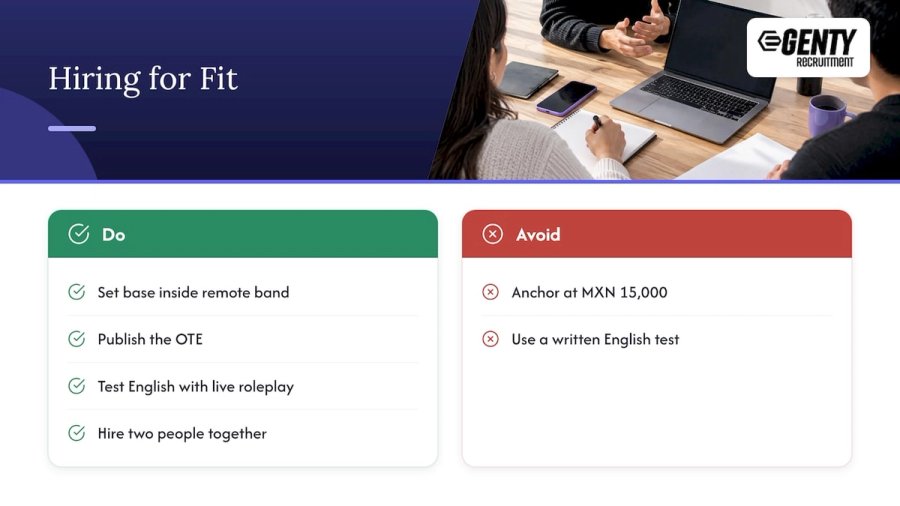
We work only on Latin America, with dedicated recruiters per vertical, and the most frequent mistake we see from US teams is building the offer around a savings target. A company that anchors at the bottom of the local range, MXN 15,000 a month, attracts candidates who are comfortable with that figure, and these are rarely the people who book meetings with US VPs of Sales. A company that offers a competitive dollar base, a clear commission plan and a real career path to AE attracts the experienced SDRs who have already worked for US companies.
The savings are still large. A remote SDR at $1,600 to $2,300 per month costs a fraction of a US-based SDR, and you keep a four to six-hour working overlap with the whole team. But the savings come from the market, not from lowballing: you capture them by hiring someone who ramps in weeks and stays for years. Replacement is the real cost driver, which is why we back every placement with a 3-month replacement guarantee.
Our advice for a first Mexican SDR hire: set the base inside the remote band, publish the OTE, test English with a live cold-call roleplay rather than a written test, and hire two people at once so they can share playbooks and cover each other’s holidays.
— Eugene
Hiring an SDR in Mexico With GENTY recruitment
If you would rather not source, screen and benchmark on your own, our sales recruitment service starts from $2,999 per hire as a one-off fixed fee, with no upfront payments. Shortlists of triple-vetted SDR and AE candidates from Mexico, Colombia, Argentina and Brazil arrive within 7 days, and we replace a placement within three months if it does not work out. If you want to employ your new SDR without opening a local entity, our remote staffing and EOR in LATAM service starts from $99 per employee per month. For wider context on the market, read our SDR salary in Latin America comparison across countries, or the tech sales hiring guide.
A Checklist Before You Post the Role
- Decide whether the SDR is a contractor, an EOR employee or a hire through your own entity.
- Set base and OTE in US dollars, and state both in the posting.
- Confirm the working window: for example, 8 a.m. to 5 p.m. Eastern, or 9 a.m. to 6 p.m. Pacific.
- Define the metric for variable pay: qualified meetings held, not meetings booked.
- Test spoken English with a live roleplay.
- Ask each finalist for outbound numbers: touches per day, reply rate and meetings booked in the last two quarters.
- Agree a 30-day ramp plan with a named manager.
- Budget for tools, data and coaching time.
FAQ
How much does an SDR make in Mexico?
Posted local jobs mostly pay MXN 15,000 to MXN 30,000 per month, and Glassdoor reports a Mexico City median of MXN 35,000 including commissions. Remote SDRs working for US companies earn a base of about $1,600 to $2,300 per month. The employer type matters more than the job title.
Is SDR an entry-level position in Mexico?
Often yes in the local market, where many roles suit candidates with up to two years of experience. US-facing remote roles usually ask for two to five years of outbound experience and English fluency, so they are better described as early-career rather than entry-level.
Do SDRs in Mexico earn commission?
In SaaS the variable part is frequently a significant share of OTE, while some non-tech employers pay a fixed salary only. Published figures are often base pay alone, so ask any candidate to separate base from commission when comparing offers.
Is Mexico a good place for US teams to hire SDRs?
Yes, mainly for time zone overlap, English proficiency among experienced sellers and a deep pool in Mexico City, Guadalajara and Monterrey. Live overlap with both Eastern and Pacific hours lets SDRs hand off meetings to AEs in real time.
Sources
- Glassdoor: Sales Development Representative salary in Mexico City
- Glassdoor: SDR salary in Guadalajara
- PackLead: SDR or prospecting agency, cost in Mexico
- Growly: how much an SDR earns in Mexico in 2026
- Remoshift: Sales Development Representative listing