

A remote QA engineer in Latin America typically costs a US company somewhere between the mid-$40,000s and the low $80,000s per year for junior-to-senior roles, with automation specialists and QA leads pricing higher. The spread depends less on title than on the country, the type of testing, how much code the engineer writes and whether the employer is local or international. This guide breaks the numbers down by seniority, specialty and country, shows where the published data is thin, and gives you a way to set a defensible offer.
TL;DR
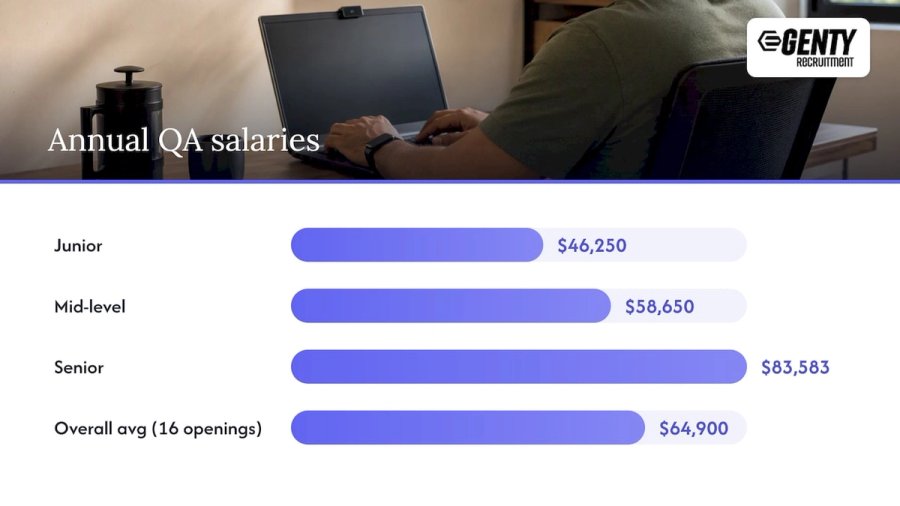
- Job-board averages for remote QA roles in Latin America run about $46,250 (junior), $58,650 (mid-level) and $83,583 (senior), a small sample that should be treated as a guide, not a quote.
- QA automation pays more than manual testing: one 90-day sample of LATAM automation postings shows a $77,000 median.
- Country matters. Mexico’s published ranges sit well below what US-facing automation roles pay in Brazil or Colombia once you add seniority and English fluency.
- Budget for the market rate of an international employer, not the local rate, or you will lose offers to better-paying competitors.
- Colombia aligns with US Eastern time, and Mexico, Argentina and Brazil overlap heavily with EST and PST working hours, so you can run daily standups and release testing live.
What a remote QA engineer earns in Latin America
The public data on this role is fragmented. Salary sites quote local currency for local employers, job boards quote dollars for remote roles, and sample sizes are small. Three views are worth putting side by side.
Remote postings aimed at US employers. An aggregate of remote QA engineer openings across the region reports an average of $64,900 per year, based on 16 openings, with averages of $46,250 for junior, $58,650 for mid-level and $83,583 for senior roles. Sixteen postings is a thin sample, so read the shape (roughly a 1.8x climb from junior to senior), not the exact digits.
Monthly net pay for the local market. A Latin American training provider describes indicative net monthly ranges of $600–$1,200 for trainee or junior QA, $1,200–$2,200 for semi-senior, $2,200–$3,800 for senior and $3,500–$5,500 for QA lead or manager. The source calls these orders of magnitude, not guaranteed offers. They are net of tax, and they reflect what many engineers earn from local employers. They are your floor, not your offer.
What do you need?
Choose the hiring path that fits
After reading "QA Engineer Salary in LATAM: 2026 Budget Guide for US Teams", most teams compare these options before deciding how to hire.
Hourly rates charged to US employers. A nearshore rate guide lists QA and test automation rates of $25–$38 per hour for mid-level, $38–$55 for senior and $50–$68 for lead or architect profiles. At 2,080 hours a year, that is roughly $52,000–$79,000 for mid-level, $79,000–$114,000 for senior and $104,000–$141,000 for leads. These are vendor-style rates that include overhead and margin, so they overshoot what an engineer takes home.
How the three views fit together
The gap between local net pay and remote offers is the core of the LATAM hiring opportunity. A senior QA engineer earning $2,200–$3,800 net per month locally can take a US-dollar offer well above that and still cost you far less than a US hire.
Manual QA vs. QA automation salaries
Automation skills are the biggest single premium in the QA market. One salary tracker reports a $77,000 annual median for QA automation postings across Latin America, with half of the observed jobs between $64,000 and $77,000. It covers 22 jobs with stated salaries over a 90 days window, so it is a snapshot, but the number sits above the $58,650 mid-level average for QA generally.
Why automation pays more:
- Coding load. Engineers writing Cypress, Playwright, Selenium or API test suites in TypeScript, Python or Java are closer to software engineers than to scripted testers.
- CI/CD exposure. Wiring test suites into GitHub Actions, GitLab CI or Jenkins pipelines, and owning flaky-test triage, is a developer-adjacent skill.
- Cloud and API testing. Testing services on AWS or GCP and validating contracts between microservices is where fintech and SaaS teams feel the most pain.
The Latin American training provider above makes the same point: testing type, whether the employer is local or international, how much the role codes and CI/CD exposure change compensation materially, beyond seniority alone. In Mexico, a salary aggregator notes that employers often weigh practical automation skills, such as Cypress or Selenium, more heavily than certifications. When you screen, ask for a repository or a live exercise before you ask about an ISTQB certificate.
Manual QA still has a place: exploratory testing, accessibility checks, regression on mobile devices and testing in regulated domains where a human judgment call matters. If you need that profile, a dedicated manual QA tester shortlist is a different search from a hire for an SDET.
Salary by country: Mexico, Colombia, Argentina and Brazil
Where the engineer lives affects pay, tax cost and how aggressively local tech employers compete for them.
Mexico
A salary aggregator lists 2026 annual ranges for Mexico of about $12,000–$20,000 for junior, $20,000–$35,000 for mid-level and $35,000–$58,000 for senior QA engineers. These reflect the broader market, and international employers routinely pay above them to attract senior engineers. Mexico City, Guadalajara and Monterrey have the deepest QA benchmark pools, and Central time puts the team in the same working day as the US East and West coasts. For a related benchmark in the same city set, see our DevOps engineer salary in Mexico analysis.
Colombia
Colombia is a strong fit for East Coast companies because Bogotá and Medellín share the US Eastern clock during standard time. A salary database reports an average QA engineer salary of COP 74,410,952 per year, with an entry-level average of COP 53,116,623 and a senior-level average of COP 84,961,336, as of July 2026. Those are peso figures for the local market, and an international offer in dollars will usually land well above them.
Argentina
Argentina’s peso volatility makes local salary tables go stale fast. One database shows an average QA engineer pay of ARS 24,474,305, updated in June 2026. Because of inflation, Argentine engineers commonly prefer dollar-denominated contracts, so quote your offer in USD and state how and when it is paid. Argentina’s QA talent is typically strong in automation and English, which is why many US teams hire there first.
Brazil
Brazil has the largest tech workforce in the region and the most competition from local employers, which pushes senior automation pay toward the upper end of the regional ranges. English proficiency is more varied than in Argentina, so test spoken English during the interview, not only on the CV. Brazil’s time zone overlaps with US Eastern hours for most of the working day.
The factors that move the number
A QA salary in this region is the product of several variables. Use them as a checklist when you set a band.
Budgeting checklist for a LATAM QA hire
- Level of coding. Manual tester, automation engineer or SDET? Each step up adds a premium.
- Test scope. API, mobile, performance and security testing cost more than UI regression.
- Stack. Cypress, Playwright, Selenium, k6, Postman, plus the language your product uses.
- Seniority and ownership. Does the person write a test strategy or execute one?
- Employer type. A US company competes with other international employers, not with the local pay scale.
- Industry. FinTech and regulated products pay more for QA that understands compliance.
- Contract model. Direct contractor, employer of record or agency staffing changes your total cost.
- Country and city. Hub cities such as São Paulo, Mexico City, Buenos Aires and Bogotá carry higher offers.
Remote pay is also a policy decision. Some companies index salary to the engineer’s location, others pay one rate for the role. The guide to location-based pay explains the trade-offs of each approach, which is useful before you decide how to treat engineers in Brazil versus Mexico on the same team.
How to set an offer that gets accepted
Budget by percentile, not average. For a mid-level automation engineer, target the middle of the dollar-denominated ranges above, then move up for specific skills. Typical moves:
- Add for CI/CD ownership and cloud testing. If the engineer will own pipelines, price at the senior band.
- Add for overlap commitments. If you need full PST coverage from someone in Colombia or Brazil, expect to pay for the shifted hours.
- Do not anchor on local pay. Engineers know what international employers pay and will discount offers that look like local salaries.
Salary mismatch is the usual cause of failed offers. When your band sits well below what the candidate expects, the process stalls late. Understanding what a salary expectation mismatch looks like from both sides helps you raise comp expectations in the first call rather than the last one. Our own data on offer acceptance rate benchmarks shows how to track the problem, and our overview of what salary benchmarking is explains how to build a band from live data.
Some platforms publish quarterly reports built from successful recruitment and candidate data and tailor salary recommendations to stack and seniority. Whatever source you use, check it against how many placements it reflects, and refresh your band at least twice a year. If you are comparing tools, our review of salary benchmarking tools covers the options by type.
Our perspective
We see the same pattern in QA searches. Companies post a “QA engineer” role, receive a wide mix of manual testers and automation developers, and then discover that the salary they set matches only one of the two. The cheapest mistake to fix is the one you make before you open the search: decide whether you are hiring someone who executes test plans or someone who builds the test infrastructure, and price accordingly.
Our view is that QA is one of the best-value remote hires in Latin America when the role is scoped properly. The timezone overlap with US Eastern and Pacific hours means your QA engineer is online when your developers merge, not the next morning. The talent pool in Argentina, Brazil, Mexico and Colombia has deep experience with the same stacks US startups use. And the cost gap against a US hire is large enough that you can pay at the top of the regional market and still come in well under a domestic salary. Skill-first screening, with a practical automation exercise before any interview, matters more than the title on the CV.
— Eugene
Hiring a LATAM QA engineer with GENTY recruitment
GENTY recruitment places pre-vetted QA talent, both manual testers and QA automation engineers, through our IT recruitment service. Pricing is a fixed fee from $2,999 per hire, with no upfront payment and a 3-month replacement guarantee. If you would rather not run payroll and contracts yourself, our staffing and EOR option starts from $99 per employee per month. Tell us the stack and the seniority and we will return a curated shortlist within days.
For leadership-level quality roles, see how pay scales in our engineering manager salary guide for LATAM, and for adjacent infrastructure roles, our DevOps salaries in Latin America report. Our remote hiring playbook walks through the process end to end.
FAQ
What is the average QA engineer salary in Latin America?
For remote roles posted for international employers, one job-board sample reports an average of $64,900 per year from 16 openings. Local-market pay is much lower and is usually quoted in local currency. Treat any single average as a starting point and build your band by seniority and specialty.
Do QA automation engineers earn more than manual testers?
Yes. Automation postings in Latin America show a median of $77,000 per year in one recent 90 day sample, above the $58,650 mid-level average for QA roles generally. The premium reflects coding, CI/CD and cloud skills.
Which LATAM country is best for hiring QA engineers?
There is no single answer. Colombia gives the cleanest overlap with US Eastern hours, Mexico offers the most competitive ranges for junior and mid-level roles, and Argentina and Brazil have deep automation talent. Choose by the overlap you need and the seniority you are hiring.
How much should I budget in total to hire a QA engineer from LATAM?
Start with the salary band for the level you need, then add the recruiting fee or staffing fee and any contractor or EOR costs. With GENTY recruitment, the recruiting fee starts from $2,999 per hire, or staffing from $99 per employee per month. A nearshore rate guide puts senior QA automation at $38–$55 per hour when sourced through a vendor.
Sources
- Remote QA Engineer Jobs in Latin America
- QA automation salaries in Latin America
- Hire QA Engineer in Mexico
- Cuánto gana un QA Tester, Coderhouse
- Nearshore Web Development Rates in Latin America
- QA Engineer Salary in Colombia
- QA Engineer Salary in Argentina
- Get on Board Insights Pro
- Remote Pay Adjustments: How Location-Based Pay Works
- Salary Expectation Mismatch