
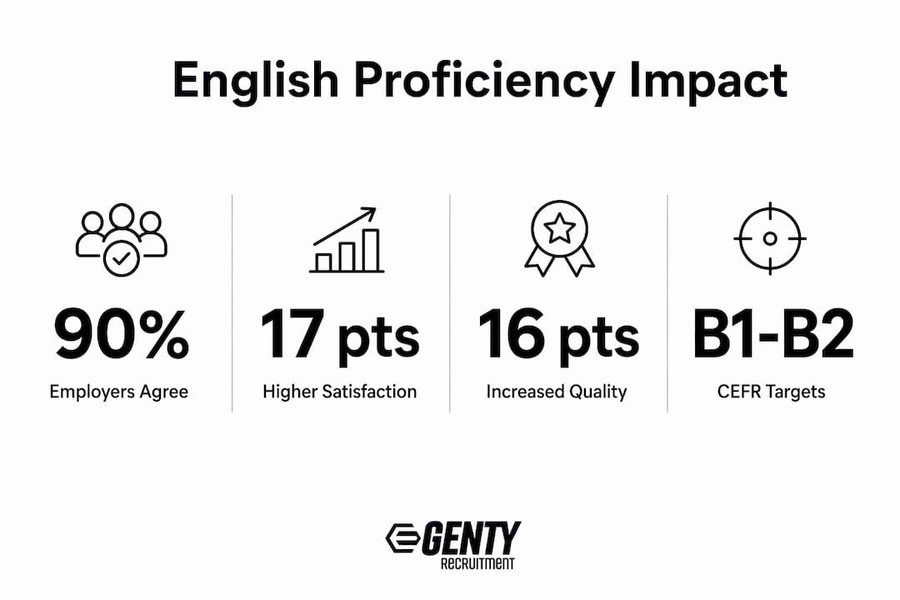
English proficiency is defined as the ability to read, write, speak, and listen in English at a level sufficient for professional work. The role of English proficiency in tech hiring is not a soft preference. 90% of employers identify it as critical to organizational success, and 83% report direct costs to productivity and retention when they hire candidates who fall short. For hiring managers building remote teams across Argentina, Brazil, Mexico, and Colombia, English fluency is the connective tissue between technical skill and actual team output. Nearshore timezone alignment with US EST and PST gives LATAM talent a structural advantage. English proficiency is what turns that advantage into daily results.
How does English proficiency affect remote tech team integration?
English proficiency directly shapes how well a remote engineer integrates into a US or European tech team. The effect shows up fast, in the first standup, the first pull request review, the first Slack thread where a misread message sends a sprint sideways.

Daily collaboration in distributed teams runs on written English. Async tools like Confluence, Notion, and GitHub pull requests require engineers to write clearly and read precisely. A developer in Bogotá or Buenos Aires who writes vague ticket comments or misreads a technical spec creates downstream errors that cost hours to untangle. Poor English communication causes project delays, misinterpreted requirements, and innovation bottlenecks across the team.
The impact compounds at the mid-senior level. Engineers who can write a clear bug report are valuable. Engineers who can run a cross-team architecture discussion in English, manage stakeholder expectations, and present technical tradeoffs to a non-technical product manager are rare and worth prioritizing. Tone adjustment and persuasive communication in English separate contributors who get promoted from those who plateau.
Before you start hiring
Check location, salary, and hiring fit
If you are moving from research to action, start with the market basics so your hiring plan is clearer.
- Standup clarity: Engineers with B2+ English describe blockers accurately, which cuts resolution time.
- Code review quality: Written feedback in English requires precision. Vague comments like “fix this” create confusion and slow iteration.
- Async documentation: Teams in Mexico City or São Paulo writing clear Confluence pages reduce the need for synchronous catch-up calls across time zones.
- Client-facing work: Engineers on FinTech or SaaS products who interact with US clients need C1-level fluency to manage expectations without a manager translating.
Pro Tip: When evaluating LATAM candidates, ask them to submit a written summary of a recent technical challenge in English before the first interview. The quality of that document tells you more than a resume ever will.
What are the best standards for assessing English in tech hiring?
The Common European Framework of Reference for Languages, known as CEFR, is the recognized international standard for measuring language proficiency. CEFR guidelines map directly to role complexity: B1 for internal operations roles, B2 for cross-team async collaboration, and C1 to C2 for client-facing or leadership positions. Using these thresholds reduces interview time and removes subjective bias from the screening process.
Resume claims about English proficiency are unreliable. Candidates frequently self-report “advanced” or “fluent” English with no objective basis. The only way to verify is through structured, multi-stage assessment. Multi-stage testing that includes written assessments, recorded video responses, and live interviews captures both async and conversational fluency. Candidates screened through this process consistently outperform those evaluated only through a single interview.
Organizations that adopt standardized English assessments report 17 points higher workflow satisfaction and 16 points higher productivity compared to those without structured screening. That gap is not marginal. It represents the difference between a team that ships on schedule and one that spends cycles on miscommunication cleanup.
Real-world scenario testing is the most predictive format. Asking a candidate to defend a design choice or respond to critical feedback in English reveals professional fluency that grammar tests miss entirely. GENTY recruitment embeds this kind of structured English screening into its pre-vetting process, so hiring managers receive shortlists where language ability is already confirmed.
Pro Tip: Build a short scenario prompt into your take-home technical assessment. Ask candidates to write a brief explanation of their solution as if presenting it to a non-technical stakeholder. This tests English and communication instinct simultaneously.
Why is English proficiency more critical than ever in AI-driven tech workflows?
English is the primary language of AI training data, and that fact has direct consequences for every developer using AI-assisted tools in 2026. Large language models are trained predominantly on English datasets, which means the quality of a developer’s English prompt directly determines the quality of the AI output. A vague or grammatically ambiguous prompt produces a vague or incorrect code suggestion.
Developers in Argentina or Colombia who use tools like GitHub Copilot or ChatGPT for code generation need linguistic precision, not just programming knowledge. Describing a technical constraint clearly in English, specifying edge cases, and interpreting generated output accurately all require advanced reading and writing skills. Improving English communication is now a parallel track to programming expertise, not a separate soft skill.
The practical implications for hiring managers are concrete:
- Engineers with strong English write better prompts and get more accurate AI-generated code on the first pass.
- Developers who struggle with English spend more time correcting AI output, which erases the productivity gain the tool was meant to deliver.
- Technical documentation written in clear English feeds better context into AI tools used for code review and architecture analysis.
- Prompt engineering, a growing specialty in FinTech and SaaS teams, requires C1-level English to be effective.
The surge in AI adoption across software development teams means English proficiency now affects output quality in ways that were not measurable three years ago. Hiring managers who treat English as a secondary criterion are accepting a hidden productivity tax on every AI-assisted workflow their team runs. For teams building on AI in Web3, SaaS, or FinTech, this is a hiring risk worth taking seriously.
How does English proficiency shape career growth in remote LATAM tech roles?
Functional English gets an engineer through the first year. It does not get them to senior engineer, tech lead, or engineering manager. The transition from individual contributor to leadership in a remote tech team is almost entirely a communication challenge, and English is the medium.
Senior engineers are evaluated on their ability to write design documents that influence product strategy, run cross-team meetings, and manage relationships with non-technical stakeholders. These are not grammar exercises. They require structured argumentation, clear logic, and the ability to adjust tone for different audiences. A developer in Medellín who writes brilliant code but cannot articulate architectural tradeoffs in a written proposal will not advance, regardless of technical skill.
The “hidden ceiling” is a documented pattern in remote tech teams. Mid-level developers plateau not because their technical skills stall, but because their English proficiency does not keep pace with the communication demands of senior roles. Career growth depends on making technical thinking visible and persuasive, not just demonstrating competence in code.
- Identify the gap early. Assess English proficiency at the hiring stage and map it against the candidate’s target career trajectory, not just their current role requirements.
- Prioritize professional scenarios over grammar drills. Training focused on writing design docs, running retrospectives, and presenting to stakeholders builds the skills that actually matter for advancement.
- Build English development into onboarding. Engineers who receive structured English coaching in their first 90 days integrate faster and reach full productivity sooner.
- Set clear CEFR targets for promotion criteria. Making B2 a requirement for mid-level and C1 a requirement for senior removes ambiguity and gives engineers a concrete development goal.
Pro Tip: When sourcing English-speaking LATAM talent, ask candidates about a time they had to explain a technical decision to a non-technical stakeholder. The answer reveals both English fluency and communication maturity in one question.
Key takeaways
English proficiency is a measurable hiring criterion that directly determines remote team productivity, AI tool effectiveness, and career advancement for LATAM tech talent.
What I’ve learned from treating English as a core hiring criterion
After working with hiring managers across US and European tech companies placing talent in Argentina, Brazil, Mexico, and Colombia, one pattern stands out clearly. Teams that treat English proficiency as a core criterion from the first screening call build faster, tighter, and more autonomous remote teams. Teams that treat it as a nice-to-have spend the first six months managing communication friction that should never have existed.
The counterintuitive part is that raising the English bar does not shrink the LATAM talent pool as much as hiring managers fear. Argentina and Colombia in particular produce engineers with strong English proficiency, especially at the mid-senior level. The pool is there. The problem is that most hiring processes do not screen for it objectively, so language gaps slip through and surface only after onboarding.
I have also seen the opposite mistake: setting English requirements so high that technically exceptional candidates get screened out for roles that genuinely only need B2. A DevOps engineer managing infrastructure pipelines does not need C1 English. A tech lead running weekly architecture reviews with a US product team does. Calibrating the requirement to the actual communication demands of the role is what separates a well-designed hiring process from one that either accepts too much risk or misses great candidates.
The practical fix is straightforward. Build a CEFR target into every job description. Use a hiring manager checklist that includes English assessment as a scored criterion alongside technical skills. And treat English development as part of the onboarding plan, not a remediation measure after a problem surfaces.
— Eugene
GENTY recruitment’s approach to English-verified LATAM tech hiring
GENTY recruitment screens every candidate for English proficiency before a hiring manager sees their profile. That means written assessments, recorded responses, and live interview evaluation are already complete when you receive a shortlist.
Hiring managers working with GENTY recruitment access pre-vetted LATAM tech talent from Argentina, Brazil, Mexico, and Colombia, with confirmed English proficiency matched to role complexity. Shortlists arrive within 7 days. Candidates are aligned to US EST and PST time zones, so daily standups and async collaboration work from day one. Fixed-fee pricing by seniority level means no surprises, and a 3-month replacement guarantee protects your hiring investment. Teams save up to 40% compared to equivalent US or European hires without trading away communication quality. Contact GENTY recruitment to build your next remote tech team with language screening already done.
FAQ
Why does English proficiency matter so much in tech hiring?
90% of employers identify English proficiency as critical to organizational success, and 83% report direct costs to productivity when it is insufficient. In remote tech teams, English is the primary medium for code reviews, documentation, standups, and stakeholder communication.
What CEFR level should I require for a software engineer role?
B2 is the standard target for engineers working in cross-team or async collaboration environments. C1 is required for tech leads, client-facing engineers, or anyone managing stakeholder relationships in English.
How does English proficiency affect AI tool performance for developers?
Developers with stronger English write clearer prompts and get more accurate output from AI coding tools. Linguistic precision directly determines the quality of AI-assisted code generation, making English a technical skill in modern workflows.
What is the most reliable way to assess English proficiency in tech candidates?
Multi-stage assessment combining written tests, recorded video responses, and live scenario-based interviews is the most accurate method. Resume self-assessments and single interviews consistently underpredict language gaps.
Can LATAM engineers realistically reach C1 English proficiency?
Yes. Engineers in Argentina, Colombia, and Mexico frequently reach C1 and above, particularly those with experience working on US or European product teams. GENTY recruitment’s pre-assessed talent pool includes candidates with verified C1 proficiency ready for senior and leadership roles.