

Pre-vetting in hiring is the process of verifying a candidate’s background, credentials, and job-relevant behaviors before any offer is extended. This practice goes far beyond reading a resume. Approximately 70% of workers admit to lying on their resumes, and bad hires can cost over 30% of a candidate’s first-year earnings in turnover, lost productivity, and legal fees. For tech startups moving fast on limited budgets, those numbers are not abstract. Pre-employment screening is the industry term for this structured verification process, and understanding how it works gives hiring managers a real edge in building reliable teams.
What does the role of pre-vetting in hiring actually include?
Pre-vetting covers several distinct verification activities, each targeting a different category of risk. The specific checks you run depend on the role, but the core components apply across most tech hiring scenarios.
- Employment and education verification. Confirm job titles, dates of employment, and degrees directly with past employers and institutions. Discrepancies here are common and often reveal inflated seniority claims.
- Criminal background checks. These are scoped to the role’s risk level. A developer with access to financial data warrants a different check depth than a junior content writer.
- Skills and credential verification. For technical roles, this means confirming certifications like AWS, Google Cloud, or relevant engineering credentials with the issuing body, not just the candidate’s word.
- Reference checks. Structured reference calls with former managers produce more useful signal than open-ended conversations. Ask about specific behaviors tied to the role’s requirements.
- Candidate disclosure and consent. Disclosure and consent must be obtained before any background verification begins. This is a legal requirement under the Fair Credit Reporting Act (FCRA) in the United States, not a courtesy.
Timelines vary. Traditional checks take days to weeks, but automation now enables certain checks in under one minute with full compliance. That speed matters when you are competing for senior engineers who hold multiple offers. Gentyrecruitment’s process combines technology-driven screening with hands-on verification to keep timelines tight without sacrificing accuracy.
Pro Tip: Run employment verification and skills checks in parallel rather than sequentially. Parallel processing cuts your total vetting timeline by roughly half without adding compliance risk.
Need help hiring?
See the next step after this guide
If this topic is relevant to your team, these are the most useful pages to check next.

How does pre-vetting reduce hiring risk and improve quality?
The financial case for pre-employment screening is direct. Bad hires cost organizations over 30% of first-year earnings. That figure includes severance, rehiring costs, team disruption, and in some cases legal exposure. For a startup paying a senior engineer $150,000 annually, one bad hire can cost $45,000 or more before the team recovers.
“Effective pre-screening is not about knowing everything but verifying what affects role suitability and risk.” — Logical Commander
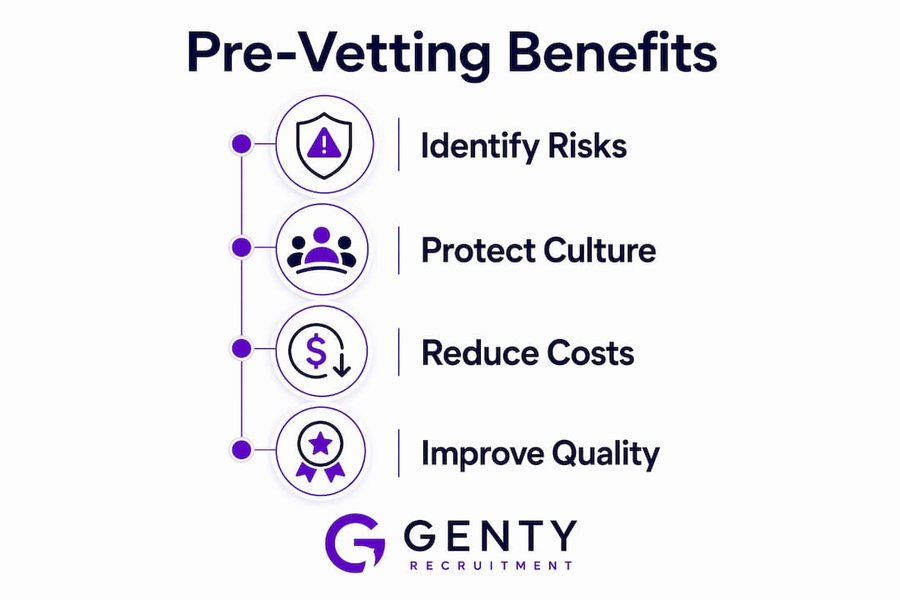
Beyond the financial argument, pre-vetting protects workplace culture and company reputation. A single bad hire in a 12-person startup affects a much larger share of the team than the same hire at a 5,000-person enterprise. The cultural damage compounds fast at small scale.
The most forward-thinking hiring managers now treat pre-vetting as more than a rearview mirror check. Modern pre-screening acts as an early-warning system that assesses current operational risks and job-relevant behaviors, not just historical records. That shift matters because a clean background check does not guarantee good judgment or role fit.
Here is how structured pre-vetting improves hiring quality at each stage:
- Filters out misrepresentation early. Catching credential inflation before the offer stage saves interview time and prevents awkward post-hire discoveries.
- Narrows focus to job-relevant risk. Structured assessments narrow inquiries to what actually affects role suitability, making the process legally defensible and practically useful.
- Protects the employer brand. Documented, non-discriminatory vetting processes reduce the risk of disputes and demonstrate fair hiring practices to candidates and regulators alike.
- Improves offer acceptance rates. Candidates who experience a transparent, well-organized vetting process view the company as professional. That perception influences their decision to accept.
How to tailor pre-vetting strategies to different roles
A one-size-fits-all background check is inefficient and legally risky. Role-based risk tier frameworks prevent unnecessary exhaustive screening and reduce both legal exposure and process inefficiency. The right approach is to categorize roles by their access level, financial responsibility, and team impact, then assign a check package accordingly.
This tiered model keeps your process proportionate. Running a full financial history check on a junior QA analyst wastes time and may create legal exposure if the check is not clearly job-relevant. Running only a basic check on a developer with access to your production database is a different kind of risk.
Technical roles require one additional layer that non-technical roles do not: skills verification tied to the actual work. Confirming that a candidate holds an AWS Solutions Architect certification is straightforward. Confirming that they can apply it under real conditions requires a structured technical assessment. Gentyrecruitment uses both credential verification and structured technical assessments to validate that candidates meet the actual demands of the role, not just the resume description.
Pro Tip: Build your role tier framework before you open a requisition, not after. Defining the check package at the job description stage prevents delays and keeps your process consistent across hiring managers.
What are modern tools and best practices for pre-vetting in tech startups?
Technology has changed the speed of pre-employment screening significantly, but it has not replaced the need for human judgment. The most effective vetting process combines both.
- Automated screening platforms handle identity checks, criminal database queries, and employment verification at speed. They work well for high-volume, lower-risk checks where data sources are reliable and standardized.
- Human researchers for primary record verification. Effective vetting relies on trained human researchers verifying original court and credential records directly. Automated data aggregators pull from secondary databases that can be outdated or incomplete. For senior or high-risk roles, primary source verification is not optional.
- FCRA-compliant processes. Professional screening services reduce legal exposure compared to informal online searches. Non-discriminatory, documented vetting protects employers against disputes and reputational harm.
- Candidate transparency throughout. Candidates must receive a chance to respond to any contested vetting results. This requirement is both a legal obligation under FCRA and a practical way to catch data errors before they cost you a good hire.
- Dispute and clarification workflows. Build a clear internal process for handling discrepancies. A candidate whose employment dates differ by two months from your verification result deserves a conversation before you withdraw their offer.
The importance of vetting candidates extends to remote hiring, where you cannot rely on in-person signals. For distributed tech teams, digital verification tools combined with structured video-based assessments give hiring managers the confidence they need to extend offers across borders. Gentyrecruitment’s approach to vetting remote candidates applies this combined model specifically to Latin American tech talent for US and European companies.
Key Takeaways
Pre-vetting is the single most cost-effective step a tech startup can take to reduce bad hire risk, and it works only when it is structured, role-specific, and legally compliant.
Pre-vetting in 2026: what I’ve learned from watching startups get it wrong
Most startups I have worked with treat pre-vetting as a checkbox at the end of the hiring process. They run a basic background check after the verbal offer, cross their fingers, and move on. That sequence is backwards, and it costs them.
The smarter approach is to treat pre-vetting as a filter that runs in parallel with your interview process, not after it. By the time you reach the offer stage, you should already have verified employment history, confirmed credentials, and completed a structured skills assessment. The offer then becomes a formality rather than a gamble.
The other mistake I see consistently is conflating speed with efficiency. Startups rush vetting because they fear losing a candidate to a competing offer. But a rushed check that misses a credential discrepancy is not faster hiring. It is deferred risk. The hiring process pre-vetting steps that feel slow upfront are the ones that prevent six-figure mistakes six months later.
My honest recommendation for 2026: invest in role-based risk tiers before you need them. Build the framework when you are not under pressure to fill a seat. That preparation is what separates hiring teams that scale reliably from those that spend half their time fixing bad hires.
— Eugene
How Gentyrecruitment helps tech startups hire pre-vetted talent
Tech startups that want the benefits of thorough candidate screening without building the process from scratch have a direct path forward with Gentyrecruitment.
Gentyrecruitment specializes in pre-vetted IT recruitment for US and European tech companies hiring from Latin America. Every candidate goes through structured technical assessments, credential verification, and English proficiency checks before reaching your desk. The result is a shortlist of engineers, product managers, and tech leads who are qualified, verified, and ready to integrate into global teams. For startups in FinTech, AI, and SaaS that need to hire fast without cutting corners, Gentyrecruitment’s pre-vetted remote talent model removes the guesswork from the process entirely. Reach out to Gentyrecruitment to see how the process works for your next hire.
FAQ
What is pre-vetting in hiring?
Pre-vetting in hiring is the process of verifying a candidate’s background, credentials, and job-relevant qualifications before extending an offer. It goes beyond resume review to include employment verification, criminal checks, and skills assessments.
Why does pre-employment screening matter for tech startups?
Bad hires can cost over 30% of a candidate’s first-year earnings. For small teams, one wrong hire disrupts culture and productivity at a scale that larger companies absorb more easily.
What does FCRA require during candidate vetting?
The Fair Credit Reporting Act requires employers to obtain written disclosure and consent from candidates before running any background check. Candidates must also receive a chance to dispute inaccurate results before a hiring decision is finalized.
How should vetting depth vary by role?
Roles with access to production systems, financial data, or leadership authority require deeper checks, including financial history and primary source credential verification. Junior or short-term roles need lighter packages focused on identity and basic employment confirmation.
How to vet applicants for remote tech roles?
Remote candidate vetting combines digital identity verification, structured technical assessments, and direct credential confirmation with issuing bodies. Human researchers should verify primary records for senior roles rather than relying solely on automated data aggregators.