

For most US and European tech teams, hiring in Latin America takes roughly as long as hiring at home for the same role, and it can take much less when the process is built for the region. Senior engineers run longer than SDRs, executives longer than both, and the biggest delays usually sit inside your own process: scheduling gaps and slow decisions, not a shortage of candidates. This guide gives you the benchmarks by role, the stages where time disappears, and a plan to compress the calendar without lowering the bar. At GENTY recruitment, we deliver curated shortlists within 7 days, which is the starting point for the timelines below.
TL;DR
- Time to hire counts from an open requisition to an accepted offer’s decision point; time to fill runs until the person actually joins. Track both, because each exposes a different problem.
- Published 2026 medians put US time-to-hire at 44 days and tech roles at 50 to 60 days, with role medians from 22 days for SDRs to 60 for senior engineers and about 90 for VP-level hires.
- The slowest stages are the gap between application review and recruiter screen, and the wait between screen and first interview.
- LATAM timezone overlap with US Eastern and Pacific lets you run interview loops in a single day, which is the cleanest way to shorten the calendar.
- GENTY recruitment’s fixed-fee model starts at $2,999 per hire, with no upfront payments and a 3-month replacement guarantee.
What time to hire actually measures
Before comparing numbers, make sure you are comparing the same clock. HR Dive reports the common definition: time to hire runs from the moment a requisition opens to the day the offer is made, while time to fill ends when the hire joins the company. Some teams instead start the clock when a candidate enters the pipeline, which produces much shorter figures. If a benchmark does not say where its clock starts, treat it as directional.
The two metrics answer different questions. Indeed’s employer guidance explains that a high time to fill with a relatively low time to hire points to a sourcing or attraction problem, while both being high means delays are spread across the whole process. For LATAM hiring this matters in a specific way: notice periods and contractor onboarding add days after the offer, so your time to fill will always run longer than your time to hire. We cover the fill side in our guide to time to fill metrics.
Time to hire benchmarks by region
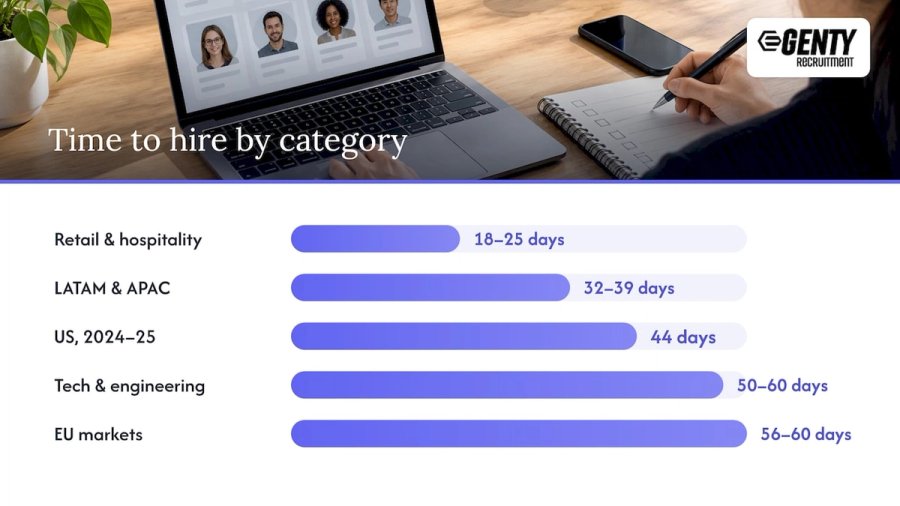
The most useful regional comparison we found comes from Raffi Research’s 2026 benchmark report. It puts the US median at a record 44 days for 2024 to 2025, up from 38 days in 2020, with EU markets at 56 to 60 days and LATAM and APAC at 32 to 39 days. The same report shows tech and engineering roles at 50 to 60 days, against 18 to 25 days for retail and hospitality.
Before you start hiring
Check location, salary, and hiring fit
If you are moving from research to action, start with the market basics so your hiring plan is clearer.
Two cautions when you use these numbers. First, regional medians blend every industry, so a LATAM figure of 32 to 39 days includes high-volume roles that close fast. Second, a median describes the middle of the pack, not a target. A startup with a clear scorecard and one-day interview loops can beat it comfortably, and a company with five interview rounds and a committee sign-off will miss it.
The practical reading for a CTO in New York or Berlin: the region itself is not the slow part. The candidate pool in Brazil, Mexico, Argentina and Colombia is deep enough that the calendar is set mainly by how quickly you screen, interview and decide.
Time to hire by role: engineers, DevOps, data and sales
Role seniority moves the clock more than geography. The table below combines the role medians reported by Raffi Research with the typical shortlist timing we work to at GENTY recruitment. The medians are general market figures, not LATAM-only, so use them as the baseline you are trying to beat.
The same report notes C-level searches often stretch to around six months. For executive roles, a dedicated process pays for itself in avoided delay, which is why we run executive search for LATAM leaders as a separate service.
A few LATAM-specific patterns we plan around:
- Software engineers in Argentina and Brazil. Strong supply, but senior engineers often hold several offers at once. Slow feedback loses them, so decide within days of the final interview.
- DevOps and cloud engineers in Mexico and Colombia. Pools are narrower for Kubernetes and platform specializations, so sourcing takes longer than interviewing. Start outreach before the job description is final.
- SDRs and AEs. English-fluent sales talent is concentrated in Mexico City, Bogotá, São Paulo and Buenos Aires. Short loops make 3 to 4 weeks realistic.
For role-specific sourcing detail, see our guides on hiring software developers and software engineer recruiting.
Where the days go: the slowest hiring stages
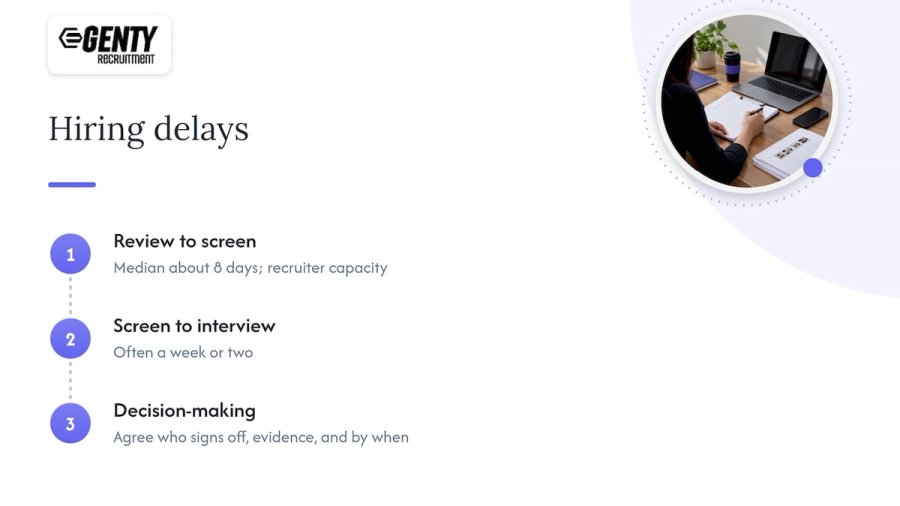
Most of the calendar is waiting, not evaluating. The Raffi report identifies the longest single delay in the funnel as the step from application review to recruiter screen, at a median of about 8 days, driven by recruiter capacity. Candidates feel that wait directly: the longer it takes to hear back, the more likely a strong engineer accepts something else.
The second gap is scheduling. Hiring benchmarks from other sources describe the stretch between a screen and the first interview as a major bottleneck, often a week or two. Cross-border hiring can make this worse when interviewers and candidates are many time zones apart and every slot requires negotiation.
A third source of delay is decision-making. As HireQuest’s CEO told HR Dive, too much time can diminish an opportunity for hire, and setting expectations across the board is crucial to avoid losing top talent to slow decisions. For a founder, that means agreeing before the search who signs off, on what evidence, and by when.
Factors that speed up or slow down hiring in LATAM
Speeds up:
- Timezone overlap that allows same-day interview loops
- A pre-agreed skills scorecard shared with every interviewer
- A compensation range approved before outreach starts
- Pre-vetted shortlists, so screening is done before your team’s first call
Slows down:
- Sequential interviews booked one at a time across weeks
- Take-home assignments with no review deadline
- Offers that ignore local market expectations on pay and contractor terms
- Background checks started after the offer rather than in parallel (see our overview of background checks in Latin America)
When your own recruiting team is stretched thin, process tooling helps with the capacity side of this problem. A comparison of project management tools for recruitment agencies shows how teams track scheduling and handoffs so candidates do not sit idle between stages.
The timezone advantage in practice
Nearshore alignment is the structural reason LATAM can beat other offshore regions on calendar time. Mexico City sits on or near US Central time, Colombia lines up with US Eastern, and Brazil and Argentina are one to two hours ahead of Eastern for most of the year. That gives US East Coast and West Coast teams a working overlap of several hours with every major LATAM hub, and European teams a usable late-afternoon window.
For hiring, that overlap changes the shape of the process:
- Screens and panels in the same day. A technical interview, a system design round and a founder conversation can happen back to back, instead of across three weeks of calendar tetris.
- Fast feedback. Debriefs happen the same afternoon, not the next morning in a different time zone.
- Offer calls with real conversation. Compensation, start date and contractor terms get settled live.
An EST or PST team that compresses its loop into two days removes the largest controllable block of delay in the table above.
How to cut time to hire without lowering the bar
Speed and quality are not opposites, but rushing the wrong step is. Greenhouse’s 2026 guidance cautions that the goal of tracking time to hire is not to race through the process: rushing a second-round interview risks the wrong hire and a poor candidate experience. The right target is removing idle time, not evaluation time.
A six-step plan for a 2 to 3 week timeline
- Write the scorecard first. List four to six outcomes for the role, such as shipping a service to production within 90 days. Interviewers score against the same list, which shortens debriefs.
- Fix the pay range before outreach. Set it against the local market for the country you are hiring in. Our LATAM salary benchmarking service exists for this step.
- Start with a vetted shortlist. Receiving three to five screened candidates in the first week removes the 8-day screening queue entirely. With GENTY recruitment, shortlists are curated within 7 days.
- Batch interviews into one or two days. Use timezone overlap to run technical and culture rounds consecutively.
- Set a decision deadline. Commit to feedback within 24 hours of the final round and an offer within 48.
- Run checks in parallel. Reference and background checks begin when the final round is scheduled, not after the offer.
Industry guidance on best-in-class teams suggests the fastest performers reach 14 to 21 days for engineers and 10 to 16 days for sales roles through parallel stages and less scheduling lag. That is the standard to aim for if you hire repeatedly in the region.
A quick self-audit checklist
- [ ] Do you know where your clock starts and stops?
- [ ] Is there a named decision-maker for each stage?
- [ ] Are interview slots held in advance for the week the shortlist arrives?
- [ ] Is the compensation range approved?
- [ ] Do candidates hear back within two business days at every stage?
If you can tick all five, your timeline will track the faster end of the benchmarks regardless of role.
Where GENTY recruitment fits
We built our process around the stages that consume the calendar. Our recruiters work by vertical, our shortlists are triple-vetted and delivered within 7 days, and pricing is a transparent fixed fee per seniority level with no upfront payments. Every placement carries a 3-month replacement guarantee.
- IT recruitment for software engineers, DevOps and data specialists, from $2,999 one-off per hire.
- Sales recruitment for SDR and AE teams, from $2,999 one-off per hire.
- Recruitment process outsourcing when you are hiring several roles at once and want a dedicated pipeline.
- Staffing, from $99 per month per employee.
Tell us the role, the country and your timeline at gentyrecruitment.io, and we will map it against the benchmarks above.
Our perspective
Time to hire is a process metric, and most of the time you can win back is inside your own calendar. When we work with CTOs and founders, the pattern is consistent: the candidates exist in Brazil, Mexico, Argentina and Colombia, and the delay comes from late screening, slow scheduling and unclear decision rights.
That is why we focus exclusively on Latin America and assign recruiters by vertical. A recruiter who works only on engineering talent in the region knows which candidates are active, what they expect to earn and how quickly they need an answer. Our skill-first process is designed to put a curated shortlist in front of you within 7 days, so your team starts at the interview stage rather than the screening queue.
We also believe the cost of a hire should be predictable. A fixed fee by seniority, no upfront payment and a 3-month replacement guarantee let you plan the search the way you plan a sprint. Combined with timezone overlap that lets you finish interview loops in a day or two, it is how we help teams hire faster and still save up to 40% compared with US or European hiring.
Eugene
FAQ
What is a good time to hire for a LATAM software engineer?
A realistic target is 3 to 4 weeks from kickoff to accepted offer for a mid-level engineer, and 4 to 6 weeks for senior roles. Published medians for engineering roles are 45 to 60 days, so beating them requires a pre-vetted shortlist and interview loops completed within a couple of days.
Is hiring in Latin America faster than hiring in the US or Europe?
Published 2026 benchmarks show LATAM medians of 32 to 39 days against 44 days in the US and 56 to 60 days in the EU. Timezone overlap with US teams also makes it easier to schedule interviews and give feedback quickly.
How is time to hire different from time to fill?
Time to hire measures from an open requisition to the offer, while time to fill measures until the candidate actually joins. In LATAM, notice periods and contractor onboarding mean time to fill is longer, so track both.
How long does it take to hire SDRs and account executives in Latin America?
Sales roles close fastest. Market medians are about 22 days for SDRs and 32 for account executives, and a focused process can bring them to 3 to 4 weeks. Short loops and a pre-agreed commission structure keep candidates engaged.
Sources
- What is ‘time to hire,’ and why does it matter? | HR Dive
- Time to Fill vs. Time to Hire | Indeed
- Time to hire benchmarks 2026 | Raffi Research
- What is time-to-hire? | Greenhouse