

There is no single Latin American developer salary, and any article that gives you one number is hiding the spread. In the first half of 2026, Deel’s data put median annual pay for software developers at US$66,000 in Brazil, US$56,000 in Mexico and Chile, US$46,000 in Argentina and US$43,000 in Colombia. Seniority, English level, stack and whether the person works for a foreign company move those numbers by tens of thousands of dollars. This guide shows how to read the ranges, where the published figures disagree, and how to turn them into a budget for a US or European team. At GENTY recruitment we place engineers, DevOps and data specialists across these markets, and the budgeting logic below is the one we would give a CTO before the first search starts.
TL;DR
- Remote software developer medians in H1 2026 ran from US$43,000 (Colombia) to US$66,000 (Brazil), with Argentina at US$46,000 and Mexico and Chile at US$56,000.
- Published ranges conflict because they measure different things: local employer pay, self-reported total compensation, remote contract pay and agency billing rates.
- Budget on total cost to you: base pay, employer-side costs or contractor rate, and any intermediary fee, not on the headline salary.
- Time zones are a real part of the value: Brazil and Argentina overlap US Eastern hours well, Colombia sits on Eastern-like hours, and Mexico overlaps Central and Pacific teams.
- Role matters: AI/ML, DevOps and senior backend profiles sit at the top of each country’s range.
What developers earn in Latin America in 2026
Start with the most useful single comparison: Deel’s payroll data on software developers working remotely across the region. Deel is a global payroll and compliance platform, and its 2026 Global Compensation Report was summarized by Mexico Business News in August 2026.
Both columns come from the Deel report coverage, and the developer column is repeated in Bloomberg Línea’s reporting on the best-paid remote jobs of 2026.
Three things stand out.
- Software pay sits well above the all-roles median everywhere. In Mexico the developer median is more than double the all-roles figure, and in Colombia it is roughly double. Engineering is one of the few remote categories where Latin American pay is priced against global demand rather than the local market.
- Brazil is the most expensive of the big markets, and also the deepest. A larger pool of senior engineers means more choice at each price point, but also more competition from multinational employers.
- Colombia and Argentina give the most headroom per dollar. The Deel gap between Brazil and Colombia for all remote roles is about 2.4 times, which is why many US startups build a distributed team across two or three countries instead of concentrating in one.
These are medians, so half of developers earn more. A senior backend engineer with strong English and fintech or infrastructure experience will usually be above the median in any of these countries.
What do you need?
Choose the hiring path that fits
After reading "Developer Salaries in Latin America 2026: Ranges by Country", most teams compare these options before deciding how to hire.
A second data point: Brazil in local currency
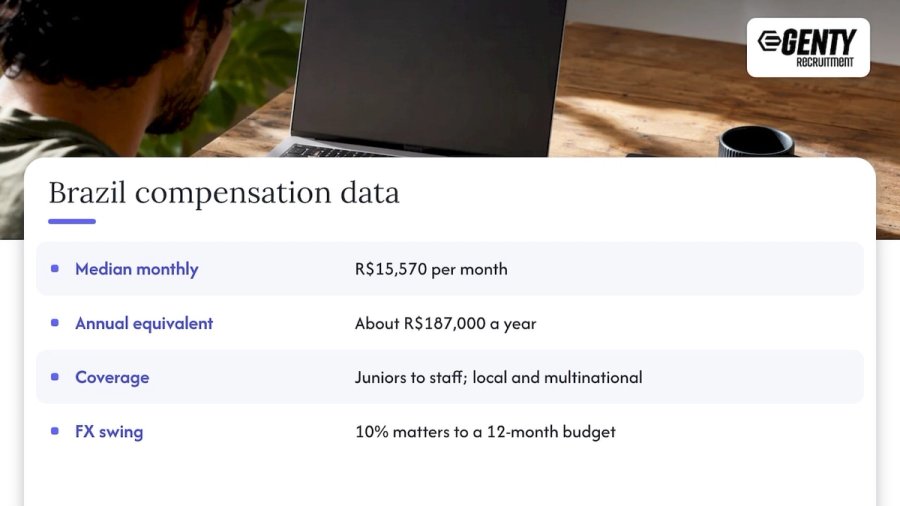
Self-reported data gives a useful cross-check. Levels.fyi, which collects total compensation submitted by engineers, lists the median software engineer in Brazil at R$15,570 per month, about R$187,000 a year. That figure covers everyone from juniors to staff engineers, many of them at local employers or multinationals, and it moves with the real-to-dollar exchange rate. The practical lesson: if a candidate quotes you in reais, pesos or Colombian pesos, convert at the rate on the day of the offer and decide in the contract whether the salary is fixed in dollars or in local currency. An exchange-rate swing of 10% matters more to a 12-month budget than most negotiation wins.
Why published salary numbers disagree
Search this topic and you will find senior Latin American engineers priced at $40,000 in one guide and $80,000 in another. Both can be accurate. The differences usually come from five places:
- Who is measured. Local-market pay for a company in São Paulo or Bogotá is lower than pay from a US employer hiring remotely.
- What is measured. Net pay, gross salary, total compensation with bonuses, employer total cost and agency billing rate are five different numbers for the same person.
- Seniority definitions. A “senior” with five years in one report is an eight-year tech lead in another.
- Sample size and source. Self-reported platforms favor people at larger tech firms; payroll platforms see only the people hired through them.
- Currency timing. Figures converted at different exchange rates in the same year can differ by double digits in Argentina and Brazil.
When you compare quotes or reports, write down which of the five a number is before you compare it with anything else. That one habit removes most of the apparent contradictions.
Salary by role: where the premiums are
Role is the second biggest driver after country. We keep deeper pages on the roles our clients hire most; the pattern is consistent across them:
- AI and machine learning engineers are at the top. In Colombia, AI and ML specialists are the best-paid remote tech workers at US$52,143 a year, well above the country’s US$43,000 developer median. Our breakdown is in AI engineer salaries in Latin America.
- DevOps and platform engineers command senior-level pay even at mid-level experience because the supply is thin. See DevOps salaries in Latin America.
- Backend specialists in Python and Go are priced by stack scarcity. Go is the smaller pool, which shows in offers: Python developer pay in LATAM and Golang developer pay in LATAM show the gap.
- Frontend developers, including React specialists, have the deepest supply and the most predictable offers. See React developer pay in LATAM.
A workable rule for planning: take the country’s developer median as the mid-level anchor, expect senior generalists to land above it, and expect scarce specialties (AI/ML, platform, Go, security) to land well above it.
English fluency and the foreign-employer premium
Two factors lift salaries beyond the country and role. The first is whether the employer is foreign: a developer working for a US company is competing against dollar-denominated offers, not local ones. The second is English. Candidates who can run a stand-up, write clear design docs and handle a customer call are the ones US companies bid for, and they are priced accordingly. We cover why this matters for hiring decisions in LATAM English proficiency. The practical consequence for your budget: do not search for a bargain on English. A candidate with weaker spoken English is cheaper, but the saving disappears the first time a product manager has to relay every conversation.
Turning a salary into a real budget
The salary on a job ad is not what the hire costs you. Build the budget in four layers.
1. Base compensation
Use the country medians above as the anchor, then adjust for seniority, stack and English. Decide whether you pay in US dollars or local currency. Many remote engineers prefer dollars, and offering them simplifies your forecast.
2. Employment structure
There are three routes, and they change the total:
- Direct employment through a local entity gives the most control, but needs a legal entity, local payroll and benefits administration in each country.
- Employer of record (EOR) places the person on a local compliant payroll without you opening an entity. It is the common route for teams of one to a few dozen people. Our remote staffing and EOR service starts at $99 per employee per month.
- Independent contractor is the fastest to start, but carries worker-misclassification risk if the person works full-time under your direction. Rules differ by country, so get local legal advice before putting a full-time engineer on a contractor agreement.
3. Employer-side costs
In most Latin American countries, mandatory contributions, bonuses and benefits add a significant percentage on top of base pay for employees, and the percentage differs by country. Ask your payroll or EOR provider for a country-specific cost sheet instead of using a regional rule of thumb. Our overview of hiring costs in Latin America for US tech employers walks through the line items.
4. Recruiting cost
This is where the biggest range sits. A percentage-of-salary agency fee grows with every salary you approve. A fixed fee does not. GENTY recruitment charges from $2,999 one-off per hire for recruitment, with no upfront payment and a 3-month replacement guarantee, so the fee stays the same whether the hire lands at the median or above it.
Worked example: a three-engineer squad
Suppose you are hiring a backend engineer in Brazil, a full-stack engineer in Mexico and a DevOps engineer in Colombia, all at the Deel developer medians:
That is the starting line, not the final cost. Because DevOps is a scarce specialty, plan for the Colombian hire to land above the country median. Then add employer-side costs for each country and the EOR or staffing fee. Adding recruiting at the listed from-price of $2,999 per hire gives $8,997 in one-off recruiting fees for the three hires. The point of the exercise is to decide a ceiling per role before the first interview, so a strong candidate never forces an unplanned conversation about budget.
Country-by-country notes for hiring managers
Brazil
The biggest talent pool and the highest median. Portuguese is the working language locally, so confirm spoken English early. Brazil’s time zone is close to US Eastern, which gives you most of the working day in common.
Mexico
The strongest option for teams on US Central and Pacific time, because the working day lines up with minimal adjustment. Mexico’s developer median is more than double its all-roles median, which signals how much US demand is shaping pay for engineers. That also means you compete with US firms for the strongest candidates.
Argentina
A mature engineering culture with strong English and a lower median than Brazil or Mexico. Currency volatility makes contract currency a real decision here, so write down the currency and the review date in the offer.
Colombia
The lowest developer median of the five, strong for early-stage and mid-level roles, with Eastern-hours overlap that suits teams on the US East Coast and in Europe’s afternoon. AI/ML talent here is already paid well above the country median.
Chile
A smaller pool than Brazil or Mexico with a median equal to Mexico’s. Hire here for specific profiles rather than volume.
Timezone overlap as part of the price
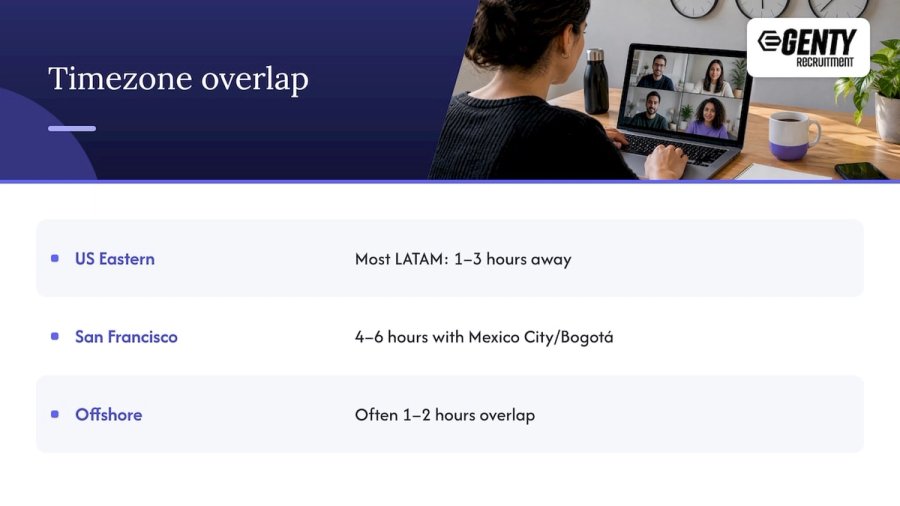
Salary savings only count if the engineer is online when your team is. Most of Latin America sits within one to three hours of US Eastern time, so a New York team and a Bogotá or São Paulo engineer share nearly the full workday, and a San Francisco team still shares four to six hours with Mexico City or Bogotá. Compare that with offshore hiring, where overlap is often a one- or two-hour window. Overlap shortens review cycles, makes on-call rotations workable and lets a junior ask a senior a question in real time. Budget the saving from overlap as less rework, not as a number on the offer letter.
Checklist before you set a salary band
- Define seniority by scope (owns a service, leads a team), not by years.
- Name the pay basis: gross salary, total compensation or contractor rate.
- Pick the currency and the review date.
- Choose the employment route: entity, EOR or contractor, with local legal advice for contractors.
- Get a country-specific employer cost sheet.
- Set a ceiling per role, with room above the median for scarce stacks.
- Confirm the working-hours overlap you need with your team.
- Decide how you will test spoken English before the final round.
Where GENTY recruitment fits
If you already know the country and role, the slow part is sourcing and vetting people who meet the range and speak English well. Our IT recruitment service delivers curated shortlists within 7 days through a skill-first process, with dedicated recruiters per vertical, a fixed fee from $2,999 per hire and no upfront payments. If you need to set or test a band first, we also do salary benchmarking, and for a full distributed team we cover RPO. Our guide on how to hire remote developers covers the process end to end, and how much it costs to hire a developer breaks down the cost side.
To scope a role, start from the GENTY recruitment site and tell us the country, stack and seniority you need.
Our view on LATAM developer pay
Founders usually ask us for the average salary, and we steer them away from the average. The useful question is what this specific role costs in this specific country at the seniority you need, paid in the currency you choose, through the employment route you choose.
We see the market in two tiers. The first is the deep middle of each country’s market, where supply is large and offers are predictable. The second is the scarce specialties: senior platform, AI/ML and Go engineers, where pay is set by global demand. Treat them as two different budgets.
That is why we recruit by vertical, with dedicated recruiters, and why our fee is fixed per seniority level. You should know your recruiting cost before the search starts, and it should not rise because you chose a stronger candidate. The 3-month replacement guarantee and no upfront payments mean the risk of the search sits with us.
Our advice: set the ceiling first, hire for the overlap hours you need, and keep one engineer on your team who has done this before.
Eugene
FAQ
What is the average developer salary in Latin America in 2026?
There is no single figure, but Deel’s H1 2026 medians for software developers range from US$43,000 in Colombia to US$66,000 in Brazil. Mexico and Chile sit at US$56,000 and Argentina at US$46,000. Senior and specialist roles land above these medians.
Which Latin American country is cheapest for hiring developers?
On Deel’s 2026 medians, Colombia is lowest at US$43,000, followed by Argentina at US$46,000. The cheapest median is not always the cheapest hire: scarce skills such as AI/ML are paid above the country median even in Colombia.
Is a contractor cheaper than an EOR?
A contractor has no employer-side payroll costs, so the monthly line is lower. A full-time engineer working under your direction can be reclassified as an employee in some countries, so confirm the rules with local counsel. An EOR puts the person on compliant local payroll; ours starts at $99 per employee per month.
Why do salary reports show such different numbers?
They measure different things: local pay versus remote pay, net versus gross, total compensation versus contractor rates, and different seniority definitions. Identify the basis of each figure first, then compare.
Sources
- Mexico’s remote salaries lag behind regional leaders, Deel finds (Mexico Business News)
- Los trabajos remotos mejor pagados en 2026 en Latinoamérica (Bloomberg Línea)
- Software Engineer Salary in Brazil (Levels.fyi)