

Leadership hiring is defined as the deliberate, outcome-driven process of recruiting senior executives — CXOs, VPs, and directors — to deliver measurable business results within an 18–24 month horizon. Unlike standard recruitment, which fills roles based on skills and experience, leadership hiring targets business transformation. For tech startups and scale-ups in the US and Europe, this distinction matters enormously, especially when building leadership teams across LATAM markets like Argentina, Brazil, Mexico, and Colombia. The typical search takes approximately 130 days from initiation to placement, which means every decision in the process carries compounding risk.
What is leadership hiring and how does it differ from regular hiring?
Leadership hiring is a specialized discipline within executive talent acquisition. It focuses on appointing leaders who can change the trajectory of a business, not just manage a function. The difference from traditional recruiting is structural, not cosmetic.
Standard hiring starts with a job description listing required skills and experience. Leadership hiring starts with a business problem. Before writing a single requirement, the hiring team must answer: what must this leader accomplish in the next 6–18 months? Replacing long job descriptions with concise one-page results sheets that define near-term deliverables produces sharper candidate alignment and faster decision-making. Founders often confuse a title with a mission, and that confusion is where most leadership hires go wrong.

The timeline difference is significant. A standard software engineer search might close in 30–45 days. A VP of Engineering or Chief Revenue Officer search runs closer to 130 days because the process involves proactive outreach to passive candidates who are not browsing job boards. These executives are already succeeding somewhere else. Reaching them requires a personalized pitch, not a posting.
Before you start hiring
Check location, salary, and hiring fit
If you are moving from research to action, start with the market basics so your hiring plan is clearer.
The cultural lens distinction deserves attention. Hiring for cultural contribution rather than cultural fit means selecting leaders who will evolve the organization, not simply conform to it. For a startup moving from seed to Series B, a leader who challenges existing assumptions is more valuable than one who blends in.
Pro Tip: Before posting any senior role, write a one-page results sheet listing three to five concrete deliverables for the first 18 months. If you cannot write it, you are not ready to hire.
How to define and assess leadership roles in tech startups hiring in LATAM
Role clarity is the single biggest predictor of a successful leadership hire. Diagnosing the company’s context — whether it is in startup mode, growth phase, or turnaround — before drafting a candidate profile prevents the most common and costly mismatch: hiring a scaling operator when you need a builder, or vice versa.
A well-constructed leadership role definition includes four elements: the mission (what the leader must accomplish), the authority (what decisions they own), the success measures (how performance is evaluated at 30, 60, and 90 days), and the support structure (who they report to and what resources they control). Without all four, candidates cannot assess whether the role fits their strengths, and hiring teams cannot evaluate candidates against a consistent standard.
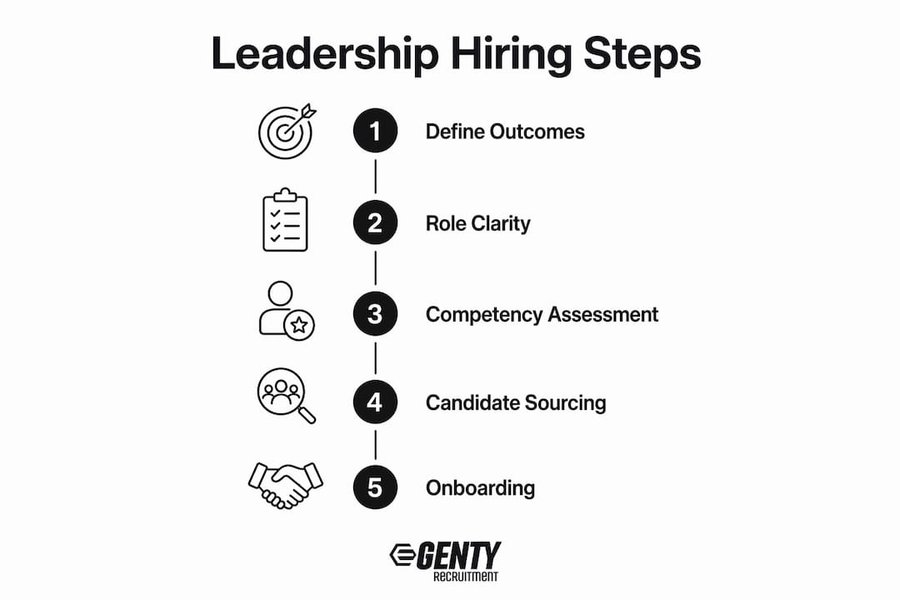
For tech leadership roles, five competencies consistently separate high performers from average ones:
Structured competency-based interviews, including the STAR method, produce significantly more reliable assessments than unstructured conversations. They also align with EEOC guidance on fair and consistent evaluation, which matters when hiring across borders. For LATAM-based candidates, adding a cultural adaptability dimension to the scorecard reflects the real demands of leading distributed teams across Argentina, Brazil, Mexico, and Colombia.
Salary competitiveness in LATAM is a genuine advantage for US and European startups. Senior engineering leaders in Argentina and Colombia typically cost 40–50% less than equivalent US-based hires, while offering strong English proficiency and full overlap with US EST and PST working hours. That cost efficiency does not come at the expense of quality. LATAM leadership talent pools in FinTech, SaaS, and AI have grown substantially over the past five years.
Pro Tip: Use a structured hiring scorecard with numeric ratings for each competency. Gut-feel assessments introduce bias and make post-hire accountability nearly impossible.
How do you source and engage leadership candidates in LATAM?
Proactive, personalized outreach is the only reliable method for reaching top leadership candidates. Top-tier executives need to be sold on a role with a clear articulation of impact, authority, and support. A generic LinkedIn message about an “exciting opportunity” does not move them.
The most effective sourcing channels for LATAM leadership roles include:
- Executive search firms with established LATAM networks and country-specific market knowledge
- LinkedIn Recruiter with Boolean search filters targeting senior titles in Argentina, Brazil, Mexico, and Colombia
- Professional networks and alumni communities at major LATAM universities and tech hubs
- Industry conferences in FinTech, SaaS, and AI across São Paulo, Buenos Aires, Bogotá, and Mexico City
- Referral programs that incentivize current senior employees to recommend peers
The outreach sequence matters as much as the channel. Passive candidate outreach requires personalization aligned with each candidate’s career trajectory. The first message should reference a specific achievement or project, not a job title. The second message should introduce the mission and the problem the company is solving. The employer’s identity is often withheld until trust is established, which protects both parties and keeps the conversation focused on fit rather than brand perception.
Timezone alignment is a practical advantage that hiring teams underestimate. LATAM markets share 4–8 hours of daily overlap with US EST and PST zones. That overlap means a VP of Product based in Buenos Aires can join a San Francisco leadership team’s morning standup without anyone working unusual hours. LATAM provides significant timezone overlap with US markets, making cross-border leadership collaboration genuinely workable, not just theoretically possible.
Building a compelling leadership value proposition also requires honesty about the company’s current stage. Executives who have led growth-stage companies want to know the real challenges, the board’s expectations, and the resources available. Overselling the role creates misalignment that surfaces within the first 90 days.
What does effective leadership onboarding look like?
New leaders most often fail not because of skill gaps but because of context failure. Many leadership failures occur when new hires are unprepared for organizational realities: unclear authority, misaligned expectations, and insufficient support in the first 90 days. Structured onboarding prevents this.
Pre-onboarding begins before the start date. The hiring team should share organizational charts, key stakeholder bios, current OKRs, and any active crises or priorities. The new leader should arrive on day one with context, not questions.
A 30-60-90 day plan for leadership onboarding should include:
- Days 1–30: Stakeholder mapping, listening sessions with direct reports, review of current metrics and roadmaps
- Days 31–60: Identify two to three quick wins, begin building team trust, align with the CEO or board on 6-month priorities
- Days 61–90: Present a 90-day assessment to leadership, propose structural or process changes, establish reporting cadence
For LATAM-based leaders joining US or European companies remotely, onboarding must account for the distributed context. Scheduled video check-ins, clear async communication norms, and early introductions to cross-functional counterparts reduce the isolation that remote leaders often experience in their first quarter.
Hiring your first senior leader requires investing as much effort in the 90 days after the offer as in the search itself. The search finds the right person. Onboarding determines whether they succeed.
Pro Tip: Assign a peer mentor from the leadership team for the new hire’s first 60 days. Peer mentors accelerate cultural integration faster than any formal onboarding document.
Key Takeaways
Effective leadership hiring requires outcome-defined roles, structured assessment, proactive sourcing, and disciplined onboarding to produce lasting business impact.
Why I think most startups get leadership hiring backwards
The conventional wisdom says: write a job description, post it, interview the applicants, pick the best one. That process works reasonably well for individual contributors. For leadership roles, it is close to guaranteed to produce a bad hire.
What I have seen repeatedly is that startups rush leadership searches because they feel the pain of a gap acutely. A VP of Sales seat has been empty for three months, revenue is stalling, and the pressure to fill the role overrides the discipline to fill it correctly. Impatient hiring managers significantly increase the risk of catastrophic leadership mistakes. The cost of a wrong leadership hire, including severance, lost momentum, and team disruption, routinely exceeds the annual salary of the role itself.
The LATAM opportunity is real, but it requires the same rigor. I have seen US startups treat LATAM leadership searches as a cost-cutting exercise rather than a talent strategy. They hire a cheaper executive without doing the context diagnosis, the structured assessment, or the proper onboarding. The result is the same failure they would have had with a US hire, just with a smaller invoice.
The mindset shift that produces results is treating leadership hiring as a strategic investment with a defined return. You are not filling a seat. You are acquiring a capability that should compound over 18–24 months. That framing changes how you define the role, how you evaluate candidates, and how seriously you take the first 90 days. Get those three things right, and the hire pays for itself many times over.
— Eugene
How GENTY recruitment accelerates leadership hiring in LATAM
Tech startups that need senior leadership talent in LATAM face a specific challenge: the best candidates are not looking, the market moves fast, and a wrong hire sets the company back by a year or more.
GENTY recruitment specializes in IT and leadership hiring across Argentina, Brazil, Mexico, and Colombia, with a skill-first process that delivers curated shortlists within 7 days. Fixed-fee pricing by seniority level, no upfront payments, and a 3-month replacement guarantee reduce the financial risk of every search. Clients consistently save up to 40% compared to equivalent US or European hires while gaining leaders who operate in full US timezone alignment. Contact GENTY recruitment to start your next leadership search with a team that knows the LATAM market from the inside.
FAQ
What is leadership hiring in simple terms?
Leadership hiring is the process of recruiting senior executives, such as CXOs and VPs, with a focus on delivering specific business outcomes rather than filling a role. It differs from standard recruitment by targeting passive candidates and defining success through 18–24 month impact metrics.
How long does the leadership hiring process take?
The typical leadership hiring process takes approximately 130 days from search initiation to placement. That timeline reflects the complexity of proactive outreach, structured assessment, and executive-level decision-making on both sides.
What qualities should you look for in leadership candidates?
The most predictive qualities include execution under ambiguity, cross-functional communication, strategic thinking, team-building track record, and cultural adaptability. Structured competency-based interviews using the STAR method assess these qualities more reliably than unstructured conversations.
Why hire leadership talent from LATAM?
LATAM markets offer senior leadership talent at 40–50% lower cost than US equivalents, with full overlap across US EST and PST time zones. Argentina, Brazil, Mexico, and Colombia have growing executive talent pools in FinTech, SaaS, and AI sectors.
What causes new leadership hires to fail?
Most leadership failures are context failures, where new executives lack clarity on their authority, stakeholder relationships, and near-term priorities. A structured 30-60-90 day onboarding plan with pre-start preparation significantly reduces this risk.