

What is candidate experience, and what shapes it?
Candidate experience is the overall perception a job seeker forms from every interaction with your organization’s hiring process, starting from the moment they discover a job posting through application, interviews, offer negotiation, and onboarding. It is not a single touchpoint. It is the cumulative impression built across every email, every interview, every silence, and every decision communicated or withheld.
The core elements that shape this perception include:
- Job discovery and employer brand: How candidates first encounter your company, whether through a job board, LinkedIn, or a referral, sets the initial tone.
- Clarity of job descriptions: Vague or inflated role descriptions create misaligned expectations and drive early attrition.
- Application process usability: A friction-heavy application form signals organizational dysfunction before a candidate even speaks to a recruiter.
- Interview quality: Structure, preparation, and respectful treatment during interviews are among the most influential factors in offer acceptance decisions.
- Communication timeliness: Delays erode candidate enthusiasm and signal disrespect for their time.
- Fairness and consistency: Candidates evaluate whether procedures apply equally to everyone, a principle codified in Professor Stephen Gilliland’s procedural justice framework, which identifies 10 fairness rules for selection systems.
- Feedback quality: Timely, honest feedback, even for rejected candidates, protects employer reputation and keeps future talent pipelines open.
- Onboarding experience: The transition from candidate to employee is where hiring promises either hold up or fall apart.
Candidate experience directly influences whether top candidates accept offers, recommend your company to peers, or walk away and post a negative review. For US and European tech companies hiring in Latin America, where talent competition across Brazil, Argentina, Colombia, and Mexico is intensifying, getting this right is a concrete competitive advantage.
What makes a candidate experience genuinely positive?

A positive hiring experience does not happen by accident. It requires deliberate design across five interconnected dimensions.
What do you need?
Choose the hiring path that fits
After reading "Candidate Experience: What It Is and Why It Matters", most teams compare these options before deciding how to hire.

Technology and personalization
Applicant tracking systems, automated scheduling tools, and AI-assisted screening reduce administrative friction and speed up the process. But technology cannot replace human-centric interaction, particularly in cross-border recruitment where cultural nuances shape how candidates interpret automated responses. The right balance is automation for logistics and humans for relationship-building.
Key technology practices:
- Use candidate-facing portals where applicants can track their application status in real time.
- Automate scheduling and status updates, but personalize interview invitations and offer communications.
- Avoid over-relying on AI screening for senior or specialized roles where context matters.
Clarity and transparency
Candidates consistently reward organizations that communicate role expectations honestly. A job description that accurately reflects the day-to-day reality of a role reduces the “reality shock” that drives early attrition. Misalignment between the recruitment pitch and the actual job is one of the most documented causes of first-year turnover.
Practices that build clarity:
- Write job descriptions around specific deliverables, not generic responsibilities.
- Share team structure, reporting lines, and growth paths during the interview process.
- Communicate the hiring timeline upfront and update candidates when it shifts.
Fairness and consistency
Respectful treatment throughout the selection process improves organizational attractiveness and a candidate’s willingness to recommend the employer. Consistency matters just as much: candidates notice when procedures seem to vary by candidate, and that perception of inequity damages trust quickly.
Timeliness
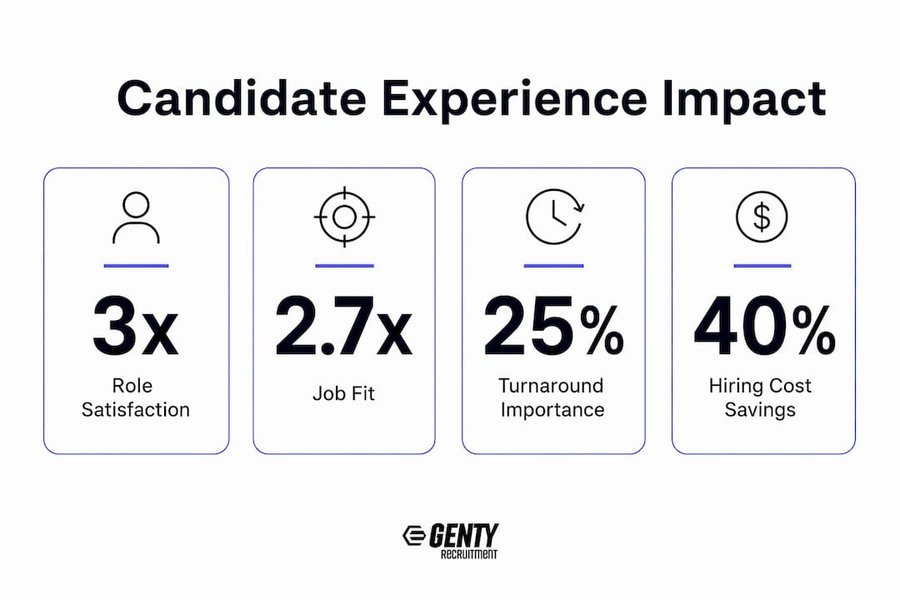
In 2023, 25% of employees identified turnaround time as the single biggest factor, outside of pay, influencing their decision to accept an offer. That figure was up from 22% in 2022. Speed through the hiring funnel communicates respect. Delays communicate indifference.
Personalization
Generic, templated communications feel transactional. Candidates who receive role-specific outreach, tailored interview preparation materials, and individualized feedback report higher satisfaction and stronger cultural connection. For LATAM candidates, personalization also means acknowledging timezone realities, conducting interviews at hours that respect their working day, and communicating in clear, accessible English.
Why positive candidate experience drives real business outcomes
The business case for investing in candidate experience is well-documented and direct. Employees who experienced an exceptional hiring process are 3 times more likely to be extremely satisfied in their role than those who did not. That satisfaction translates into retention, productivity, and cultural cohesion.
Candidates who go through a strong hiring process are also 2.7 times as likely to find their job as good as or better than expected, which directly reduces early-tenure attrition. The hiring process, in effect, is the prologue to the employee experience.
Poor candidate experience carries real costs. Rejected candidates who feel disrespected become vocal detractors. In tech markets where talent communities are tightly networked, particularly across LATAM hubs like Buenos Aires, São Paulo, Bogotá, and Mexico City, a reputation for poor hiring practices spreads fast and narrows your future applicant pool.
Best practices for each phase of the hiring process
Improving candidate experience requires action at every stage, not just during interviews.
Attracting candidates
- Write job descriptions that reflect your actual employer value proposition, not a wish list of qualifications.
- Be specific about compensation ranges, remote work policies, and growth opportunities.
- For LATAM roles, highlight timezone alignment with US EST/PST as a concrete working benefit, not just a logistical detail.
Application process
- Reduce application steps to what is genuinely necessary for screening.
- Confirm receipt immediately and set clear expectations for next steps.
- Use a system that lets candidates track their status without needing to follow up manually.
Interview communication
- Structure interviews around job-relevant competencies, consistent across all candidates.
- Brief interviewers before each session so candidates are not repeating their background story to every person they meet.
- Treat every interview as a two-way evaluation: candidates are assessing your culture as much as you are assessing their skills.
Feedback and post-process communication
Providing timely, informative feedback builds candidate trust and engagement, even for those who are not selected. Rejected candidates who receive honest, constructive feedback are far more likely to reapply in the future and recommend the company to peers. This is a low-cost, high-return practice that most organizations still skip.
Pro Tip: Treat every candidate interaction as a relationship, not a transaction. Research from SIOP consistently shows that organizations viewing hiring as relationship-building produce better long-term outcomes for both candidates and employers. This is especially true in LATAM markets, where personal rapport and mutual respect carry significant cultural weight.
Automation and AI can handle scheduling, status updates, and initial screening efficiently; see how NOWJOBS & ChatGPT enhance candidate experience to improve tech recruitment efforts. The human element, however, must remain central to feedback delivery, offer conversations, and any moment where a candidate’s career decision is at stake. Balancing AI-driven automation with personalized human interaction is particularly important in LATAM recruiting, where cultural nuances shape how candidates interpret every signal from a prospective employer.
How LATAM hiring shapes candidate experience for US tech companies
For US and European tech companies, Latin America offers a talent pool that combines technical depth with practical operational advantages. But realizing those advantages requires a candidate experience strategy built for the specific context of cross-border hiring.
Timezone alignment as a candidate experience factor
Brazil operates on BRT (UTC-3), and Colombia on COT (UTC-5), both of which overlap directly with US EST and PST working hours. This means interviews, feedback calls, and offer conversations can happen in real time without the scheduling friction that plagues hiring across Asia-Pacific or Eastern European time zones. Candidates notice when a company accommodates their schedule. It signals organizational maturity and genuine interest.
Cost and quality in LATAM markets
US and European tech companies save up to 40% in hiring costs by building nearshore pipelines in Latin America without sacrificing quality. Argentina and Brazil produce strong software engineering and data science talent. Colombia and Mexico have rapidly growing pools of DevOps, SaaS, and FinTech professionals. The cost efficiency does not come at the expense of candidate experience quality; it creates room to invest more in the hiring process itself.
Common pitfalls in cross-border candidate experience
- Sending templated, impersonal outreach that ignores local context.
- Scheduling interviews without accounting for local holidays or working norms.
- Failing to explain remote work infrastructure expectations clearly upfront.
- Underestimating the importance of cultural fit signals during interviews.
GENTY recruitment’s skill-first hiring process addresses these pitfalls directly. By delivering pre-vetted shortlists within 7 days, using fixed-fee pricing per seniority level, and providing a 3-month replacement guarantee, GENTY recruitment removes the friction points that most damage candidate experience in cross-border tech hiring. Companies hiring remote LATAM talent through a structured process like this one consistently report stronger candidate satisfaction and faster time-to-hire.
Actionable steps for US tech companies hiring in LATAM:
- Partner with a specialized recruiter who understands local talent markets in Brazil, Argentina, Colombia, and Mexico.
- Build a candidate communication cadence that respects LATAM working hours and cultural communication norms.
- Use structured interviews with consistent criteria across all candidates, regardless of location.
- Collect post-process feedback from every candidate, accepted or rejected, to identify gaps in your hiring experience.
- Align your employer value proposition with what LATAM tech professionals actually prioritize: remote flexibility, growth opportunities, and clear compensation structures.
Ready to build a hiring process that attracts and retains top LATAM tech talent? GENTY recruitment delivers curated shortlists within 7 days, with no upfront payments and a 3-month replacement guarantee. Start hiring in LATAM today.
Key Takeaways
Candidate experience is the single most controllable factor in whether top candidates accept your offer, stay in their role, and recommend your company to others.