

A DevOps engineer in Brazil typically earns between R$6,000 and R$10,000 per month at a local company, and senior profiles reach R$16,000 or more. Engineers working remotely for US companies are paid in dollars at roughly twice the local level at mid-career: about $43,500 to $62,500 a year, rising to $61,000 to $95,000 at senior level. Below, we break down the figures by seniority, city and employment model, and explain how to read them before you set a budget.
TL;DR
- Local Brazilian pay for DevOps averages about R$8,000 per month, with most professionals between R$6,015 and R$10,016, according to Empregos.com.br.
- Remote pay from a US employer runs about $26,500 to $36,000 a year for juniors and $61,000 to $95,000 for seniors, per Entrevia’s October 2026 model.
- São Paulo pays the most, but Rio de Janeiro, Distrito Federal and Ceará are close on official hiring data.
- Published figures mix gross and net, monthly and annual, and CLT and contractor pay, so normalize them before comparing.
- Brazil sits one to two hours ahead of US Eastern time, which makes real-time collaboration with a US team practical.
What DevOps engineers earn in Brazil
No single number describes the market, because each source measures something different. The most useful way to read them is as a band, then to place your role inside it by seniority and employment model.
For local employment, three independent sources point to the same zone:
- Empregos.com.br reports an average of R$7,984 per month, with most professionals between R$6,015 and R$10,016 and the top 10% reaching R$12,049.
- Glassdoor shows a median total pay of R$10,000 per month (range R$8,000 to R$13,000) from 1,306 anonymous submissions, with base pay of R$7,000 to R$12,000 and additional pay of R$535 to R$1,000.
- Benway, using Novo CAGED official hiring data from October 2025 to September 2026, puts the national median admission salary for a DevOps engineer at R$12,000 per month.
The spread is wide on purpose. Self-reported salary platforms tend to skew toward people who update their profiles, while admission data from CAGED reflects contracts that were actually signed. Salary benchmarks of this kind are market references rather than official payroll statistics, so use them to set a range, not a point estimate.
Need help hiring?
See the next step after this guide
If this topic is relevant to your team, these are the most useful pages to check next.
Salary by seniority: local pay versus remote US pay
Seniority is the biggest driver of pay. Entrevia’s model, updated in October 2026, is the clearest side-by-side we found of what the same engineer earns at a Brazilian employer versus a US one.
Source: Entrevia, October 2026, exchange rates fixed August 2026.
Two patterns matter for your budget. First, the local range compresses at the top: a staff-level engineer earns only modestly more than a senior in reais. Second, the remote premium widens with experience. Entrevia notes that at mid-level the remote range is about 2.0 times the local range in dollars, and that from senior level up a foreign employer pays more to avoid a bad hire than to save money. That matches what we see: the engineers you most want to hire have the most options, and they price accordingly.
Other surveys land in the same neighborhood. Código Fonte TV’s 2025 survey of 240 DevOps professionals, collected between March and July 2025, reports averages of R$4,778 for juniors, R$8,593 for pleno (mid-level) and R$18,791 for seniors. Empregos.com.br shows a tighter ladder: R$4,046 to R$6,015 for juniors with up to two years, R$6,015 to R$10,017 for pleno, and R$10,017 to R$12,049 for seniors with five or more years. The senior averages differ because a survey average is pulled upward by a few very high earners, such as engineers already working for foreign companies.
Glassdoor’s trajectory shows the same climb on an annual basis: R$108,000 to R$163,000 a year for a DevOps engineer, and R$139,000 to R$206,000 for a senior.
Salary by city: São Paulo, Rio de Janeiro and beyond
São Paulo leads, but the gap is narrower than many US teams expect, and in a remote setup the city matters less than the seniority and English level.
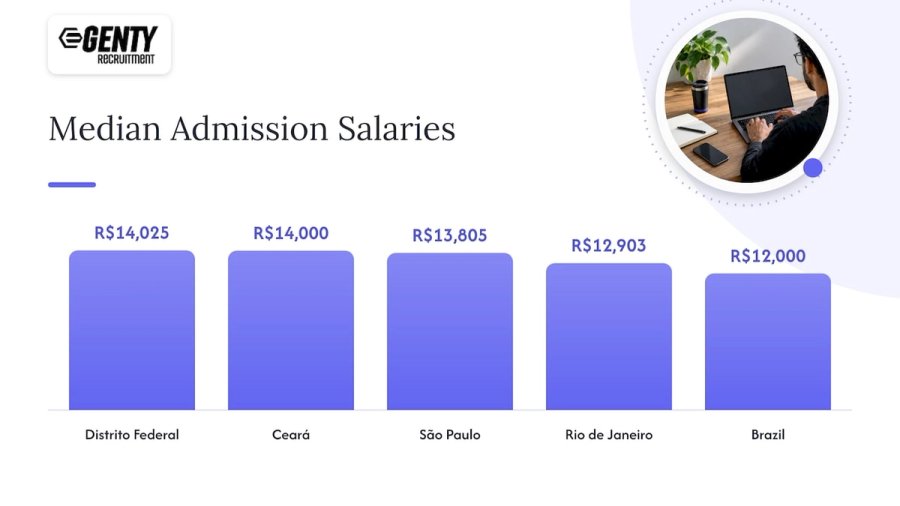
The most reliable city data comes from CAGED admissions, summarized by Benway for October 2025 to September 2026:
Rio’s median sits 8% above the national median, and its interquartile range runs from R$7,947 to R$17,000. São Paulo’s large sample makes its number the most dependable. The smaller states are less stable, as the Código Fonte TV survey shows: São Paulo averages R$12,923 per month from 77 respondents, while Pernambuco (8 respondents) averages R$6,376 and Mato Grosso (5 respondents) R$8,901. With samples that small, treat state-level figures outside the big hubs as directional.
Contractor benchmarks follow the same order. Paymetric Labs reports permanent SRE salaries of R$27,000 per month in São Paulo versus R$23,000 in Belo Horizonte, with Rio about 4% above the national median and Belo Horizonte about 8% below.
Nominal pay is also not purchasing power. High rent and commuting costs in São Paulo can erase part of its nominal premium. That is one reason strong engineers in Curitiba, Belo Horizonte, Recife or Florianópolis often accept remote contracts without relocating, and why 61.3% of DevOps professionals in the Código Fonte TV survey already work remotely.
Gross, net, monthly, annual: reading the numbers correctly
Most comparison mistakes come from mixing bases. Check four things before you put any figure in a budget.
- Monthly or annual. Glassdoor’s headline annual averages and Empregos.com.br’s monthly figures are not interchangeable, and some aggregators publish a sample so small it should not drive a decision. For example, Prosfy reports a median gross annual salary of R$65,305 from only 19 postings with a declared salary, with a P10 to P90 span of R$35,290 to R$265,580.
- Gross or net. Take-home pay is reduced by income tax (IRRF) and social security (INSS). On a gross monthly salary of R$25,000, Paymetric Labs estimates an effective tax rate of about 26.7%.
- What the annual figure includes. Under the Brazilian CLT employment regime, Benway’s annual figure covers 12 months plus the 13th-month salary and the one-third vacation bonus, but not the FGTS employer contribution. A candidate quoting a monthly CLT salary is describing a package that is more than twelve payments.
- CLT or contractor. Contractor rates run higher because the contractor carries the cost of taxes, holiday pay, sick pay and pension. That benchmark puts the median DevOps/SRE contractor rate at R$25,000 per month, typically between R$20,000 and R$31,000. Compare it with a CLT salary only after you add those costs to the CLT side.
What moves a Brazilian DevOps engineer’s pay
Beyond seniority and city, four factors decide where a candidate lands inside the range.
English level. Entrevia reports that intermediate English lowers the remote range by roughly 8%, and that with basic English the US remote market is effectively closed because interviews are in English. For a US team, this is the first filter worth applying: fluent engineers cost more and communicate better in incident calls and design reviews.
Employment model. A CLT employee, a contractor invoicing through a company and an engineer hired through a staffing arrangement have different total costs for the same take-home pay.
Stack and scope. Kubernetes, Terraform, AWS or GCP depth, observability and security automation push candidates toward the top of their band. Pure ticket-driven operations work sits near the bottom. SRE titles, with on-call ownership and reliability targets, generally price above generalist DevOps.
Market scarcity. Brazil’s estimated shortage of IT professionals is projected to reach 530,000 by the end of 2026, which keeps competition for experienced engineers high among local employers too. Strong candidates rarely sit unemployed for long.
Do DevOps engineers in Brazil make good money?
By local standards, yes. Glassdoor’s median of R$10,000 per month and the CAGED admission median of R$12,000 sit well above the Brazilian minimum wage; Benway calculates Rio’s R$12,903 median at 7.96 times the minimum wage. In dollar terms the same engineer is paid far less than a US counterpart, which is the reason US companies hire here. The more useful comparison for a candidate is local employer versus foreign employer: a mid-level engineer working remotely for a US company earns about double the local range, so the best engineers increasingly target dollar-paid roles. When you recruit, you are competing with that expectation, not with the local market alone.
What this means for a US hiring budget
Here is how a US CTO can turn these figures into a plan.
- Senior DevOps engineer: budget $61,000 to $95,000 a year in salary, which is the Entrevia remote range. Add employer costs that depend on how you engage the person.
- Mid-level: $43,500 to $62,500 a year covers most strong profiles.
- Staff or lead with architecture and team ownership: $76,000 to $129,500, with the upper end reserved for people who have run platforms at scale.
Compare that with US pay for the same role and the savings are substantial. Our own client positioning is up to 40% savings compared with US or European hiring, once you include the full cost of the hire, and the gap is usually larger for senior roles in US high-cost metros.
Time zones complete the picture. Brazil’s main tech hubs run on Brasília time, which is one hour ahead of US Eastern during daylight saving time and two hours ahead in winter. That leaves a near-complete working-day overlap with New York and Atlanta, and about four to five hours with San Francisco and Seattle, enough for stand-ups, pairing and on-call handoffs. Compare this with hiring in Eastern Europe or Asia, where overlap with US teams drops to a few hours at best.
If you are comparing Brazil with other countries, our guides cover DevOps salaries across Latin America, DevOps engineer pay in Mexico and Colombia DevOps contractor rates. For adjacent roles in Brazil, see our backend developer salary guide and the broader Brazil software salary guide.
Checklist: before you make a DevOps offer in Brazil
- Decide on CLT, contractor or staffing arrangement, and price all three on the same gross basis.
- Fix the exchange rate and date you use in the budget, and state the currency in the offer.
- Set the English requirement for the role. Daily incident response needs fluent spoken English.
- Confirm required overlap hours with your team and your on-call rotation.
- Benchmark against at least two sources, one of them CAGED-based, rather than a single average.
- Define scope by seniority: tooling depth, cloud platform, ownership of production.
- Plan for the 13th-month salary and vacation bonus if you hire under CLT.
Our perspective
We see the same pattern in almost every DevOps search in Brazil. Salary averages look low next to US pay, so teams anchor on the average, then discover that the engineers who can own a production platform in English are priced in the top of the range. The average is not the price of the person you need.
Our approach at GENTY recruitment is to separate the benchmark from the offer. We define the seniority, the stack, the English bar and the engagement model first, then build the shortlist around candidates who fit that profile. Our dedicated IT recruiters work only on Latin America, and our process is skill-first, so a candidate’s tooling depth and incident experience are assessed before a profile reaches you.
The result we aim for is a curated shortlist within 7 days, at a transparent fixed fee with no upfront payment, and a 3-month replacement guarantee. For DevOps in particular, where one wrong hire means a fragile pipeline and a slow quarter, that structure keeps the cost of getting it right predictable.
Eugene
Hire a DevOps engineer in Brazil with GENTY recruitment
If you are ready to turn these ranges into a hire, our IT recruitment service starts from $2,999 one-off per hire, with no upfront payments and a 3-month replacement guarantee. We deliver triple-vetted shortlists of pre-vetted Latin American engineers, including DevOps and SRE profiles in Brazil, Argentina, Mexico and Colombia. If you prefer a monthly model, our staffing option starts from $99 per month per employee, and you can read the practical steps in our DevOps engineer hiring playbook.
To discuss a role, contact us through the GENTY recruitment site and tell us the seniority, stack and time-zone overlap you need.
FAQ
How much does a DevOps engineer make in Brazil?
At a local company, most DevOps professionals earn between R$6,015 and R$10,016 per month, with an average of R$7,984, according to Empregos.com.br. Glassdoor’s median total pay is higher at R$10,000 per month. Working remotely for a US company, senior engineers are typically paid $61,000 to $95,000 a year.
Which Brazilian city pays DevOps engineers the most?
São Paulo has the largest and most dependable data, with a CAGED admission median of R$13,805 per month. Distrito Federal and Ceará show slightly higher medians in smaller samples, and Rio de Janeiro is at R$12,903. For remote hiring, city matters less than seniority and English level.
Is the DevOps salary in Brazil quoted gross or net?
Most published figures are gross. Brazilian take-home pay is reduced by income tax and social security, and CLT annual packages add a 13th-month salary and vacation bonus. Always confirm whether a figure is gross, monthly or annual before comparing it to a US offer.
Do I pay in reais or dollars?
Both are common. Local employers pay in reais, while US companies hiring remote engineers usually quote in dollars, which is why remote ranges are published in USD. Fix an exchange rate and date in your budget, and state the currency in the offer.
Sources
- Empregos.com.br: Salário de DevOps em 2026
- Glassdoor: DevOps Engineer salaries in Brazil
- Entrevia: DevOps / SRE engineer salary in Brazil (2026)
- Código Fonte TV: Pesquisa Salarial 2025, DevOps
- Benway: Salário de engenheiro DevOps no Rio de Janeiro
- Paymetric Labs: SRE salary in Brazil 2026
- Paymetric Labs: DevOps contract rates in Brazil 2026
- Prosfy: DevOps Engineer salary in Brazil
- Skillta: Brazil Salary Explorer
- CarreiraUp: Tabela Salarial 2026
- CodeCrush: Salários em Tecnologia no Brasil