

A backend developer in Brazil earns a median of R$ 9,366 per month on formal payroll, according to RAIS 2025 data. Pay for the same developer working remotely for a US company is a different number. A senior engineer can land at roughly US$57,500 to US$89,500 a year on a US contract, while the local-employer equivalent is far lower. This guide gives you both sets of figures, shows how seniority, region, skills and English level move them, and explains what a US or European team should budget when hiring from Brazil.
TL;DR
- Formal-sector backend pay in Brazil has a median of R$ 9,366 per month (p25 to p75: R$ 5,652 to R$ 14,167), well above the national formal-job average of R$ 4,249.
- By seniority, a large 2025 survey shows mean monthly pay of R$ 4,598 (junior), R$ 8,376 (mid-level), R$ 15,920 (senior) and R$ 20,200 (specialist, tech lead or principal).
- Remote pay for US employers sits well above local pay: one model puts senior backend contracts at US$57,500 to US$89,500 a year, and Deel data shows a software development median near US$66,000.
- Budget beyond the base: Brazilian employment carries heavy employer costs, and English fluency, specialization and region all shift the number.
- Brazil’s time zone gives your team daily overlap with both US Eastern and Pacific hours.
What backend developers earn in Brazil, in reais
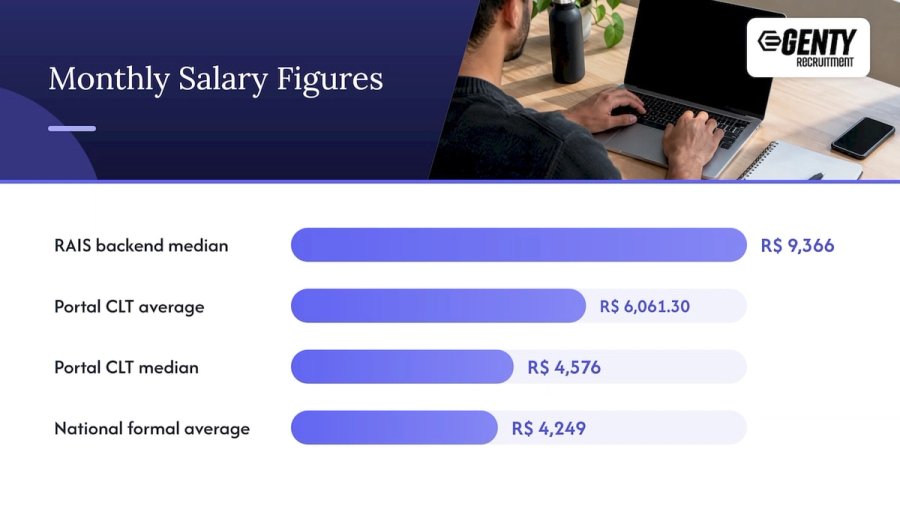
Three public datasets describe the local market, and they disagree because they measure different things. Reading them side by side is the fastest way to avoid a bad budget.
Why the gap? Portal Salário builds its figure from 52,958 CLT admissions and separations over the previous 12 months, which includes many entry-level hires and excludes bonuses, commissions and overtime. The RAIS-based figure reflects employees already holding the backend developer occupation code. Both cover formal employment only, so contractors (PJ) and self-employed developers are not in the data.
For context, the backend median of R$ 9,366 compares with a 2025 average of R$ 4,249 per month across all formal jobs in Brazil, so the role pays roughly double the national formal average on this measure.
What do you need?
Choose the hiring path that fits
After reading "Backend Developer Salary in Brazil: 2026 Local and Remote Pay", most teams compare these options before deciding how to hire.
Treat these figures as the floor of what a good hire expects, not the price of the hire you want. Developers who pass a strong technical screen and speak fluent English rarely work on local CLT terms for long.
Backend developer salary in Brazil by seniority
The most useful breakdown for hiring comes from the Código Fonte TV 2025 salary survey, which collected responses from 3,760 backend professionals between March 12 and July 4, 2025. It reports mean monthly pay by level:
The jump from mid-level to senior is the steepest in the table, nearly doubling. That matches what we see when sourcing: senior backend engineers with production ownership of distributed systems are the scarcest profile, and local employers already compete hard for them.
The Entrevia model, published in October 2026, gives a more conservative view of local-company pay in US dollars per year. It states plainly that these are model estimates, not survey results:
Use the survey for relative gaps between levels and the model for a dollar-denominated sense of the local ceiling. Neither is a quote for a remote hire.
Local employer vs remote for a US company
This is the comparison that matters if you are reading from a US or European headquarters. The same Entrevia model, assuming advanced English and no premium skills, gives annual ranges for Brazilian backend developers working remotely for a US company:
Two observations help you plan. First, the remote premium grows with seniority: it is modest for juniors and close to triple for seniors in this model. Second, it is the premium you must match to keep a developer, since the best candidates compare your offer with other foreign employers, not with Brazilian companies.
A second data point comes from Deel figures reported by Bloomberg Línea in August 2026. Among workers contracted by foreign companies between January and June 2026, software development in Brazil showed a median annualized base salary of about US$66,000, counting only roles with at least 50 contracts. That sits comfortably inside the mid-to-senior band of the model above.
For a US team, the practical reading: a mid-level backend engineer in Brazil typically costs a fraction of a US hire at the same level, and a senior costs materially less than a US senior while still earning several times the local-employer rate. That gap is where the cost advantage of LATAM hiring comes from. Our own claim is that clients save up to 40% compared with US or European hiring, and the exact figure depends on level, stack and your current local salary bands.
What moves the number: region, skills and English
A single “Brazil backend salary” hides four variables that shift an offer by tens of percent.
Region
The Southeast, centered on São Paulo, is the pay reference. Calculadora Dev’s 2026 benchmark reports that salaries in the Northeast and North are often 20% to 25% lower for local CLT roles than in the Southeast. For remote work for a US employer, the gap narrows, because you are competing with global rates rather than a local labor market. Do not assume a developer in Recife or Florianópolis will accept a discount just because of where they live. Strong candidates are spread across the country, and hiring outside São Paulo mainly widens your pipeline.
Specialization
The same benchmark finds that AI/ML and DevOps carry higher pay benchmarks than generalist backend work, and that PJ contracts and international remote work carry higher multipliers than CLT employment. If your backend role touches infrastructure, our DevOps salary guide for Latin America shows how that premium plays out across the region, and the Golang developer salary guide does the same for one of the most requested backend languages.
The FIAP Radar Tech 2026 points to a shift in what the market values: engineers who move beyond simple coding toward architecture and security, building scalable systems with security designed in (DevSecOps). When you write the job description, put system design and security ownership at the top if you need that profile, and price it as senior.
English fluency
English is the most underpriced variable in hiring. Contractor-side salary research for Brazilian developers in US companies reports that developers at the same technical level can sit 30% to 40% apart depending on English fluency and communication ability. Brazil has plenty of technically strong engineers; the smaller group is those who can run a design review, write a clear RFC and handle an incident call in English. Screening for that early saves you a failed hire.
Contract type
Brazilian developers work either as CLT employees or as PJ contractors. CLT carries statutory benefits and employer charges, while PJ pays more per month and shifts those costs to the developer. Official RAIS and Novo CAGED data cover formal employment only, so PJ rates never appear there. When you compare an offer with a published number, check which of the two the number describes.
Budgeting beyond base salary
A base salary is not a hiring cost. Portal Salário lists a company cost of R$ 10,304 per month against its R$ 6,061.30 average base CLT salary, about 70% above base, and notes that its salary figures exclude bonuses, commissions, overtime and add-ons. If you hire through a local employer of record or a Brazilian entity, expect that kind of load on top of the salary.
Use this checklist when you build a budget for one Brazilian backend hire:
- Base salary or monthly rate for the level, from the tables above, adjusted for English and specialization.
- Contract structure: CLT through an employer of record, or PJ contractor, and who bears statutory benefits.
- Employer costs if employing through a local entity, using the cost-to-salary relationship above as a starting point and confirming with your payroll provider.
- Recruitment fee: one-off per hire or percentage-based.
- Equipment, tools and security setup for a remote engineer.
- Time-zone overlap plan: which hours your team shares with the new hire.
- Replacement risk: what happens if the hire leaves in the first months.
Our article on what it costs to hire a developer walks through the full cost structure, and the Brazil salary guide covers more than 40 roles if you are staffing beyond backend.
Time zone: the nearshore advantage
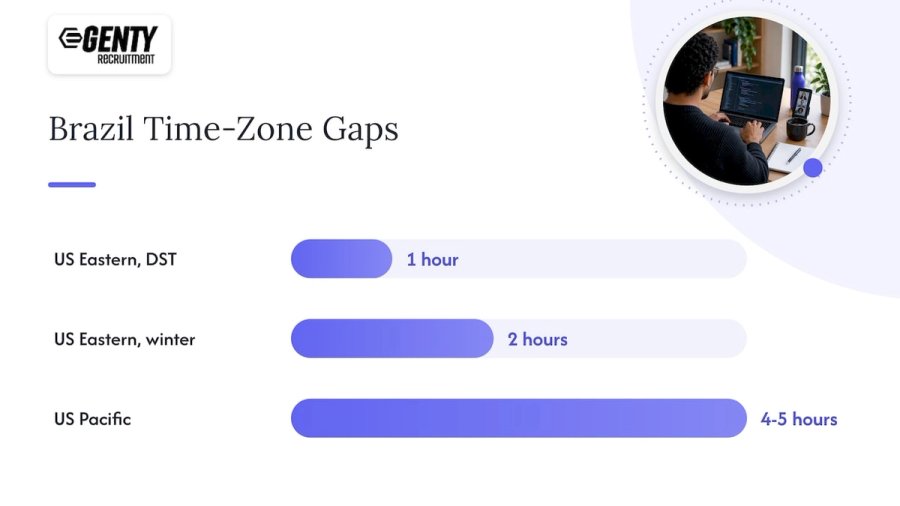
Brazil’s Brasília time is one hour ahead of US Eastern during daylight saving time and two hours ahead in winter, which leaves a full working day of overlap with New York, Boston or Miami teams. For US Pacific teams the difference is four to five hours, so a developer starting at 9 a.m. in São Paulo overlaps with the Pacific morning for standups, code review and incident response. Compared with sourcing from Asia or Eastern Europe, that overlap means synchronous pairing and on-call handoffs without anyone working at midnight. For European teams, the afternoon overlap works well for sprint ceremonies.
Brazil is the largest talent pool, but not the only one. Argentina shares a similar time zone and has a deep engineering culture, Colombia sits on Eastern time for part of the year, and Mexico aligns with US Central. Many of our clients build backend teams across two or three of these countries to balance cost, seniority and coverage.
How reliable are these salary numbers?
Treat every figure as a range with a date, not a quote. Portal Salário updates monthly from CLT admissions and separations. Calculadora Dev reports medians because they are less distorted by outliers than averages. RAIS covers formal employment only. Entrevia states that its figures are a model. Three habits keep your budget honest:
- Anchor on the interquartile range (p25 to p75), not the average.
- Check whether a figure is monthly or annual, BRL or USD, base or total cost.
- Validate against live candidate expectations from a shortlist before you fix the offer, because exchange rates and demand for senior engineers move faster than annual surveys.
Our perspective
Most budgeting mistakes we see come from pricing a Brazilian hire against the local market. A strong backend engineer who can work in English with a US team is not choosing between you and a São Paulo employer. They are choosing between you and every other foreign company hiring in the country. Offers pitched at local CLT medians draw a thin, mostly junior pipeline, while offers pitched at remote-market rates draw seniors.
We built GENTY recruitment around that reality. We focus exclusively on Latin America, with dedicated recruiters for each vertical, and we screen on skills first, so a backend shortlist reflects real system design and English communication, not keyword matches. Our process is designed to deliver a curated shortlist within 7 days, with a fixed fee set by seniority level, no upfront payment and a 3-month replacement guarantee.
If you are hiring your first Brazilian backend engineer, start from the remote-market range for the level you need, add the employer costs of your chosen contract structure, and plan the time-zone overlap before you open the role. That sequence produces offers that get accepted.
Eugene
Hire a backend developer in Brazil with GENTY recruitment
If you already know the level and stack you need, our IT recruitment service starts from $2,999 one-off per hire, with a fixed fee by seniority, no upfront payments and a 3-month replacement guarantee. If you want to keep the engineer on a monthly basis without building a local entity, our staffing service starts from $99 per month per employee. You can see the type of profiles we place on our backend developers in LATAM page.
Tell us the role, the level and the countries you are considering through the GENTY recruitment site, and we will come back with salary expectations for that profile and a plan for the shortlist. For a broader view of the process, read our guide to hiring remote developers.
FAQ
What is the average backend developer salary in Brazil?
On formal payroll, the RAIS 2025 median is R$ 9,366 per month, with a middle range of R$ 5,652 to R$ 14,167. Portal Salário’s October 2026 average for base CLT pay is lower, at R$ 6,061.30, because it includes more entry-level hires. Remote work for a US company pays more than either figure.
How much do Brazilian backend developers earn working for US companies?
One October 2026 model places senior backend pay at US$57,500 to US$89,500 per year for US employers, and mid-level at US$40,000 to US$57,500. Deel data reported in August 2026 shows a median near US$66,000 for software development in Brazil among workers contracted by foreign companies. Your number depends on English level, specialization and contract type.
Is a backend developer in Brazil paid more than the average worker?
Yes. The backend median of R$ 9,366 per month compares with R$ 4,249 as the 2025 average for formal jobs in Brazil. The gap widens for seniors, whose mean pay reaches R$ 15,919.56 in the 2025 Código Fonte survey.
Does location inside Brazil change the salary?
For local CLT jobs, yes: the Northeast and North are often 20% to 25% lower than the Southeast. For remote roles with US companies the gap is smaller, since pay follows international market rates more than local ones.
Which Brazilian time zone overlap should I plan for?
Brasília time is one to two hours ahead of US Eastern, depending on the season, and four to five hours ahead of US Pacific. That leaves a full working day with East Coast teams and a morning overlap with West Coast teams.
Sources
- Salários por cargo no Brasil, RAIS 2025 e Novo CAGED
- Desenvolvedor back-end: salário, Portal Salário
- Pesquisa Salarial de Programadores 2025, Back-End, Código Fonte TV
- Salário de desenvolvedor backend no Brasil (2026), Entrevia
- Brasil tem os maiores salários para trabalho remoto na América Latina, Bloomberg Línea
- Benchmark Salarial Devs Brasil 2026, Calculadora Dev
- Raio-x da valorização tech 2026, FIAP Radar Tech