
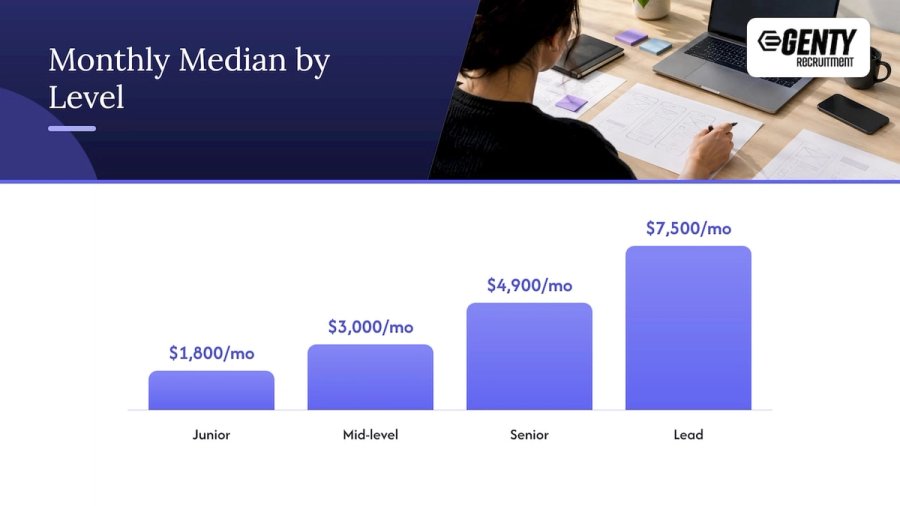
A mid-level UX designer in Latin America typically costs a US or European employer about $3,000 per month in base pay, a senior around $4,900, and a lead around $7,500, according to Vacantes Digitales’ 2026 Mexico-base estimates. Remote roles for US companies often pay more than local employers do, and country, English level and employer type move the number by thousands of dollars. This guide gives you the ranges by seniority and country, explains what pushes offers up, and shows how to turn the figures into a budget for a hire that overlaps your team’s EST or PST working day.
TL;DR
- Mexico-base monthly medians for 2026: $1,800 junior, $3,000 mid-level, $4,900 senior, $7,500 lead. These are market estimates, not offers.
- Senior ranges differ by country: $3,230–$5,100 in Peru, $3,420–$5,400 in Colombia, $4,104–$6,480 in Costa Rica, $4,180–$6,600 in Uruguay.
- Selling to a US employer adds a premium. One model applies 30%, which puts senior pay at $4,940–$7,800 per month.
- Advanced English, US-aligned time zones and in-demand tools raise pay. Budget for the top of the band if you need all three.
- Colombia, Mexico, Argentina and Brazil share large overlap with EST and PST, so synchronous design critiques and sprint rituals work without shifting anyone’s day.
What UX designers earn in Latin America: the headline numbers
The most useful single benchmark for a conventional UX designer is the Mexico-base estimate from Vacantes Digitales, which covers $1,400 to $9,000 per month overall. The page labels its numbers as market estimates and says they vary with experience, English, work mode, employer size, technology stack and demand. Treat them as a planning band, then adjust for the factors below.
The medians by level, in USD per month, with the annual equivalent we calculate:
Notice the shape: the jump from mid-level to senior is about $1,900 per month, and from senior to lead about $2,600. Seniority, not geography, is the biggest divider. Cross-border data from Argentina points the same way: HiresLink’s figures rise from a $2,450 junior median to $4,900 mid-level and $7,150 senior, which shows that Argentine designers selling to foreign clients price closer to the top of the regional range.
What do you need?
Choose the hiring path that fits
After reading "UX Designer Salary in LATAM: 2026 Ranges by Country and Level", most teams compare these options before deciding how to hire.
A second cut comes from job postings. Hirify’s regional page builds its UI/UX figures from salary-stated postings in the last 90 days, based on 13 postings, so they show what employers offered rather than what employees reported. With a sample that small, use it to sanity-check the other numbers, not to set your offer.
Salary by country: where your budget goes furthest
Country matters, but less than most hiring managers expect. The ranges for senior UX designers in the Vacantes Digitales dataset sit in a fairly tight corridor:
Source: Vacantes Digitales, 2026.
For the four countries most US teams start with, a different type of source helps: annual mid-career medians for UI/UX designers from Global Salary Guide list Argentina at $51,722, Mexico at $46,781, Colombia at $42,197 and Brazil at $42,092. Those are salary-level medians for local-market employment, so they sit near the mid-level to senior boundary of the remote estimates above. They are a useful floor: a remote offer to a designer in any of those countries should not undercut what local employers already pay.
Colombia
Local pay in Colombia gives you the floor. Coderhouse’s 2026 salary guide reports 2,800,000 to 3,500,000 COP per month for juniors and 6,500,000 COP or more for senior UX/UI designers. Those local figures are well below the remote USD bands, which is exactly why a US-dollar contract is attractive to Colombian designers and why you can win good candidates without stretching to US pay. Bogotá and Medellín sit in or next to Eastern time, so the overlap with a New York team is essentially the full day.
Chile
For designers working remotely from Chile for US or European companies, Trabajo Remoto Chile gives monthly gross ranges of $1,200–$2,000 for junior, $2,000–$3,500 for semi-senior and $3,500–$5,500 for senior roles. It also notes that net income for contractors billing foreign companies is approximately 80% of the agreed gross amount. That matters when you negotiate: a candidate who quotes a number may be thinking about take-home, so confirm whether a figure is gross or net before you compare it with anything else.
Mexico, Argentina and Brazil
Mexico is the base for the most-cited 2026 benchmark, and Mexico City shares Central time, which gives a full-day overlap with Chicago and a workable one with both coasts. Argentina has a deep design community and strong English among senior designers, but remote pay there is often quoted in dollars because of local currency volatility, so agree the currency in the contract. Brazil has the largest design market in the region and a deep pool of product designers at fintechs and marketplaces. Portuguese is the working language in many Brazilian companies, so screen for English early if your team runs critiques in English.
What moves a UX designer’s pay up or down
The figures above are medians. Where an individual lands depends on a handful of factors, and the same ones show up across sources.
- English proficiency. Trabajo Remoto Chile says advanced English can increase pay by 20–40%. UX is a communication job: running research sessions, presenting rationale and writing specs all depend on language. We cover the topic in more depth in our piece on LATAM English proficiency.
- Time zone alignment. The same source lists working in US-aligned time zones as a salary-raising factor. Designers who can join a 10:00 a.m. Pacific critique, or a 9:00 a.m. Eastern stand-up, are scarcer than those who cannot, and they know it.
- Tools and stack. Experience with specific, high-demand tools raises the band. For UX, think design-system work in Figma, prototyping for complex flows, and comfort with front-end handoff.
- Employer type. US startups with recent funding and large tech companies often pay well above the market average for remote Latin American talent, per the same Chilean source. If you compete with those employers, price accordingly.
- Title versus scope. EULE Institute points out that a UX designer title at a major company such as MercadoLibre or Nubank can carry far more autonomy and impact than the title suggests, and pay follows scope. Two candidates with the same title can sit $1,500 apart.
- Work mode and company size. Vacantes Digitales lists both among the variables behind its ranges.
The remote-for-US premium
A designer who contracts with a US or European company usually earns more than the local market pays. Vacantes Digitales models a 30% US-remote premium on its Mexico-base ranges, which takes senior pay to $4,940–$7,800 per month. The same logic applied to the medians looks like this:
The premium columns are our arithmetic on the cited 30% assumption, so read them as a modeled ceiling for planning, not a quote. EULE Institute also observes that remote work is rapidly eroding geographic salary differences, and it lists senior international-remote roles at €70,000 to €120,000. That top end belongs to a small group of designers at well-funded companies, not to a typical hire, but it is why the best senior designers in the region are rarely on the market for long.
How to budget a UX designer hire in LATAM
A practical budget has three layers: base pay, employment structure and the cost of finding the person.
Step 1: Pick the band
Start with the seniority table and decide which level the work needs. A product with an established design system and a researcher already in place can hire a mid-level designer. A first design hire at a seed-stage startup usually needs a senior who can set process, run discovery and ship alone.
Step 2: Add the premium where you need it
If you require advanced English, daily overlap with a US time zone and a specific stack, plan on the upper half of the band. If the role is asynchronous and the work is production design inside a mature system, the median is a fair target.
Step 3: Choose the structure
Contractor agreements, an employer of record and a staffing arrangement each change who carries payroll, benefits and compliance. For a team under ten people, staffing is often the quickest path because it removes the need to open a local entity. Our staffing service starts from $99 per month per employee, on top of the person’s pay.
Step 4: Price the search
Agency fees are the third layer. Our IT recruitment service starts from $2,999 one-off per hire, with fixed pricing by seniority level, so you know the fee before the search begins instead of a percentage of the salary that grows as you hire senior.
A checklist before you make an offer
- Confirm whether the candidate’s number is monthly or annual, gross or net, and in which currency.
- Check the figure against the local-market salary in the candidate’s country, so your offer is clearly above it.
- Define the overlap window in your time zone: for example, four hours between 9:00 a.m. and 1:00 p.m. Pacific.
- Test English with a real task, such as presenting a design rationale, not a conversation.
- Review the portfolio for scope, not only visuals: research, systems thinking, measurable outcomes.
- Decide the contract structure before the final round, so compensation and compliance are discussed together.
- Set a review point at six to twelve months. Designers in this market get recruited often, and a planned raise protects your investment.
Why LATAM works for design teams
The region’s pitch for UX hiring is not only price. Time zone alignment is the practical advantage: Colombia and Peru sit on Eastern time for much of the year, Mexico City is on Central, and Argentina and Brazil are a few hours ahead of the East Coast, which still leaves a long shared morning with the US. A designer in Bogotá can sit in a live usability session with your product manager in New York, then hand off to an engineer before lunch. That tight loop is what makes design in LATAM different from far-flung offshore models.

Cost is the second advantage. Even at the top of the remote bands, the figures sit far below what the same seniority commands in major US tech hubs, and our own clients save up to 40% compared with US or European hiring, a result that depends on role and seniority. For wider context on how those savings add up across roles, see our analysis of hiring costs in Latin America, and our guide to hiring remote developers for the engineering side of the same team. If you are building the full product trio, the product manager salary guide and the QA engineer salary guide give you comparable bands.
Our perspective
We see the same pattern in almost every design search: companies anchor on a local salary figure, discover that it only works for juniors, and lose their best candidate in the last week because the offer lacked a clear US-dollar structure.
Our view is that UX is the role where a specialist-led search pays off most. Portfolios look similar at first glance, and the difference between a pixel producer and a product thinker only appears when someone who understands design evaluates scope, research depth and communication. That is why GENTY recruitment assigns dedicated recruiters per vertical and runs a skill-first process that delivers a curated shortlist within 7 days.
We also believe in pricing that does not punish you for hiring well. Our fixed fee depends on seniority, there are no upfront payments, and every placement carries a 3-month replacement guarantee. A transparent number lets you budget a senior designer with the same confidence as a junior one, and lets you spend the saved effort on the offer itself.
Eugene
Hire a UX designer in LATAM with GENTY recruitment
If you are ready to move from benchmarks to a shortlist, GENTY recruitment specializes in IT and sales recruitment across Argentina, Brazil, Mexico, Colombia, Chile and other Latin American markets. We present pre-vetted candidates with a skill-first process, a fixed fee from $2,999 per hire, no upfront payments and a 3-month replacement guarantee. Start on our IT recruitment page and tell us the seniority, the overlap window and the stack.
If you also need compensation data for a role that is not listed here, our salary benchmarking service, available through our main page, covers custom roles and markets.
FAQ
How much does a senior UX designer make in Latin America?
The 2026 Mexico-base median for a senior is $4,900 per month, and country ranges run from $3,230–$5,100 in Peru to $4,180–$6,600 in Uruguay, per Vacantes Digitales. Add a premium if the role is remote for a US company and needs strong English. Plan on the upper half of the band for that profile.
Are LATAM UX salaries reported monthly or annually, and gross or net?
Remote contracts are normally quoted per month in USD, while local salary sites often show annual figures in local currency. Gross and net get mixed up often: for Chilean contractors with foreign clients, net is approximately 80% of the agreed gross amount, according to Trabajo Remoto Chile. Always confirm the basis in writing.
Does a LATAM UX designer overlap with US working hours?
Yes. Colombia and Peru share Eastern time for much of the year, Mexico City is on Central time, and Argentina and Brazil are a few hours ahead of the East Coast. Most teams set a four-to-six-hour overlap window with both EST and PST, then let the designer work independently outside it.
What raises a UX designer’s pay the most?
Seniority is the largest factor, followed by advanced English, which can add 20–40% according to Trabajo Remoto Chile, and the type of employer. Funded US startups and large tech companies often pay above market. Scope also counts: a title at a major regional firm can carry more responsibility than it suggests.
How much does it cost to recruit a UX designer through GENTY recruitment?
Our IT recruitment service starts from $2,999 one-off per hire, with a fixed fee by seniority and no upfront payments. Each placement includes a 3-month replacement guarantee. Staffing arrangements start from $99 per month per employee.
Sources
- Salario UX Designer LATAM 2026, Vacantes Digitales
- Sueldo de un Diseñador UX/UI en Colombia, Coderhouse
- Cuánto cobrar trabajando remoto para una empresa de EEUU desde Chile, Trabajo Remoto Chile
- Salario UX Designer 2026: España y LATAM, EULE Institute
- UI/UX Design salaries in Latin America, Hirify
- UI/UX Designer Salary by Country, Global Salary Guide