

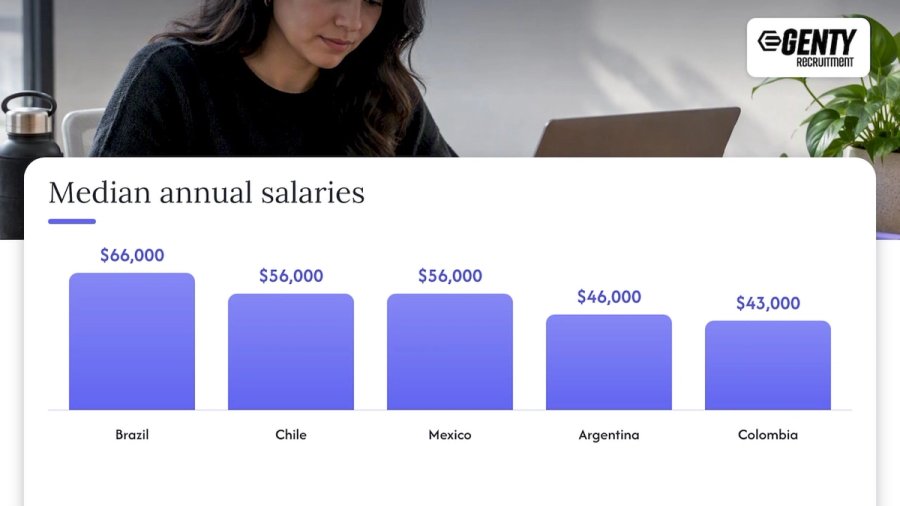
A remote software engineer in Latin America typically costs a US fintech roughly half of what the same role pays at home. Deel’s first-half 2026 data puts the median software development salary at $66,000 in Brazil, $56,000 in Mexico and Chile, $46,000 in Argentina and $43,000 in Colombia. This guide shows how to read those numbers, what pushes a fintech offer above the median, and how to budget a hire from Bogotá, São Paulo, Mexico City, Buenos Aires or Santiago without surprises.
TL;DR
- Median software development pay in the region runs from $43,000 (Colombia) to $66,000 (Brazil), against a US median of $135,980 for software developers.
- Fintech roles with payments, compliance or security depth sit above those medians, so budget in the upper half of the local band for senior hires.
- Published figures mix gross pay, total compensation and different data periods. Normalize them before comparing countries.
- Every major LATAM hub overlaps US Eastern and Pacific working hours, which cuts the hidden cost of asynchronous work.
- GENTY recruitment places pre-vetted fintech talent under a fixed fee, starting at $2,999 per hire.
What fintech engineers earn in Latin America, country by country
Start with the most useful single dataset for engineering budgets: median annual pay for software development roles. Deel’s 2026 report, as summarized by Archyde, shows the following for the first half of 2026.
Two patterns matter for a CTO. First, Brazil is the most expensive of the five at the median, but it is also the deepest market, with the largest pool of engineers who have worked at payments companies, banks and neobanks. Second, Colombia and Argentina give you the lowest median cost, and both have mature fintech scenes in Bogotá, Medellín and Buenos Aires.
These are medians for software development in general. The sources we reviewed do not break out a separate fintech median per country, so treat fintech as a premium you negotiate on top of the band rather than a fixed multiplier. For deeper country detail, the Brazil software developer salary guide covers more than 40 roles.
Before you start hiring
Check location, salary, and hiring fit
If you are moving from research to action, start with the market basics so your hiring plan is clearer.
Average remote compensation across all roles
A second dataset looks at everyone hired remotely, not only developers. The Deel Global Compensation Report 2026, reported by Bloomberg Línea, gives average annual compensation for remote hires in the first half of 2026:
Do not read this table next to the first one as if they were the same measure. The first is a median for developers. The second is an average across every remote role, including support and operations, which pulls Mexico and Colombia down sharply. The gap between the two tables is itself useful: engineers in Mexico earn more than double the all-roles average, which tells you that tech talent is priced in a separate market from local wages in general.
How these salaries compare with US pay
For the US side of the comparison, one aggregator of Bureau of Labor Statistics data reports that US software developer wages in May 2025 ran from $82,460 at the 10th percentile to $214,670 at the 90th, with a median of $135,980.
Put the numbers side by side:
- A Brazilian developer at the $66,000 median costs about 51% less in base salary than the US median.
- A Mexican or Chilean developer at $56,000 is roughly 59% below it.
- An Argentine developer at $46,000 is about 66% below it, and a Colombian at $43,000 about 68% below.
Those percentages compare base salary only. Once you add employer contributions, mandatory bonuses, equipment and a recruiting fee, the real saving narrows. GENTY recruitment’s own estimate is that clients save up to 40% against US or European hiring, which is the number we plan with after those costs are in. The LATAM hiring costs breakdown walks through the line items.
What pushes a fintech salary up or down
The median is where a conversation starts. Five factors move the offer from there.
Seniority and scope
A senior engineer who owns a ledger service, a card-issuing integration or a reconciliation pipeline is priced differently from a generalist web developer. Expect to pay at the upper end of the local range for anyone who has shipped regulated payment flows in production.
Stack and specialty
Go, Kotlin, Rust and cloud infrastructure skills command more than standard web stacks in fintech, because they sit behind latency-sensitive systems. Our salary pages for DevOps engineers and Golang developers show how much a specialty can shift the band.
Regulatory experience
Experience with PCI DSS, open banking rules, Brazil’s Pix ecosystem or Mexico’s SPEI payment rails is scarce. Candidates with it know they are scarce. A fintech hiring for compliance-heavy work should budget a premium for it and screen for it explicitly.
Dollar contracts versus local currency
Many senior candidates expect to be paid in USD, especially in Argentina, where local-currency pay has historically been hard to plan around. Offering USD-denominated pay widens your pool and simplifies your budget, but it also resets what the candidate compares you against: other foreign employers, not local banks.
English level and client exposure
Candidates who can lead a design review or an incident call in fluent English cost more than those who read documentation fluently but speak less. If the role is customer-facing, that premium is worth paying. Our piece on LATAM English proficiency explains how to test for it.
Timezone alignment is part of the price
A salary comparison that ignores hours is incomplete. Brazil, Argentina and Chile sit within about one to two hours of US Eastern time depending on the season, and Colombia sits on or near Eastern time year-round. Mexico City runs close to Central time, so it overlaps with both coasts: an engineer in Guadalajara or Monterrey can join a 9:00 a.m. Pacific standup and still finish at a normal hour.
That overlap is the practical advantage over offshore teams. Code review, incident response and pairing happen in real time, so a fintech with an on-call rotation can staff it from LATAM without anyone working overnight. Daylight saving changes shift the gap by an hour in some countries, so confirm the working window in the offer letter.
Sales and revenue roles in fintech
SDRs and account executives are harder to benchmark than engineers, because pay depends heavily on how they are hired. One 2026 write-up on remote B2B sales notes that reported pay ranges are wide, from about $6 an hour through staffing agencies to above $200,000 a year for US-facing sales management roles. The driver is the hiring vehicle and the candidate’s English, not only the country.
For a fintech selling into US or European mid-market accounts, the practical approach is to set a base plus variable structure that matches what the candidate would see from a US employer, scaled to local cost of living. Our SDR salary guide for Latin America sets out typical structures, and the fintech recruitment page shows how we source sales and engineering hires for the sector.
Reading published salary data correctly
The top-ranking salary pages disagree with each other, and most of the gaps come from how the data was collected. Check four things before you put any figure in a budget.
- Gross or net. Most employer-facing salary data is gross annual pay. Local candidates often quote net monthly pay, and in some countries they quote it in local currency.
- Base or total. Mandatory bonuses are common across the region: Mexico requires an annual aguinaldo, and Brazil and Colombia have their own mandatory extra-pay rules. A figure that includes them is not comparable to one that excludes them.
- Period. Currency swings, especially in Argentina, can make a figure from 12 months ago misleading. Use first-half 2026 data or newer.
- Sample. A “remote developer” average from self-reported platforms can include freelancers on hourly rates, which is not the same as a salaried hire.
Checklist before you set a budget
- Choose one data source per country and use it consistently.
- Confirm whether the figure is gross, and in USD or local currency.
- Add employer contributions and mandatory bonuses for the country, or use a staffing model where they are bundled.
- Add a premium for fintech specialization, regulatory experience and senior English.
- Set a range, not a point, and test it against three live candidates.
Minimum wages as a floor, not a benchmark
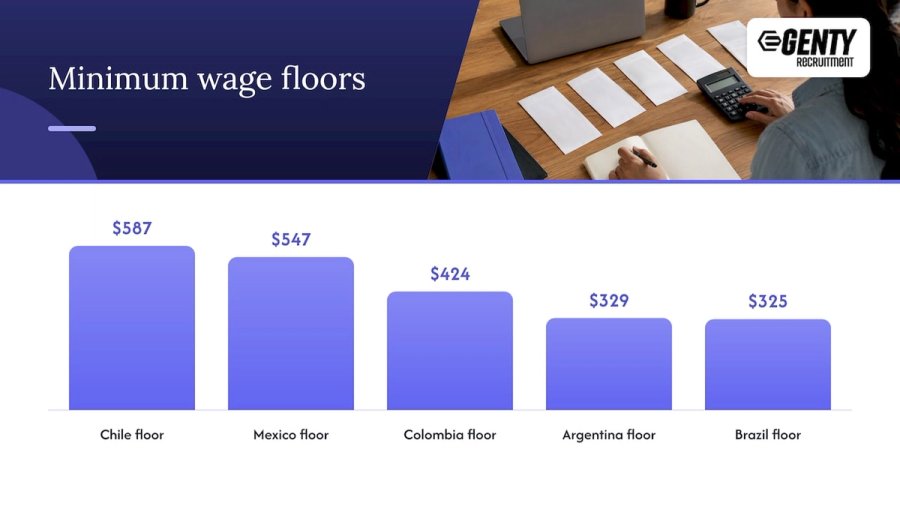
Minimum wages are useful for one thing: they show how far tech pay sits above the local baseline, which is why engineers in the region are well compensated by local standards and why retention depends on more than salary. As of May 2026, statutory monthly minimum wages in USD were $587 in Chile, $547 in Mexico, $424 in Colombia, $329 in Argentina and $325 in Brazil.
The local-currency figures are set by law. Mexico’s general minimum wage effective January 1, 2026 is 315.04 MXN per day, and Colombia’s 2026 monthly minimum was set at 1,750,905 COP on a transitional basis by Decree 0159 of February 19, 2026.
The median Colombian developer at $43,000 a year earns roughly seven times the Colombian monthly minimum wage, annualized. That is the competitive context your offer lives in: candidates compare you with other foreign employers, not with local pay.
Perspective from the GENTY recruitment team
We see the same mistake in most first LATAM hires: a team takes a single salary number from a survey, builds a budget around it and then discovers the offer is 20% short for the seniority it actually needs. Salary data is a starting point. What closes a hire is knowing which candidates in Brazil, Mexico, Argentina or Colombia match the fintech context, what they expect in USD, and how to structure an offer they accept.
That is why GENTY recruitment works only in Latin America, with dedicated recruiters per vertical. Our process is skill-first: we screen for the technical and domain depth your team needs, and we deliver curated shortlists within 7 days. Our pricing is a transparent fixed fee per seniority level with no upfront payment, and every placement carries a 3-month replacement guarantee. We built it that way so you can budget a hire before you start, with the fee as a known number instead of a percentage of whatever salary is negotiated.
If you are planning your first engineers in the region, begin with the role, the country and the seniority, then work out the budget from there.
Eugene
Hiring fintech talent in LATAM with GENTY recruitment
If you have a budget range and a role to fill, our IT recruitment service starts at $2,999 one-off per hire, and our sales recruitment service starts at the same price. Staffing, for teams that want contracting handled for them, starts at $99 per month per employee. There are no upfront payments, and placements come with a 3-month replacement guarantee.
For a wider view of the process, from sourcing to onboarding, read our guide to hiring remote talent from Latin America, or see how salary benchmarking tools compare if you want to build your own bands. To discuss a specific role, start from the GENTY recruitment home page.
FAQ
How much does a senior fintech engineer earn in Latin America?
The sources we reviewed give medians for software development by country, from $43,000 in Colombia to $66,000 in Brazil, not a separate senior fintech figure. Senior engineers with payments or compliance experience typically sit in the upper part of each local band, so budget above the median and confirm with live candidate expectations.
Which Latin American country has the highest developer salaries?
In Deel’s first-half 2026 data, Brazil leads with a $66,000 median for software development, ahead of Chile and Mexico at $56,000. Argentina follows at $46,000 and Colombia at $43,000. Higher pay in Brazil comes with the region’s largest pool of fintech-experienced engineers.
Are Latin American salary figures gross or net?
Most employer-facing figures are gross annual pay, but local candidates often quote net monthly amounts, sometimes in local currency. Confirm the basis, the currency and the period for every number, then add mandatory employer costs and bonuses before you compare countries.
Do LATAM developers work US hours?
Yes, to a large degree. Colombia is on or near US Eastern time, Brazil, Argentina and Chile are within a couple of hours of it, and Mexico City overlaps with both Eastern and Pacific working days. Agree the exact overlap window in the contract, since daylight saving shifts differ by country.
Sources
- Top Remote Jobs in Latin America 2026: Deel Report (Archyde)
- Los trabajos remotos mejor pagados en 2026 en Latinoamérica (Bloomberg Línea)
- Software Developers Salary (Office Blues)
- Account Executive y ventas B2B remotas (Tqham)
- Latin America minimum wages (Wage Indicator)
- National Commission of Minimum Wages, Mexico 2026
- Salario mínimo 2026, Decree 0159 (Beltrán Pardo)