

The Latin American developer market is large enough, and concentrated enough in a handful of countries, that a US or European engineering team can hire senior talent there on a predictable timeline. The region now counts roughly 16 million developers on GitHub, Brazil and Mexico anchor the deep pools, and Colombia and Argentina add strong mid-sized ones, all working in time zones that overlap with US Eastern and Pacific hours. The hard part is no longer finding developers. It is knowing which country fits your stack, what a realistic budget looks like, and how to reach the people who are not applying to job ads. That last problem is the one GENTY recruitment solves for CTOs, VPs of Engineering and founders: our recruiters work only on Latin America, with a dedicated recruiter per vertical.
TL;DR
- GitHub counted about 15.85 million Latin American developers in Q3 2025, up from 3.3 million in 2020. Brazil, Mexico, Colombia and Argentina hold most of them.
- Brazil is the largest market by size and investment, Mexico is the closest fit for US time zones, and Argentina and Colombia are strong picks for mid-sized product teams.
- The US median developer wage was $133,080 in May 2024, and our clients save up to 40% compared with US or European hiring.
- The best candidates are usually employed and not applying, so shortlisting speed and outreach matter more than the size of the pool.
- GENTY recruitment delivers curated shortlists within 7 days, from $2,999 one-off per hire, with no upfront payments and a 3-month replacement guarantee.
What the LATAM developer market covers
LATAM stands for Latin America: Mexico, Central and South America and the Caribbean. For hiring purposes, four countries do most of the work: Brazil, Mexico, Colombia and Argentina. Chile, Uruguay and Costa Rica matter for specific niches and are worth a look when your stack is narrow.
Two caveats about headline numbers help you read the market correctly. First, developer counts from GitHub measure accounts that build on the platform, which includes students and hobbyists. They show the direction and relative size of the ecosystem, not the number of senior engineers available to you. Second, market-size figures often bundle outsourcing agencies with in-house engineering. Use them to compare countries, not to forecast your own shortlist.
How big is the market, and how fast is it growing?
The numbers point the same way from several angles:
Planning a hire?
Talk through the best hiring option
This article usually leads to one practical question: should you use it recruitment or staffing? We can help you choose quickly.
Simple next step
Start with it recruitment and we will help you pick the best hiring setup.
- Developer population. Latinometrics, citing GitHub’s Innovation Graph, reports 15.85 million Latin American developers in Q3 2025, against 3.3 million when GitHub began reporting in 2020. Brazil leads with 7.1 million, followed by Mexico at 2.43 million, Colombia at 1.42 million and Argentina at 1.39 million.
- IT services revenue. An NYU Digital Research Initiative commentary puts the region’s IT services market at $66.2 billion in 2023, expected to reach $110.3 billion by 2030, a 7.6% compound annual growth rate.
- Custom software. Grand View Research projects Latin American custom software development at US$2,962.9 million in 2025, rising to US$12,457.9 million by 2033, with Brazil expected to register the highest growth rate.
For a hiring manager, the practical reading is simple. Demand from US companies is rising, and so is the supply of engineers with experience in US-style product teams. Competition for the best people is also rising, which is why a slow, job-board-only process loses candidates.
Country by country: where the talent sits
Government and academic sources give a consistent ranking. A Peruvian export-promotion analysis of 2025 software markets lists Brazil at about USD 26 billion, Mexico at USD 15 billion, Argentina at USD 6 billion, Colombia at USD 5 billion and Chile at USD 4 billion. It counts more than 760,000 software developers in Brazil and more than 563,000 in Mexico. NYU DRI’s figures use different definitions (500,000+ software developers in Brazil, 700,000+ IT professionals in Mexico), which is a reminder that every count depends on who is included.
Brazil
Brazil is the volume market. Its depth in Java, enterprise backend and fintech engineering makes it the first place to look for teams of 10 or more engineers on one stack. Portuguese is the working language locally, so English level varies more from candidate to candidate. Screening spoken English early in the process avoids surprises later.
Mexico
Mexico combines a deep pool with the closest operating hours to US companies. A Mexico City engineer shares most of the workday with a Chicago, New York or San Francisco team, which makes pair programming, incident response and daily standups straightforward. Demand from US employers is also highest here, so compensation expectations for senior engineers move quickly.
Argentina
Argentina has a long tradition of strong computer science education and remote work for foreign employers. Buenos Aires keeps hours that sit about one to two hours ahead of US Eastern depending on the season, which still leaves a comfortable morning overlap for East Coast teams and a half-day overlap for Pacific teams. Senior product engineers, data specialists and Web3 developers are common here, and you can read more about that niche in our guide to Web3 talent in Latin America.
Colombia
Colombia sits in the same band as US Eastern time for most of the year, so Bogotá and Medellín engineers can work an almost identical day to a New York team. The pool is smaller than Brazil’s or Mexico’s, which makes it a good fit for teams of up to a dozen engineers and a harder fit for very large single-stack builds.
Time zones: the practical LATAM advantage
Time-zone alignment is the reason many CTOs choose Latin America over other remote regions. With Mexico, Colombia and much of the region, you can run live code reviews, on-call rotations and sprint ceremonies inside normal business hours for both US EST and PST teams. Brazil and Argentina are one to a few hours ahead of the East Coast and still leave a solid shared window. For a European team the overlap is narrower, mostly the European afternoon, so Europe-based companies should plan for an asynchronous-first rhythm with a fixed daily overlap.
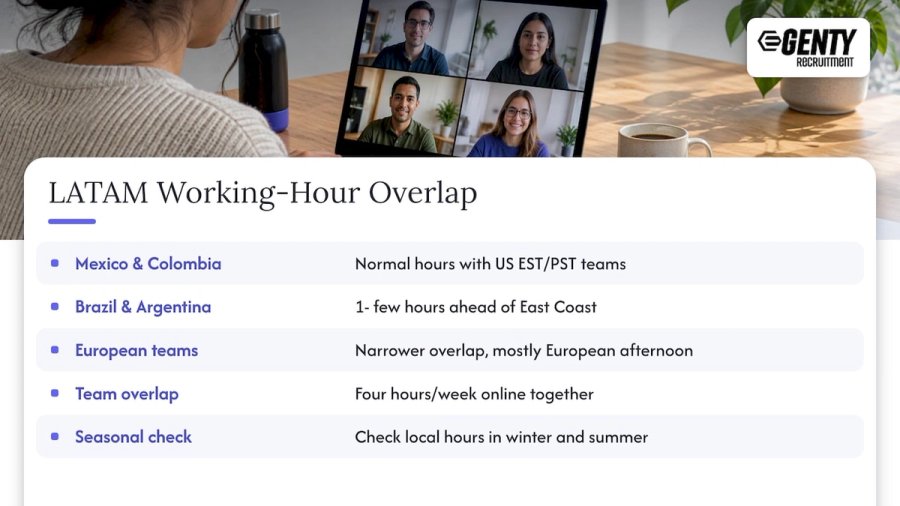
A useful test before you commit to a country: write down the four hours a week you need the whole team online together, then check that every candidate’s local hours cover them in both winter and summer. Daylight saving changes shift the overlap in some countries and not in others.
What developers cost, and how to compare it
The baseline for comparison is the US market. The Bureau of Labor Statistics reports that the median annual wage for software developers was $133,080 in May 2024. That is a base wage, before benefits, payroll taxes, equipment and recruiting fees, so the fully loaded US cost is higher.
Our clients save up to 40% compared with US or European hiring, and the saving comes from three places:
- Base compensation. Salaries for comparable seniority are lower in every major LATAM market, and the gap is widest in Brazil and Argentina.
- Recruiting. A fixed fee per seniority level replaces a percentage of first-year salary, so the fee does not grow as you hire more senior people.
- Speed. A shortlist inside a week shortens the cost of an empty seat on a roadmap.
When you build a budget, keep three numbers separate: the candidate’s salary, your total employer cost (including local taxes, mandatory bonuses and contractor or employer-of-record fees) and the rate an agency would charge you. Mixing them is the most common budgeting error. Our guides on developer salaries in Latin America and hiring costs in Latin America walk through each number by country and seniority.
A worked example
Suppose you need two senior backend engineers and one DevOps engineer. In the US, the BLS median alone puts one developer near $133,000 a year before overhead. Hiring the same three roles in Mexico, Colombia or Argentina typically lowers the base-compensation line materially while keeping a same-day working overlap. Run the comparison with your own offer range per country, add the employer burden for each, and you have a budget you can defend to a finance team. For role-specific ranges, our LATAM salary benchmarking gives you the numbers by seniority.
The pre-hire checklist for the LATAM market
Use this before you open a search:
- Stack fit by country. Match the pool to your technology: Java and enterprise backend leans Brazil, JavaScript and full-stack product work is strong in Mexico and Argentina, data and Web3 talent shows up across Argentina, Colombia and Chile.
- Overlap window. Define the hours the engineer must be online, in both daylight saving seasons.
- English level. Assess spoken English with a live technical conversation, not a resume line.
- Engagement model. Decide between direct full-time hire through a local entity or employer of record, and contractor or staffing arrangements. Employer burden varies by country and engagement type.
- Seniority and salary band. Set a band per level before you talk to candidates, so offers stay consistent across countries.
- Retention plan. Engineers at US employers are often courted by other US employers. Plan growth paths, learning budgets and compensation reviews from day one.
- Trade and tax questions. Check with your counsel or accountant on contractor classification and tax treatment in the country you pick before signing.
Why the best LATAM developers are hard to reach
A growing market does not make hiring easier by itself. The strongest senior engineers in Mexico City, São Paulo, Buenos Aires or Bogotá already have jobs, often with US companies, and they are not scanning job boards. Posting a role and waiting returns a wide funnel of mixed quality, and your internal team spends weeks screening for the five people who matter.
The process that works is skill-first and direct: define the exact stack and seniority, approach qualified people in the right country, verify technical depth and spoken English, then present a short list the hiring manager can interview immediately. It is also why a recruiter who works only on Latin America and only on your vertical (fintech, AI, SaaS, Web3) finds candidates faster than a generalist agency working a global database.
The wider ecosystem supports this. Training programs such as the one in the Laboratoria case study show how the region keeps building technical talent beyond the largest cities.
How GENTY recruitment hires in the LATAM market
We are a specialized IT and sales recruitment agency for US and European tech companies hiring pre-vetted remote talent from Latin America: software engineers, DevOps, data specialists and sales teams across Argentina, Brazil, Mexico, Colombia, Chile and more. Our process delivers triple-vetted, curated shortlists within 7 days.
Pricing is a transparent fixed fee per seniority level. IT recruitment starts at $2,999 one-off per hire, with no upfront payments, and every placement carries a 3-month replacement guarantee. If you would rather keep the engineer on a monthly arrangement, staffing starts at $99 per month per employee. Building an SDR or AE team in the region? Our sales recruitment uses the same model. For multi-role programs we also offer recruitment process outsourcing and executive search.
Tell us the stack, the seniority and the hours you need covered, and we will map the right country and send a shortlist you can interview within the week. Start at GENTY recruitment.
Our perspective
Most US teams that struggle in Latin America do not struggle with the talent. They struggle with the search. They post a role, receive two hundred resumes, and spend a month on screening calls with people who do not match the stack.
We built GENTY recruitment around the opposite approach: a recruiter dedicated to each vertical, focused exclusively on Latin America, who knows what a senior Go engineer in Buenos Aires or a DevOps lead in Mexico City looks like. A skill-first process, a shortlist in 7 days and a fixed fee mean you know the cost and the timeline before the search begins.
The market will keep growing, and so will the competition for its best engineers. The companies that win are the ones that move quickly, with a clear salary band and a working-hours overlap that makes the new engineer part of the team from the first sprint.
Eugene
FAQ
Which Latin American country is best for hiring developers?
It depends on your stack and your time-zone needs. Brazil has the largest pool, Mexico offers the broadest overlap with US hours, and Argentina and Colombia are strong for product, data and Web3 roles. We match the country to the role before the search starts.
Is the LATAM developer market big enough for large teams?
Yes. Latin America counted about 15.85 million developers on GitHub in Q3 2025, and Brazil and Mexico each have several hundred thousand professional software developers. Teams of 20 or more on one stack are usually built across Brazil and Mexico, while Colombia and Argentina suit smaller product teams.
How much can a US company save hiring in Latin America?
Our clients save up to 40% compared with US or European hiring. The exact figure depends on the country, seniority and engagement model, so set a salary band per level and add employer costs before comparing.
How fast can I get candidates?
GENTY recruitment delivers a curated shortlist within 7 days, with no upfront payments and a 3-month replacement guarantee on every placement.
Sources
- Latinometrics: 16 million LatAm developers now build on GitHub
- NYU DRI: Technology Entrepreneurship in Emerging Markets, Latin America’s Innovation Momentum
- Grand View Research: Latin America Custom Software Development Market Outlook
- Análisis de mercados para la línea de software
- U.S. Bureau of Labor Statistics: Software Developers, Occupational Outlook Handbook