
When you hire a developer in Latin America, the code they write does not automatically become yours because a US contract says so. Ownership is set by the law of the country where the developer works, by whether they are an employee or a contractor, and by what the agreement says in writing. The safe approach is a written, present-tense assignment drafted with each country’s rules in mind, signed before the first commit. At GENTY recruitment, we place pre-vetted engineers across Argentina, Brazil, Mexico, Colombia and Chile, and this is the paperwork we want every hiring manager to have settled before day one.
TL;DR
- A US choice-of-law clause will often not be honored abroad, because IP law is territorial and local courts apply their own rules in countries such as Argentina, Chile and Colombia.
- Defaults differ by country: Mexico and Brazil lean toward the employer for software, Argentina and Colombia lean toward the creator unless the contract says otherwise.
- Use present-tense wording (“hereby assigns”) plus a prior-inventions schedule, a moral-rights clause where the law allows one, and further-assurance duties.
- Sign before work starts, and record assignments with the local registry where the right requires it, such as INPI in Brazil.
- Timezone overlap with US Eastern and Pacific makes it easy to run signing and review in a single working day with the developer.
Why the US default does not travel
In the United States, copyright starts with the author. Contractor work counts as work made for hire only with a written agreement and only if it fits a listed statutory category, so software, website copy and logos often need a separate assignment. Patents follow the same logic: the inventor owns the patent unless a transfer agreement is signed.
Now add a developer in Medellín or Buenos Aires. Your US-governed agreement may be perfectly valid in Delaware and still be read through local law if a dispute lands in a local court. That is why a single template with “work made for hire” language is not enough for a LATAM team. You need the US layer (clear assignment wording) and a local layer (the formalities each country requires).
Two terms to know:
- Assignment: a written transfer of existing or future rights from the creator to your company.
- Moral rights: the creator’s personal rights, such as being named as author. In several Latin American countries these cannot be transferred at all.
Employee or contractor: the first question
Most US startups hire LATAM engineers as independent contractors or through an employer of record, and the ownership analysis changes with that choice. Employees working inside the scope of their duties usually give the employer stronger default rights. Contractors usually keep what they create until they assign it. If you are weighing the contractor route, our guide to 1099 contractors abroad covers what US companies should know, and our piece on what direct hire means for LATAM explains the alternative.
Need help hiring?
See the next step after this guide
If this topic is relevant to your team, these are the most useful pages to check next.
Whichever model you pick, put the assignment in writing. Do not rely on a default rule you have not checked for that country.
Country-by-country defaults
The table summarizes the rules the sources below describe. It is a starting point for a conversation with local counsel, not a substitute for one.
Mexico
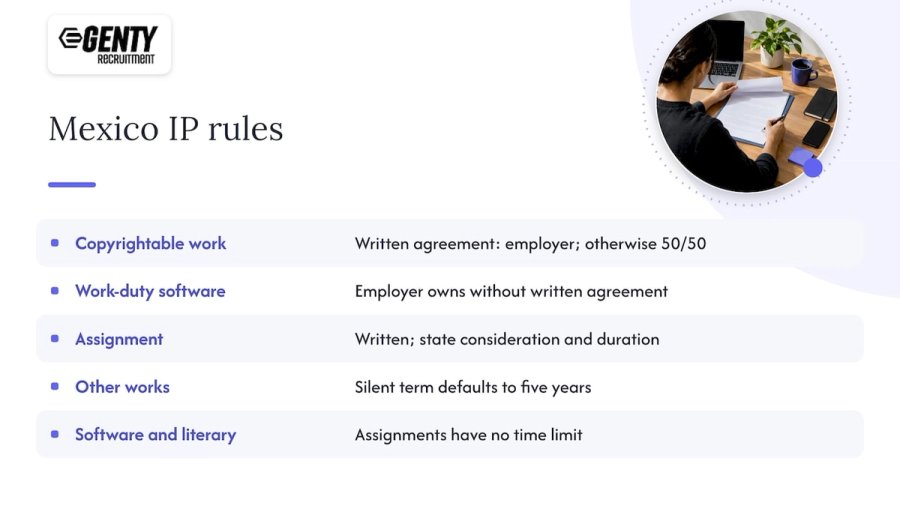
Under Mexico’s Federal Labour Law, the employer owns inventions developed within the scope of employment, and the employee may be owed extra compensation if the invention benefits the employer beyond what the wage reflects. For copyrightable work, the employer is the holder only with a written employment agreement that says so, otherwise rights split 50/50. Software developed as part of work duties is the exception: it belongs to the employer even without a written agreement.
Contractors need more care. A work-for-hire contract in Mexico is legally distinct from an assignment: an assignment must be in writing, state the consideration and stipulate duration, and the rights revert to the author when the term ends. For works other than software, the law presumes a five-year term when the contract is silent, and terms over 15 years need a valid cause. Assignments of software and literary works are not limited in time under Articles 43 and 103 of the Federal Copyright Law, which is why a software-focused team is simpler here than a design or content team.
Brazil
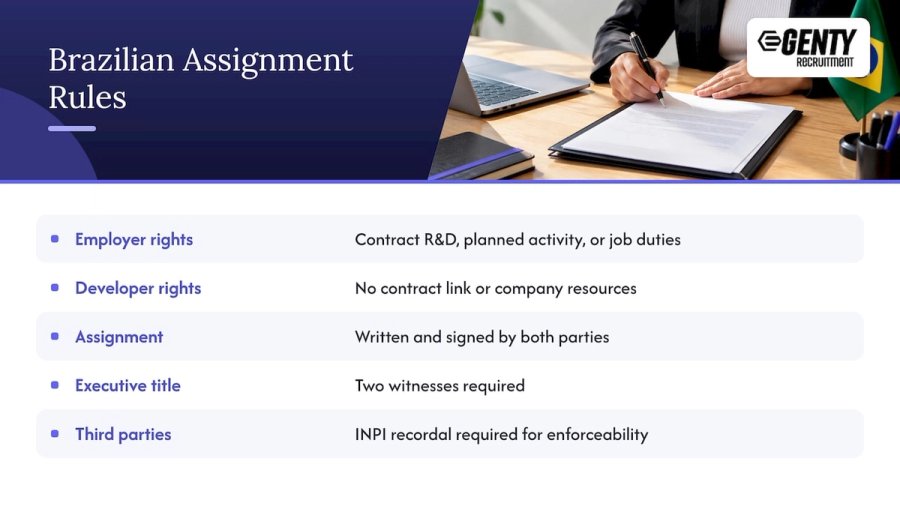
Brazil’s software law, Lei 9.609/98, gives the employer or hiring party the rights in a program when it was developed during the contract and the contract aimed at R&D, the developer’s activity was foreseen in it, or the program resulted from the nature of the duties. Rights stay with the developer when the program was created with no link to the contract and without the company’s resources, and compensation is limited, unless agreed otherwise, to the salary or fee already agreed.
Formalities matter as much as ownership. A Brazilian assignment must be in writing and signed by both parties; it needs two witnesses to qualify as an executive title; and it must be recorded with INPI, the national industrial property institute, to be enforceable against third parties. Foreign-language assignments are translated for recordal. If your Brazilian engineers also work on R&D that touches tax incentives, the documentation rules for software under the Lei do Bem are worth reading alongside the assignment terms.
Colombia
Colombian law is explicit about one case. Under Article 28 of Law 1450/2011, works created within an employment contract are understood to pass to the employer to the extent needed for its usual activities, unless agreed otherwise. That presumption applies only to written employment agreements, and moral rights are never transferred. For anyone outside a written employment contract, an explicit written assignment is the safe route.
Chile
In Chile, where the employment agreement’s purpose is inventive or creative work, the right to register and the resulting industrial property rights belong exclusively to the employer. An employee not hired for inventive work owns their inventions unless they used the employer’s knowledge or means, in which case rights go to the employer with additional remuneration. For software copyright, Law 17.336 treats the employer as owner of works created in performance of duties unless otherwise agreed in writing.
Argentina
Argentina is the country where drafting matters most. According to Argentine counsel on Ogletree’s cross-border podcast, the contract should state that the person was hired specifically to generate IP. Without that, the presumption is that they were not, and the IP belongs to them. If a creation goes beyond the normal scope of work, the employer can acquire it by paying additional compensation. For Buenos Aires engineers, put the IP-creation purpose in the first paragraph of the services agreement, then price the engagement accordingly. Our Argentina developer contractor rates page helps with that budgeting.
What the assignment should cover
A contractor assignment should reach the work product (code, designs, drafts, source files, documentation, inventions, data sets and deliverables), the rights in it (copyrights, patent and design rights, trademarks and goodwill, trade secrets, database rights, renewals and extensions), and the supporting terms: moral-rights waivers where allowed, a license to background materials, disclosure and approval of third-party and open-source components, confidentiality, further assurances, and payment and remedies.
Present assignment, not a promise
Write “hereby assigns,” not “will assign.” A promise needs a second document later, which is exactly what you cannot get from a contractor who has already left. The same guide recommends:
- present assignment of existing covered IP;
- future-invention coverage for work created during the engagement;
- a written prior-inventions schedule listing what the developer keeps;
- moral-rights waiver and consent language where the law allows;
- further-assurance duties to sign later filings;
- consideration and an effective date;
- warranties of authority.
Checklist before the first commit
- Confirm whether the person is an employee or contractor, and in which country they work.
- Check that the contract names IP creation as the purpose of the engagement (essential in Argentina).
- Use present-tense assignment language and a prior-inventions schedule.
- For Mexico, state consideration and duration where the work is not software.
- For Brazil, collect two witness signatures and plan INPI recordal, with translation if the agreement is in English.
- For Colombia, keep the assignment in writing and do not count on moral rights transferring.
- Add an open-source disclosure clause so third-party code is approved before it ships.
- Pair the assignment with a non-disclosure agreement covering trade secrets.
- Keep signed originals and recorded filings in a shared repository.
Record it where the right demands
Signing is half the job. In the US, 35 U.S.C. § 261 makes a patent assignment void against a later purchaser or mortgagee for value without notice unless it is recorded at the USPTO within three months of its date or before the later transaction. Brazil adds its own layer: patent and utility-model assignments must be notarized, apostilled and recorded with the BPTO, and moral rights cannot be assigned or waived.
This is the piece investors and acquirers examine in due diligence. A clean chain of title from each LATAM developer to your US entity shortens that review.
Timezone overlap helps the process
Latin America sits close to US Eastern and Pacific time. Colombia is aligned with Eastern, Mexico City with Central, and Argentina and Brazil run a few hours ahead of Pacific but keep a workable window. That overlap means you can walk a new hire through the assignment live, answer questions about the prior-inventions schedule, and collect signatures during the same working day, rather than trading drafts across a twelve-hour gap.
What this costs, and where hiring fits
A proper assignment is a small expense next to a disputed codebase. Local counsel review per country is a separate line from hiring, and we recommend budgeting for it with your first hire in each country. On the hiring side, GENTY recruitment’s published pricing starts at $2,999 one-off per hire for recruitment, and staffing starts at $99 per month per employee. For market context on pay, see our developer salaries in Latin America guide, and for a deeper walkthrough of contractor clauses read our IP assignment guide for remote contractors.
Our view
We see IP assignment as part of hiring, not as paperwork that follows it. The strongest LATAM engineering teams start from a short list of vetted candidates, and the contract conversation begins as soon as an offer is made: employment model, country, scope of work and who signs what. Our skill-first process is built to deliver curated shortlists within 7 days, so your legal groundwork can run in parallel instead of delaying the start date.
The point we repeat to CTOs is simple. Decide the assignment wording per country before you pick the candidate, because the right wording for a Buenos Aires contractor differs from the right wording for a Mexico City employee. Companies that do this early close hires faster and carry less risk into funding rounds.
Eugene
Hire LATAM engineers with the paperwork in mind
GENTY recruitment is a specialized IT and sales recruitment agency for US and European tech companies hiring pre-vetted talent in Argentina, Brazil, Mexico, Colombia, Chile and more. We offer a fixed fee per seniority level, no upfront payments and a 3-month replacement guarantee, and our clients save up to 40% compared with US or European hiring. If you are building an engineering team, start with our IT recruitment service.
For a broader plan, read how to hire remote talent from Latin America, or see our developer hiring page.
FAQ
Does a US work-made-for-hire clause protect me with a developer in Latin America?
Not on its own. IP law is territorial, so local courts in countries such as Argentina, Chile and Colombia apply their own legislation regardless of a US-governed assignment. Add explicit assignment wording and follow the local formalities.
Who owns code written by a contractor in Brazil?
Unless the contract says otherwise, the hiring party owns the program when the contract aimed at R&D, the developer’s role was foreseen in it, or the program resulted from the nature of the duties. Put the scope in writing and record the assignment with INPI.
Can moral rights be assigned in Latin America?
Generally no. In Colombia they are never transferred, and in Brazil they cannot be assigned or waived. Your agreement should secure the economic rights and use consent language for the rest.
When should the assignment be signed?
Before work begins. A promise to assign later requires a second signature, which is hard to get once a contractor has left. A present-tense assignment signed at onboarding covers work from the first day.
Sources
- Do You Need An IP Assignment From Contractors?
- Employee/Contractor Intellectual Property Agreements
- Intellectual Property Assignment Agreement: A Guide
- Cross-Border Catch-Up: IP Assignments Around the World
- Mexico | Lexology Panoramic 2025
- Mexico, Lexology
- Intellectual Property 2026: Mexico
- Who owns the code? IP clauses with Brazilian developers
- Intellectual property right assignments Q&A: Brazil
- IP Protection in Brazil: 7 Key Tips for Employers
- Intellectual property in employment context, Colombia
- Intellectual property in employment context, Chile
- Software na Lei do Bem