
A talent pipeline is defined as a repeatable system for identifying, engaging, and nurturing qualified candidates before a role opens. The talent pipeline building steps covered here are the industry-standard process known as proactive talent acquisition, and they apply directly to tech hiring managers who are tired of scrambling when a senior engineer quits. Proactive sourcing fills roles in 29 days versus 44 days for inbound-only hiring, while doubling quality of hire scores. That 15-day gap compounds fast across a growing engineering org. Nearly half of companies now rank pipeline building as their top hiring priority, and the ones targeting LATAM markets in Argentina, Brazil, Mexico, and Colombia are gaining a compounding advantage: nearshore timezone overlap with US EST and PST, strong English proficiency, and salaries that run 30–40% below US market rates.
What are the talent pipeline building steps that actually work?
The first step is understanding what a pipeline is not. Most recruitment teams confuse a static contact list with a dynamic, nurturing process. A spreadsheet of LinkedIn profiles is not a pipeline. A pipeline requires repeatable workflows for identifying, tagging, segmenting, and maintaining engagement with candidates over time. The distinction matters because a static list decays. Candidates change jobs, lose interest, or get hired by competitors while your list sits untouched.
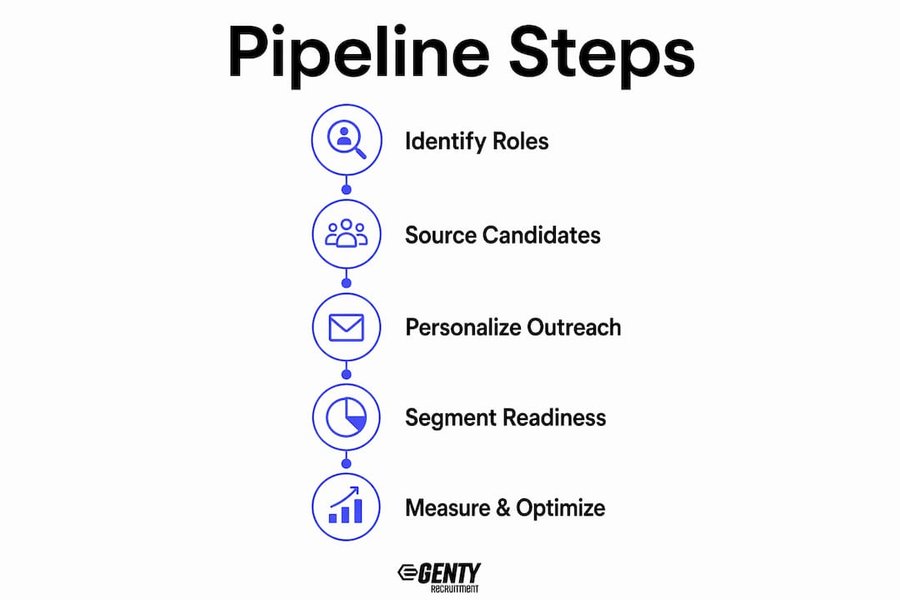
The core phases of talent pipeline development follow a clear sequence: identify target roles, source candidates proactively, personalize outreach, nurture relationships, qualify and segment candidates, and measure pipeline health. Each phase feeds the next. Skipping nurture, for example, means your sourced candidates go cold before you ever need them.

How to prioritize roles before you start sourcing
Successful pipeline building starts narrow, focusing on a few critical roles to generate early wins before scaling company-wide. Trying to pipeline every role at once produces shallow coverage everywhere and depth nowhere. The roles worth pipelining first share three traits: they recur frequently, they take the longest to fill, or they carry the highest business impact when vacant.
What do you need?
Choose the hiring path that fits
After reading "Talent Pipeline Building Steps for Tech Teams in 2026", most teams compare these options before deciding how to hire.
For most tech companies, that means starting with:
- Software engineers (backend, full-stack) in Brazil and Mexico, where developer density is high and English proficiency is growing
- DevOps and infrastructure engineers across Argentina and Colombia, where cloud-native talent is concentrated
- Data specialists including data scientists and data analysts, where demand consistently outpaces supply
- Sales engineers and SDRs for FinTech and SaaS companies expanding into new markets
Use workforce planning to forecast demand 6–12 months ahead. If your product roadmap calls for a microservices migration in Q3, you need DevOps candidates in the pipeline by Q1. Define a detailed candidate persona for each role: required skills, years of experience, preferred tech stack, remote work history, and timezone availability. Connecting role prioritization to a hiring forecast converts pipeline work from a recruiting exercise into a business planning tool.
Effective talent sourcing techniques for a LATAM-focused pipeline
Proactive sourcing combines outbound, inbound, and network channels. Relying on a single channel produces a fragile pipeline. The most effective talent sourcing techniques for LATAM remote tech roles use all three simultaneously.
Outbound sourcing starts with Boolean search on LinkedIn, GitHub, and Stack Overflow. Top recruiters prioritize GitHub contributions and conference speaker lists over generic databases to find high-relevance candidates efficiently. A developer who has contributed to open-source projects in your tech stack is a warmer lead than someone who simply lists the skill on a resume.
Inbound sourcing means building a presence that attracts candidates to you. Publishing engineering blog content, sponsoring LATAM tech meetups in São Paulo, Buenos Aires, or Bogotá, and maintaining an active LinkedIn company page all generate inbound interest from passive candidates.
Network sourcing through employee referrals is the most cost-effective channel available. Referral programs produce high-quality candidates at significantly lower cost compared to every other sourcing channel. For remote LATAM hiring, ask your existing LATAM engineers to refer peers from their university networks or former employers.
University partnerships in LATAM offer a sustainable junior talent pipeline. Intern programs in LATAM yield 60–80% acceptance rates when structured with mentorship and real project work. Partner with Universidad de Buenos Aires, UNAM in Mexico City, or USP in São Paulo to build early-career pipelines that feed senior roles three to five years out.
AI-powered sourcing tools automate initial candidate identification, freeing recruiters to focus on personalized outreach rather than manual profile reviews. Tools that aggregate profiles across LinkedIn, GitHub, and niche tech communities cut sourcing time significantly. For managing multi-channel pipeline data, an ATS with CRM functionality keeps candidate records, source tags, and engagement history in one place.
Pro Tip: Set a weekly sourcing cadence: two hours of Boolean search, one hour of GitHub community review, and one hour of referral follow-up. Consistency beats intensity for pipeline building.
How to personalize outreach and nurture candidates over time
Generic outreach fails. Personalized messages yield a 15% higher response rate than template-based messaging, according to LinkedIn data. That gap widens for passive candidates who receive dozens of generic recruiter messages per week. Referencing a candidate’s recent GitHub commit, a conference talk they gave, or a specific project on their profile signals that you did the work.
Effective nurture tactics for a LATAM-focused pipeline include:
- Quarterly check-ins that share relevant content, such as salary benchmarks or tech trend reports, rather than job pitches
- Event invitations to virtual tech talks, webinars, or LATAM-specific community events your company sponsors
- Milestone acknowledgments like congratulating a candidate on a promotion or new certification
- Role-specific updates when a position they previously expressed interest in becomes available
Consistent nurturing turns a static database into a strategic recruiting asset by maintaining candidate interest over time. A candidate who hears from you every quarter for six months is far more likely to respond when you have an opening than one who received a single cold message. Use a CRM to manage nurture sequences, track last contact dates, and flag candidates who have gone quiet for more than 90 days.
LATAM candidates in Argentina and Colombia often operate in GMT-3 to GMT-5 time zones, which overlaps directly with US EST business hours. Schedule outreach and follow-up calls during overlapping windows to maximize responsiveness. This timezone alignment is a structural advantage that European hiring cannot replicate.
Pro Tip: Segment your pipeline by candidate readiness before writing outreach. A candidate who applied six months ago needs a different message than one you sourced cold from GitHub today.
How to assess and segment candidates for pipeline readiness
A well-segmented pipeline tells you exactly how many candidates are at each stage and how quickly they move through. Define four pipeline stages and apply them consistently:
Use lightweight assessments at the qualified stage. A 30-minute informal conversation about a candidate’s current tech stack, remote work setup, and career goals provides more signal than a formal test for pipeline purposes. Save structured technical assessments for active hiring processes.
Tracking pipeline velocity, candidate conversion rates, and source effectiveness helps you identify where candidates stall. If 60% of your pipeline sits in the “engaged” stage without moving to “qualified,” your outreach is generating interest but not converting to conversations. That points to a messaging problem, not a sourcing problem.
For LATAM candidates, segment by remote work preference and visa status separately. Many candidates in Brazil and Mexico are open to fully remote roles with US companies but have no interest in relocation. Tagging this preference early prevents wasted effort later.
Best practices for measuring and optimizing your talent pipeline
A healthy pipeline requires active maintenance, not passive accumulation. Building a talent pipeline typically takes 3–6 months to gain consistent traction. The first 90 days are about building coverage; the next 90 are about improving conversion.
The KPIs that matter most for pipeline health are:
- Time-to-hire by source channel: measures which sourcing method fills roles fastest
- Pipeline conversion rate: percentage of identified candidates who reach the “ready” stage
- Candidate engagement rate: percentage of contacted candidates who respond within 14 days
- Source channel ROI: cost per qualified candidate by channel (referral, outbound, inbound, university)
- Pipeline freshness: percentage of candidates contacted within the last 90 days
Review these metrics monthly. A pipeline where 40% of candidates have not been contacted in over 90 days is not a pipeline. It is a decaying list. Set a freshness threshold and remove or re-engage candidates who fall below it. For LATAM markets, factor in hiring seasonality: january and july see lower candidate availability in Brazil due to local holiday patterns, while Argentina’s tech market is most active in Q1 and Q3.
Pair your ATS with a CRM that supports automated nurture sequences. For HR software platforms that include pipeline management features, look for candidate tagging, engagement tracking, and source attribution as baseline requirements. Diversity analytics should also be tracked from the start. LATAM pipelines naturally produce geographic diversity, but tracking gender and seniority distribution within the pipeline helps identify gaps before they become hiring problems.
Key Takeaways
A talent pipeline built on proactive sourcing, consistent nurture, and clear segmentation fills roles 15 days faster and produces measurably higher-quality hires than inbound-only recruiting.
Why most pipelines fail before they start
The uncomfortable truth I’ve learned from watching dozens of tech companies attempt pipeline building is this: the failure almost always happens at step one. Teams skip role prioritization entirely and try to build a pipeline for every position at once. Six months later, they have 400 names in a spreadsheet, no nurture history, and zero candidates ready to hire. The pipeline feels like it exists, but it produces nothing when pressure hits.
The second failure mode is treating LATAM as a cost play rather than a talent play. Yes, hiring a senior backend engineer in Colombia costs significantly less than hiring in San Francisco. But the teams that get the most from LATAM pipelines are the ones that source for skill first and treat timezone overlap as a genuine collaboration advantage, not just a scheduling convenience. Engineers in Buenos Aires working EST hours are not a compromise. They are a structural advantage for US product teams that need real-time collaboration without the overhead of a European timezone gap.
My recommendation: start your talent pipeline for LATAM with two roles, one sourcing channel, and a 90-day nurture cadence. Prove the model works at small scale before expanding. The teams that build sustainable pipelines are the ones that treat it as an operating discipline, not a one-time project. Discipline compounds. A pipeline that runs for 18 months produces candidates that a 30-day reactive search never will.
— Eugene
How GENTY recruitment accelerates your LATAM talent pipeline
Building a proactive pipeline takes time that most hiring managers do not have. GENTY recruitment’s IT recruitment process is built around pre-vetted, remote-ready candidates across Argentina, Brazil, Mexico, Colombia, and Chile, with curated shortlists delivered within 7 days.
GENTY recruitment specializes in FinTech, AI, SaaS, and Web3 roles, placing software engineers, DevOps specialists, and data teams for US and European tech companies. Fixed-fee pricing per seniority level, no upfront payments, and a 3-month replacement guarantee mean you carry no financial risk. Clients save up to 40% compared to US market rates while gaining candidates who work in EST-aligned time zones with strong English proficiency. Contact GENTY recruitment to build a pre-vetted LATAM shortlist for your next critical role.
FAQ
What is a talent pipeline in recruiting?
A talent pipeline is a proactive system for identifying and nurturing qualified candidates before a role opens. It differs from a contact list because it requires ongoing engagement, segmentation, and readiness tracking.
How long does it take to build a talent pipeline?
Building a talent pipeline takes 3–6 months to gain consistent traction. The first 90 days focus on coverage; the second 90 focus on improving candidate conversion rates.
What sourcing channels work best for LATAM tech talent?
Employee referrals, Boolean search on LinkedIn and GitHub, and university partnerships in Brazil, Mexico, and Argentina produce the highest-quality LATAM candidates at the lowest cost per hire.
How do you measure talent pipeline success?
Key pipeline metrics include time-to-hire by source channel, candidate conversion rate from identified to ready, engagement rate, and pipeline freshness. Review all four monthly.
Why is LATAM a strong market for tech talent pipelines?
LATAM engineers in Argentina, Colombia, and Mexico work in EST-adjacent time zones, carry strong English proficiency, and cost 30–40% less than equivalent US-based talent, making them a high-value pipeline target for US tech companies.