

The most effective way to build diverse tech teams combines three non-negotiable elements: leadership accountability tied to measurable KPIs, a skills-first hiring process that removes credential gatekeeping, and sourcing channels that reach beyond your existing network. Teams that get all three right don’t just check a diversity box. They outperform.
Here’s what that looks like in practice:
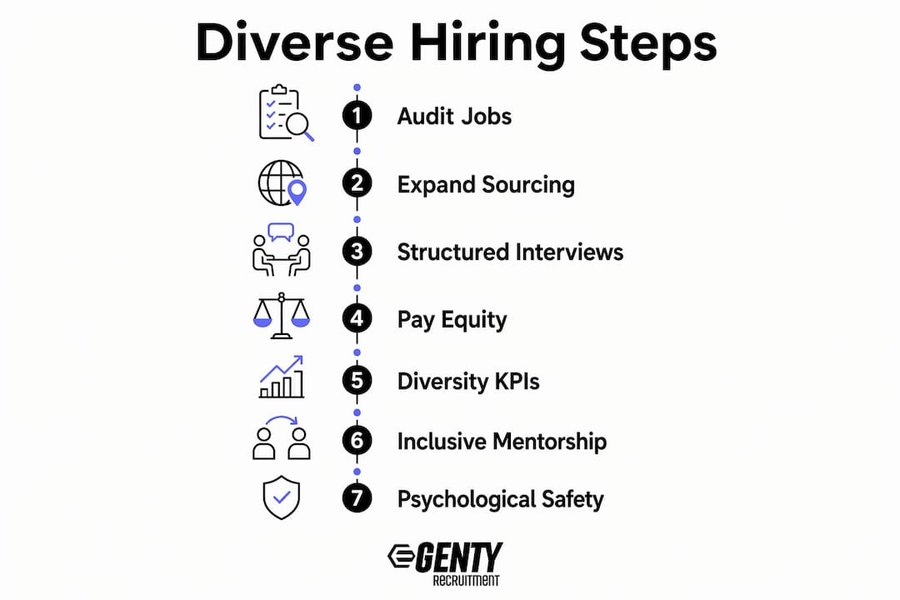
- Commit at the top. Diversity initiatives fail when HR owns them alone. A senior tech leader must be accountable, with DEI goals embedded in performance reviews and the main talent dashboard, not a separate report.
- Rewrite job descriptions. Remove degree requirements and biased language. Focus on problem-solving ability, learning speed, and specific technical competencies.
- Expand your sourcing geography. Argentina, Brazil, Mexico, and Colombia produce world-class engineers at compensation levels well below US market rates, with timezone overlap that makes real-time collaboration practical.
- Adopt structured interviews. Standardized questions and scoring rubrics applied consistently across every candidate reduce the unconscious bias that derails most hiring funnels.
- Set measurable diversity goals. Vague commitments produce vague results. Track candidate conversion rates at each funnel stage, from application to offer, to identify exactly where bias enters.
- Build inclusion into onboarding. Mentorship programs, employee resource groups, and psychological safety training determine whether diverse hires stay past 12 months.
- Review pay equity regularly. Transparent salary bands reduce compensation-driven attrition, which disproportionately affects underrepresented engineers.
Why diversity in tech teams drives better outcomes
Diverse problem-solving groups consistently outperform groups composed only of the highest-ability but homogeneous individuals. The mechanism is straightforward: when every team member approaches a problem through the same mental model, they get stuck at the same local optima. A team with varied perspectives, heuristics, and backgrounds finds solutions the uniform group never considers.
The business case extends well beyond problem-solving speed. Companies with diverse senior leadership attract and retain more top technical talent and outperform homogeneous teams in innovation. Engineers who prioritize inclusion, and that cohort is growing, actively screen employers for visible diversity before accepting offers.
What do you need?
Choose the hiring path that fits
After reading "How to Build Diverse Tech Teams That Actually Perform", most teams compare these options before deciding how to hire.
There’s a harder argument too. As AI systems make decisions about credit, fraud detection, and customer service, the teams building those systems need people who will question whether the model is fair. That capacity for critical challenge only exists when the team includes people with genuinely different life experiences. Homogeneous AI teams produce biased outputs at scale, and the consequences compound quickly.
Pro Tip: Feature diverse engineers in your recruiting materials and on your engineering blog. Candidates from underrepresented groups look for evidence that people like them have succeeded at your company before they apply.
Common challenges that slow down diverse hiring
Most hiring funnels have bias baked in at multiple stages, and the damage accumulates before a single offer goes out.
- Unconscious bias in technical screening. Résumé filters that weight prestigious universities or specific company names eliminate qualified candidates before any human reviews their work.
- Referral-heavy sourcing. When your current team refers candidates from their own networks, you replicate the demographic profile you already have. Referrals are efficient, but they’re not a diversity strategy.
- Retention failures. Hiring diverse engineers into a culture that doesn’t support them produces attrition within 18 months. The cost of replacing a mid-level engineer typically exceeds their annual salary.
- Pay gaps. Compensation inconsistency, even unintentional, signals to underrepresented engineers that advancement is not equally available to them.
- Cultural and language friction in global teams. Engineers hired from Colombia or Brazil bring different communication norms and sometimes different levels of English fluency. Without structured onboarding that addresses this, early misunderstandings erode psychological safety.
- Weak psychological safety. When engineers from underrepresented groups don’t feel safe raising concerns or disagreeing with senior colleagues, you lose the exact cognitive diversity you hired them for.
Step-by-step strategies to build diverse tech teams
Audit and rewrite job descriptions
Start with your job postings. Tools like Textio or Gender Decoder flag language patterns that discourage applications from women and underrepresented groups. Removing biased language and expanding sourcing to diverse channels measurably increases the diversity of your candidate pool. Cut degree requirements where the role doesn’t genuinely need them. List only the skills that are actually tested in the interview.
Expand sourcing beyond your default channels
Post on platforms that reach underrepresented engineers: Lesbians Who Tech, Out in Tech, the National Society of Black Engineers job board, and LATAM-focused tech communities. Hiring in LATAM tech hubs in Argentina, Brazil, Mexico, and Colombia gives you access to a deep pool of pre-vetted engineers with strong English proficiency and working hours that overlap with US EST and PST. That timezone alignment is what makes nearshore collaboration practical rather than theoretical.

Adopt structured interviews
Structured interviews with standardized questions and clear evaluation rubrics reduce unconscious bias and increase fairness in tech hiring. Every candidate for a given role answers the same questions, scored against the same criteria. Interviewers complete their scoring independently before any group debrief, which prevents the first opinion in the room from anchoring everyone else’s judgment.
Implement transparent pay equity reviews
Pay equity audits and transparent salary bands reduce compensation-related attrition among diverse engineers. Run a compensation analysis by role, seniority, and demographic group at least annually. Publish salary bands internally. When engineers can see the range for their level, negotiation gaps narrow and trust in the organization’s fairness increases.
Set measurable diversity KPIs
Clear diversity KPIs and continuous data review via talent dashboards are critical for accountability. Track representation at each level, from IC to VP, alongside promotion rates and attrition rates broken down by demographic group. Treating diversity as an execution problem and tracking candidate funnel conversion reduces bias and improves hiring outcomes. If women convert from phone screen to technical interview at half the rate of men, that’s a signal to investigate your screening criteria, not your candidate pool.
Build inclusive onboarding and mentorship
Retention improves with inclusive onboarding, mentorship, sponsored employee resource groups, and supportive leadership. Assign every new hire a buddy from a similar background where possible, and a senior sponsor who actively advocates for their visibility on high-profile projects. For LATAM hires specifically, structured onboarding that addresses communication norms and team workflows prevents the early friction that drives attrition.

Train for psychological safety
Psychological safety encourages diverse perspectives to be shared and valued. Train engineering managers in pair programming facilitation, constructive code review, and how to run retrospectives where junior engineers feel safe raising concerns. The goal is a team where the quietest person in the room still contributes their best thinking.
Diversity implementation checklist
Pro Tip: Don’t wait until you have a full DEI program to start tracking. A simple spreadsheet logging candidate demographics at each funnel stage will reveal bias hotspots within two hiring cycles.
How a skills-first approach with LATAM talent works in practice
The skills-first hiring approach treats problem-solving ability and learning speed as the primary selection criteria, not degree pedigree or prior employer brand. For US tech companies, applying this approach to LATAM talent pools produces a concrete structural advantage: you access engineers who are technically strong, cost-competitive, and available during your working hours.
Here’s how the model compares across key LATAM markets:
GENTY recruitment’s process applies this model directly. Every candidate goes through a skills-based technical assessment before any client sees their profile. Shortlists arrive within 7 days of a role brief, and every placement carries a 3-month replacement guarantee. For a CTO building a diverse engineering team, that process removes the sourcing burden while preserving full control over final hiring decisions.
The skills-first approach also supports diversity goals structurally. When you evaluate candidates on demonstrated ability rather than credential proxies, you open the pool to engineers who built their skills outside traditional university pipelines. That’s a meaningful share of LATAM’s best technical talent, particularly in Argentina and Colombia, where self-taught and bootcamp-trained engineers regularly outperform their credentialed peers on practical assessments.
For teams that need to source and hire remote LATAM tech talent at scale, blending full-time hires with contract engineers gives you flexibility to staff up for a product sprint without overcommitting headcount. Track performance at 30, 60, and 90 days using the same metrics you apply to domestic hires. Integration quality, not geography, determines whether a LATAM engineer becomes a long-term contributor.
Key Takeaways
Building diverse tech teams requires leadership accountability, skills-first hiring, inclusive culture practices, and sourcing channels that reach beyond your existing network, including LATAM talent hubs in Argentina, Brazil, Mexico, and Colombia.
Ready to build a diverse engineering team with LATAM talent?
GENTY recruitment places pre-vetted software engineers, DevOps specialists, and data professionals from Argentina, Brazil, Mexico, and Colombia into US tech teams, with curated shortlists delivered within 7 days, fixed-fee pricing by seniority level, no upfront payments, and a 3-month replacement guarantee. Clients often save a substantial amount compared to equivalent US hires while gaining engineers who work in their timezone and communicate in fluent English.
If you’re a CTO, VP of Engineering, or founder ready to expand your talent pool without sacrificing quality or speed, explore GENTY recruitment’s IT hiring services or visit gentyrecruitment.io to start a conversation.