

A candidate pipeline is a proactively maintained, assessed, and engaged pool of pre-qualified candidates at various stages of readiness, available for future or recurring roles before a requisition formally opens. According to iCIMS, strong pipeline management shortens time-to-hire, reduces cost-per-hire, and improves hire quality through continuous engagement and CRM-driven nurturing. For US tech teams hiring in Latin America, GENTY recruitment delivers curated, pre-vetted shortlists within 7 days and clients report significant cost savings versus equivalent US or European hires, making a well-run pipeline the single highest-leverage investment in your talent operation.
Why candidate pipelines change recruiting outcomes for tech teams
Reactive hiring is expensive in ways that rarely show up on a single job order. When a backend engineering seat opens and you start sourcing from zero, you typically spend two to four weeks just identifying qualified candidates, another week screening, and then another negotiating. A pipeline-enabled process collapses the front half of that funnel because sourcing and pre-assessment are already done.

SHRM’s recruiting guidance identifies source-of-hire, time-to-fill, candidate engagement rates, and stage-to-hire conversion as the core metrics that separate reactive from proactive talent operations. Active pipeline management reduces dependence on job postings and creates a centralized source of truth that scales with hiring volume.
The business impact is concrete:
- Time-to-fill: Pipeline hires typically move straight to interviews rather than starting at sourcing, cutting weeks off the front of the funnel.
- Cost-per-hire: Fewer agency fees and less emergency sourcing spend when a seat opens.
- Hire quality: Pre-assessed candidates who have been warmed over time convert at higher rates and tend to be better fits, reducing early attrition.
- Product velocity: Faster engineering hires mean faster sprint capacity, which matters when you are scaling a SaaS or FinTech product.
For a recurring mid-level backend engineer role, a team without a pipeline might spend 6–8 weeks from requisition to offer. A team with a maintained pipeline of pre-screened candidates in Argentina or Colombia can compress that to 2–3 weeks, with GENTY recruitment’s LATAM hiring process often delivering a shortlist by day 7.
Need help hiring?
See the next step after this guide
If this topic is relevant to your team, these are the most useful pages to check next.
How a candidate pipeline differs from a talent pool, ATS, and a sourcing list
These four terms get used interchangeably, and that confusion is exactly why most pipelines fail. Each concept represents a different level of operational readiness.
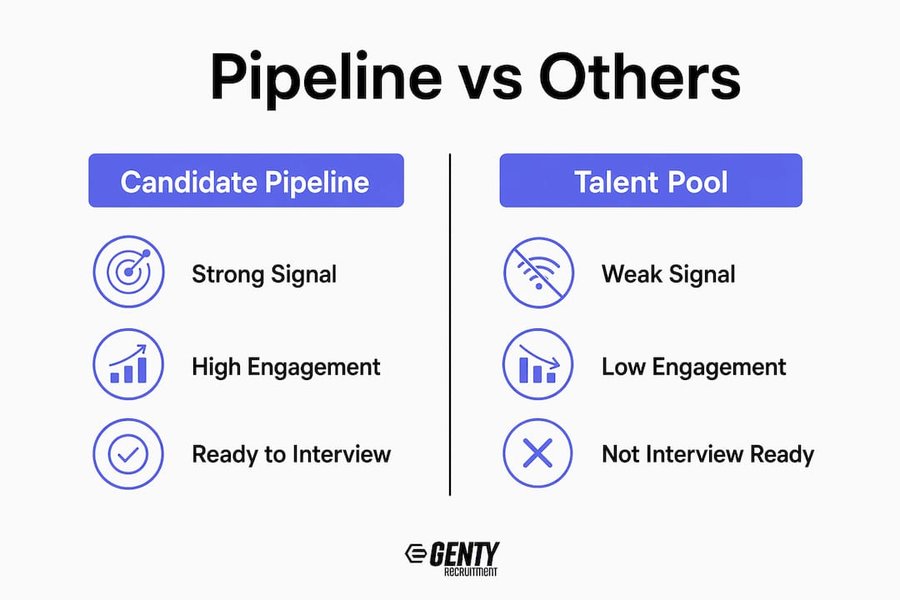
The distinction that matters most operationally: a resume on file is not a pipeline candidate. A pipeline candidate has been assessed, has responded to outreach, and has a readiness label that tells you how quickly they can move. A sourcing list is raw material. An ATS database is a historical record. A talent pool sits between the two but lacks the assessment signal that makes fast movement possible.
For a team that hires mid-level backend engineers repeatedly, a pipeline is the right investment. For a one-off VP of Product search, a talent pool or direct sourcing engagement is more appropriate. Knowing which tool you actually have prevents the false confidence of thinking you are pipeline-ready when you are really just database-rich.
What are the core pipeline stages, and what moves a candidate through them?
A well-defined stage model is what separates an operational pipeline from a list. Each stage needs an owner, entry criteria, exit criteria, and a time-in-stage threshold. Without those, candidates stall and the pipeline becomes a graveyard.
Structured assessments run early in the pipeline raise predictive validity far above resume-only signals. Standardizing these screens at the Screened/Assessed stage means you never re-screen a candidate when a requisition opens — they are already cleared.
Pro Tip: The recruiter owns the candidate through Shortlisted. The hiring manager takes ownership at Interview Loop. Document this handoff explicitly in your ATS so candidates never fall through the gap between those two stages. For LATAM hires, add a timezone overlap check (EST/PST coverage) and a minimum English proficiency marker as mandatory entry criteria at the Screened stage.
One compliance note: under US privacy best practices, candidates should provide explicit consent before you store their data in a pipeline. Document consent at the Contacted stage and apply a defined retention period (typically 12–24 months) before archiving or deleting records.
How do you build and manage a candidate pipeline from scratch?
Building a pipeline is an operational project, not a one-time setup. The steps below apply whether you are building internally or working with a partner like GENTY recruitment.
Five governance steps before you source a single candidate
- Assign a pipeline owner. One person is accountable for stage movement, SLA compliance, and data hygiene. Without a named owner, pipelines decay within 60 days.
- Define stage criteria. Use the stage table above as a starting point. Every stage needs entry and exit criteria in writing before you open the pipeline.
- Set SLAs for each stage. Time-in-stage targets (see table above) become alerts in your ATS or CRM. If a candidate sits in Screened for more than 7 days, the owner gets a flag.
- Schedule quality audits. A monthly 30-minute pipeline review with the hiring manager catches stale candidates, misaligned personas, and sourcing gaps before they compound.
- Define archive rules. Candidates who are unreachable after a full re-engagement sequence, or whose consent has lapsed, move to archive. Set a calendar reminder for retention expiry.
Sample 5-touch nurture cadence for passive candidates
Effective nurturing for passive candidates is personalized and periodic. A single generic job blast is more likely to cause attrition than re-engagement. Each touch should reference something specific to the candidate’s background or the role’s context.
Segmentation and readiness labels
Segment every pipeline candidate into one of three readiness states:
- Active: Open to new roles now; prioritize for current requisitions.
- Passive: Employed and not actively looking; maintain with periodic nurture.
- Unreachable: No response after full outreach sequence; move to archive after one re-engagement attempt.
For LATAM hires, add a fourth dimension: timezone coverage. A candidate in Buenos Aires (ART, UTC-3) overlaps with US Eastern by 1–2 hours and with Pacific by 4–5 hours. Colombia and Mexico City (both UTC-5 and UTC-6 respectively) offer stronger EST/PST overlap. Tagging candidates by country and timezone in your CRM prevents scheduling friction later.
Compliance checklist:
- Collect explicit consent at first contact; log date and method.
- Restrict pipeline access to hiring team members with a need to know.
- Set retention expiry reminders (12–24 months from last active engagement).
- Document the legal basis for data processing (legitimate interest or consent) per your organization’s privacy policy.
Which tools actually support a candidate pipeline?
The functional split is straightforward: your ATS handles active applicants and requisition workflows; your CRM handles long-term nurture, segmentation, and candidate marketing. Most teams need both, but the investment threshold differs by hiring volume.

Named platforms by category:
- ATS: Greenhouse, Lever, Workable, iCIMS, Bullhorn
- CRM / talent marketing: Beamery, iCIMS Talent Cloud (which combines both)
- Outreach / automation: LinkedIn Recruiter, email sequencing tools integrated with your CRM
When to invest in a standalone CRM: if you hire more than 20 roles per year, have recurring role families (e.g., repeated backend engineer or DevOps hires), or are building a LATAM-specific talent community, a CRM pays for itself quickly, especially as automation trends evolve with the rise of AI agents in prediction markets. If you hire fewer than 10 roles per year, a well-configured ATS with a native talent community feature (Greenhouse, Workable) is usually sufficient.
Key vendor selection criteria: API access for ATS/CRM integration, analytics depth for pipeline KPIs, and scalability as your hiring volume grows. For teams exploring recruitment automation, the integration between outreach tooling and your CRM is where most efficiency gains live.
What KPIs tell you whether your pipeline is actually working?
A pipeline without measurement is just a list with a better name. These KPIs give you the signal you need to intervene before a quarter’s hiring plan falls apart.
SHRM’s talent management guidance consistently identifies source-of-hire and time-to-fill as the two metrics most predictive of overall recruiting health. Engagement rate is the leading indicator — if responses drop, your nurture content or targeting is off, and you will see it in conversion two to three weeks later.
Slice every KPI by role family, seniority level, and geography. For LATAM pipelines, break out Argentina, Brazil, Mexico, and Colombia separately. Conversion rates and time-in-stage often differ by country because of market depth and English proficiency distribution. A pipeline that looks healthy in aggregate can be masking a stalled Colombia segment or an over-indexed Argentina pool.
Common pipeline pitfalls and how to fix them in 48 hours
Most pipeline failures trace back to a small set of operational mistakes. Each one has a fast corrective action.
- Treating a resume database as a pipeline. Fix: audit your “pipeline” today. If candidates have no structured screen score and no engagement in the last 90 days, they are archived records, not pipeline candidates. Re-engage or archive within 48 hours.
- No named owner. Fix: assign one person accountable for pipeline health before the next hiring cycle opens. Document it in your ATS.
- Missing SLAs. Fix: set time-in-stage alerts in your ATS or CRM this week. Start with the Screened stage — candidates who sit there longest cause the most damage to time-to-hire.
- One-size-fits-all nurture. Fix: segment by readiness label (active, passive, unreachable) and by role family. A DevOps engineer in Mexico City and a data scientist in São Paulo should not receive the same message.
- Failing to pre-assess. Fix: add a structured screen (30-minute video call with a standardized scorecard) as a mandatory exit criterion for the Contacted stage. Pre-assessment with structured signals raises predictive validity far above resume-only evaluation.
- Stale data. Fix: run a monthly hygiene pass. Candidates with no engagement in 6 months get one re-engagement attempt; if no response, they move to archive.
Pipeline hygiene checklist:
- Monthly audit: flag candidates with no activity in 90+ days.
- Quarterly re-engagement: send a personalized update to passive candidates.
- Archive criteria: no response after 5-touch re-engagement sequence.
- Minimum signal threshold: no candidate advances past Contacted without a structured screen score.
One ethical note: when re-contacting passive candidates, always acknowledge the time elapsed since your last interaction and give them a clear, easy way to opt out of future communications.
How GENTY recruitment builds pipelines for US teams hiring in LATAM
GENTY recruitment runs a structured pipeline process purpose-built for US and European tech companies hiring remote talent across Argentina, Brazil, Mexico, and Colombia. The operational flow moves from demand forecasting through structured pre-assessment to a curated shortlist, typically within 7 days of project kickoff.
Operational flow
The process starts with a target persona definition session with the hiring manager — role, seniority, technical stack, English proficiency minimum, and timezone coverage requirement. From there, GENTY recruitment sources across its pre-built LATAM talent network, applies a structured screen (technical assessment plus language check), and delivers a shortlisted set of pre-vetted candidates. The typical total hire cycle from shortlist to signed offer runs 2–4 weeks for most mid-to-senior engineering and sales roles.
Sample role, country, and timeline reference
For salary benchmarking by country and role, GENTY recruitment maintains dedicated LATAM market data covering Argentina, Brazil, Mexico, and Colombia. Clients consistently report substantial cost savings versus equivalent US or European hires, with no sacrifice in technical quality or English proficiency.
Pro Tip: For EST-based teams, Colombia and Mexico offer the strongest scheduling overlap — candidates in Bogotá (UTC-5) and Mexico City (UTC-6) can cover a full US business day. Argentina (UTC-3) works well for morning EST standups and async afternoons. Brazil (UTC-3 in most states) mirrors Argentina’s overlap profile. Build your interview windows around 9 AM–12 PM EST to accommodate all four countries without requiring candidates to join calls outside business hours.
GENTY recruitment’s fixed-fee pricing per seniority level, no upfront payment model, and 3-month replacement guarantee mean the financial risk of a pipeline project is defined before you start. For teams building English-proficient LATAM pipelines, the combination of pre-assessed candidates and timezone alignment removes the two most common friction points in remote hiring.
Key Takeaways
A well-governed candidate pipeline with defined stages, named owners, and structured pre-assessment is the single most effective way to cut time-to-hire and cost-per-hire for recurring tech roles.
The part most pipeline guides skip
Most articles on candidate pipelines focus on the mechanics: stages, SLAs, CRM selection. That is all necessary. What they consistently underweight is the ownership problem.
A pipeline without a named, accountable owner degrades faster than almost any other recruiting asset. A job board posting stays live until you turn it off. A pipeline requires active decisions every week: who gets re-engaged, who gets archived, which stage is stalling, and whether the persona definition still matches what the hiring manager actually wants. Without someone whose job it is to make those calls, the pipeline becomes a database within 60 days.
The second thing guides miss: persona drift. A pipeline built for a “senior backend engineer” in Q1 may be misaligned by Q3 if the team’s stack has shifted or the role’s scope has changed. The monthly pipeline review with the hiring manager is not optional maintenance — it is the mechanism that keeps the pipeline calibrated to what you actually need to hire.
For LATAM pipelines specifically, the timezone and language criteria are not soft preferences. They are hard filters that determine whether a hire will function in your team’s daily rhythm. Building those into the entry criteria at the Screened stage, rather than discovering misalignment at the offer stage, is the operational discipline that separates teams that hire well in LATAM from teams that try once and give up.
GENTY recruitment: a faster path to a pre-built LATAM pipeline
Building a candidate pipeline internally takes months of sourcing, screening, and relationship management before you have a shortlist worth presenting to a hiring manager. For US and European tech companies that need to hire in Argentina, Brazil, Mexico, or Colombia without that runway, GENTY recruitment offers a direct alternative: a pre-vetted LATAM talent pipeline with curated shortlists delivered within 7 days, fixed-fee pricing per seniority level, and a 3-month replacement guarantee.
The cost advantage is concrete: clients save up to 40% versus equivalent US or European hires, with candidates pre-assessed for technical skills, English proficiency, and timezone overlap. For teams that need RPO-level pipeline support without a long-term contract, GENTY recruitment’s model is structured around completed placements, not retainers. If you are ready to move from reactive sourcing to a pipeline that delivers shortlists in a week, contact GENTY recruitment to define your target persona and get a project scoped.
Useful sources and further reading
These resources support the claims in this article and provide deeper methodology for teams building or auditing their pipeline processes.
- SHRM Recruiting and Talent Management — The authoritative US source for pipeline KPIs, stage definitions, ownership models, and candidate engagement best practices. Start here for benchmarks and governance frameworks.
- iCIMS Candidate Pipeline Management Guide — Practical best practices for pipeline segmentation, ATS/CRM integration, and nurture campaign design from one of the leading ATS vendors.
- Predictive Validity Research on Structured Assessments — Academic foundation for why structured screens outperform resume-only evaluation; use this to justify early pre-assessment in your pipeline design.
- Indeed: How to Create and Maintain Recruitment Pipelines — Operational steps for sourcing, screening, and maintaining candidate relationships after an unsuccessful hire.
- GENTY recruitment: Hire Remote LATAM Talent — Primary source for LATAM salary benchmarking, country-specific market data (Argentina, Brazil, Mexico, Colombia), and timezone overlap analysis for US-based hiring teams.
- GENTY recruitment: Talent Pipeline Building Steps for Tech Teams — GENTY recruitment’s operational pipeline template and step-by-step guide for tech teams building LATAM-specific pipelines.