

Work culture in Latin America is relationship-first: trust, personal connection and a visible, caring leader make teams move faster, and the pattern shifts enough from country to country that Argentina, Brazil, Mexico, Colombia and Chile each need their own playbook. For a CTO or founder hiring remote engineers or sales reps in the region, the practical payoff is real: overlap with US Eastern and Pacific working hours, strong collaboration habits, and managers who build loyalty by showing up. At GENTY recruitment, we place pre-vetted LATAM talent with US and European tech companies, so this guide focuses on what changes in your day-to-day management once you hire there.
TL;DR
- Personal trust comes before task efficiency: invest in one-to-ones and camera-on conversations early, and results follow.
- Communication is often indirect, and a blunt “no” is rare, so ask open questions and confirm understanding by paraphrasing.
- Hierarchy, titles and deadlines are treated differently in Mexico, Brazil, Argentina, Colombia and Chile. Treat the region as five markets, not one.
- Time zone alignment with US Eastern and Pacific hours is a structural advantage for standups, pairing and sales calls.
- A clear written working agreement (hours, response times, decision rights) protects both sides and replaces guesswork.
What “work culture” means in Latin America
The concept most often used to describe the region is personalismo: business conducted between people who trust one another personally, rather than between institutions or job titles. Rework’s 2026 guide to business culture in Latin America describes trust as earned face to face, decisions that concentrate at the top even where an org chart looks flat, and meetings that often start late with several things happening at once.
For a hiring manager, this translates into three working habits:
- People want to know you before they work with you. A reference from a known person, or a few unhurried minutes at the start of a call, does real work. The SAGE Encyclopedia entry on communicating with people from Latin America states that relationship is a predominant value and that an introduction by a known person helps accomplish goals.
- Leaders are expected to care. In a 2021 study of top regional executives, Spencer Stuart found that humility, caring relationships and working side by side are foundations of leadership success.
- Teams rely on each other. A 2007 study of managers in 62 nations found above-average reliance on co-workers in Argentina, Brazil, Chile and Colombia, with a weaker effect in Mexico.
That last point is good news for distributed engineering. Pairing, code review and incident response all depend on colleagues who readily lean on one another. If you are exploring how remote professionals approach the market from the other side of the table, how remote roles are found gives useful context on what candidates expect from distributed employers.
What do you need?
Choose the hiring path that fits
After reading "Work Culture in Latin America: A Guide for US and European Tech Leaders", most teams compare these options before deciding how to hire.
Do not treat the region as one culture
The most common mistake we see in briefs from US and European leaders is a single “LATAM style” applied to everyone. The research argues against it. An Arizona State University study of 733 employees at eight multinationals in Argentina, Brazil, Chile, Colombia and Mexico found significant differences within the region in attachment to formal rules, formal hierarchies, structured business planning and the treatment of women at work. The 2007 managers study adds marked national variation: low reliance on specialists in Chile, on one’s own experience in Mexico and on one’s superior in Colombia.
The table below summarizes the patterns most relevant to a remote tech or sales team. Treat it as a starting hypothesis about each market, then adjust to the individual and the company.
The Brazil, Mexico and Argentina patterns come from the Rework guide above. The University of Manchester literature review describes Brazilian relationships as hierarchical with loyal workers, alongside the jeitinho, an easy-going, non-confrontational way of getting things done. For Chile it describes a paternalistic, hierarchical style with some fear of confronting authority.
City and company type matter as much as country. A 2026 cross-cultural guide notes that financial services and multinational offices in Mexico City run on tighter schedules than creative agencies in Bogotá, and cautions against using jeitinho as a universal explanation for Brazilian professionals. If your company is a FinTech or SaaS scale-up, the people you hire are frequently already used to US-style cadence from working with international clients.
Communication, feedback and the word “no”
The SAGE entry notes that communication tends to be indirect and an outright “no” is rare, though frankness is common once closeness and trust exist. A 2026 Mexico–US workplace communication guide adds that mañana can work as a polite placeholder for “not today” and that ending a meeting abruptly is felt as offensive.
For an engineering manager, that suggests concrete changes to how you run work:
- Replace yes/no questions with specifics. Instead of “Can you ship this Friday?”, ask “What would need to be true for this to ship Friday, and what could slip?”
- Paraphrase back. The PMI’s cross-cultural communication guidelines recommend paraphrasing to check clarity and remembering that cultural norms may not apply to any one individual.
- Give feedback privately and early, and frame it around the work. In hierarchical settings, per a Wharton Knowledge review of Dávila and Elvira’s research, challenging a superior can be read as an offense, so a junior engineer may not volunteer disagreement in a group call. Create a written channel for concerns.
- Over-communicate in a crisis. Spencer Stuart reports that regional leaders hold there is no such thing as over-communication during a crisis. During an outage or a quarter-end push, frequent, personal updates are welcomed.
Hierarchy, titles and decision-making
In the Wharton review, job titles and benefits carry great significance because they signal social status. Rework adds that formal titles weigh particularly in Mexico and Colombia and less in Argentina. In practice:
- Give a meaningful title to senior engineers and team leads. A title that sounds junior at the same salary can affect how clients and colleagues respond.
- State decision rights in writing. Authority may sit with a founder or a small trusted circle, so a new hire may wait for a green light you assumed was delegated.
- Delegate explicitly: “You own the database migration, and you can decide without asking me” removes ambiguity.
The same Wharton review describes paternalistic leadership across much of the region, where a senior executive feels a personal obligation to protect subordinates, with Argentina and Costa Rica as exceptions. Managers who show interest in a team member’s circumstances, their growth and their family commitments tend to earn loyalty. That loyalty is a retention asset that costs very little.
Time, meetings and working hours
Punctuality is a target rather than a hard boundary in many workplaces, according to the Mexico–US communication guide, and deadlines flex with relationship and context. Remote tech teams working with US clients adapt quickly, but you can remove friction with a few agreements:
- Fix core overlap hours in a named time zone, for example 10:00 to 15:00 US Eastern, and put them in the working agreement.
- Use a firm calendar invite with an agenda and an end time, and an explicit “decision needed” line.
- Replace rigid deadlines with short, frequent check-ins. The Mexico–US guide recommends high-frequency check-ins and flexible social buffers.
- Publish the holiday calendar early. National holidays, carnival season in Brazil and the quieter end of December vary by country, so confirm each on the official government calendar for the year.
Time zone alignment: the structural LATAM advantage
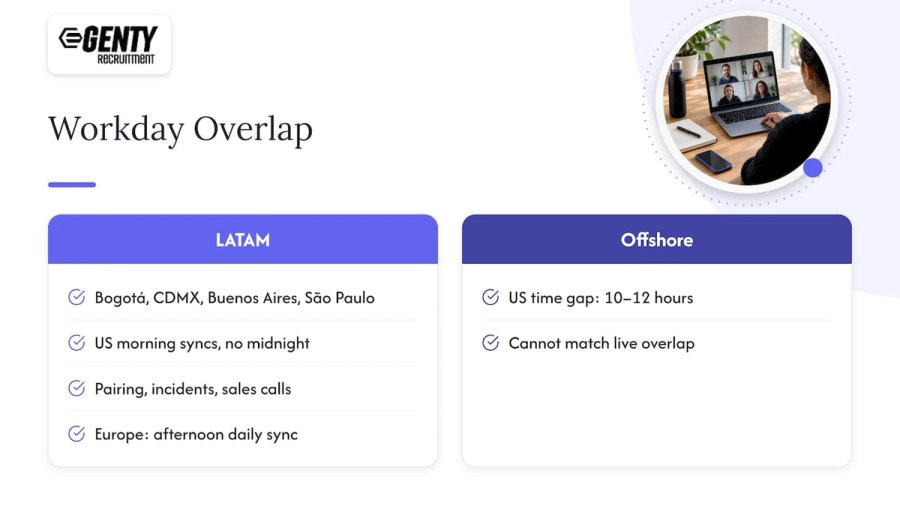
Culture is only half the argument. Because most of Latin America sits in time zones close to the US, a developer in Bogotá, Mexico City, Buenos Aires or São Paulo can join a morning standup in New York or San Francisco without anyone working at midnight. That overlap with US Eastern and Pacific hours is what makes pairing sessions, live incident response and sales calls with US prospects practical, in a way that offshore models with 10-12 hour gaps cannot match. For European companies, the afternoon overlap still supports a daily sync with the Americas.
Strong English among tech professionals compounds this. Our guide on LATAM English proficiency explains how to evaluate it for engineering roles.
A manager’s checklist for the first 90 days
- Open with a personal call. Spend the first meeting on background, interests and goals, not tickets.
- Write the working agreement. Hours, response times, escalation path and decision rights, in one page.
- Run a 360° read of the context. The PMI guidance suggests assessing the environment at the start of a project and learning from generalizations without stereotyping.
- Introduce people by name and title. Warm introductions to your US team speed trust.
- Schedule weekly one-to-ones, camera on, with space for non-work conversation.
- Ask for risks, not just status, and thank people who raise them.
- Recognize publicly, correct privately.
- Plan an in-person or offsite moment within the first year if budget allows. Rework notes trust is earned face to face.
- Onboard deliberately. Our guide to onboarding remote employees walks through the first weeks.
Culture is not destiny
One finding is useful for any leader worried about cultural friction. Spencer Stuart’s 2018 survey of 120 executives and HR directors in Argentina, Brazil, Chile, Colombia, Mexico and Peru found that many regional leaders attribute behaviors to being “latino” and believe them fixed, yet the evidence points the other way: leaders can deliberately shape culture to support strategy. Your team’s culture is built by your rituals, not inherited from a passport. The SAGE entry suggests working with local tendencies such as relationship-first interaction rather than fighting them, and notes that courtesy during delays builds the trust that gets work done.
Our perspective
We hear the same question from CTOs and sales leaders weighing a first LATAM hire: will this person work the way my team works? Our answer is that the strongest results come from matching a candidate’s skills and working style to your team’s rhythm, then setting expectations clearly on day one.
That is why our process is skill-first, with dedicated recruiters per vertical and triple-vetted shortlists delivered within 7 days. Culture fit is part of the conversation from the first call, whether you are hiring a backend engineer in Argentina, a DevOps lead in Brazil, or an SDR team in Mexico and Colombia.
Our fixed-fee pricing, no upfront payments and 3-month replacement guarantee exist so you can hire with confidence and focus on onboarding well. With nearshore time zone alignment and strong English, clients save up to 40% compared with US or European hiring.
Eugene
Hiring in LATAM with GENTY recruitment
If you are ready to build a team in the region, GENTY recruitment covers IT recruitment for LATAM tech teams and sales recruitment, both from $2,999 one-off per hire, with staffing from $99 per month per employee. Executive search, salary benchmarking and RPO are also available for leaders and growing teams.
To scope a role, compare compensation by country or plan a multi-hire rollout, start at GENTY recruitment. For more on the process, see our remote hiring playbook for LATAM tech teams.
FAQ
What is Mexican work culture like?
Mexican workplaces combine personal warmth with clear lines of authority, and titles carry weight. Courtesy matters, and a direct “no” is often softened, so ask open questions and confirm understanding. Deadlines flex with relationship and context, which short, frequent check-ins handle well.
Do Latin Americans work long hours?
Hours vary by country, sector and company. Tech and sales roles serving US clients generally follow an agreed schedule with a defined overlap window. Set hours, response times and holidays in a written agreement so expectations are the same on both sides.
Is Latin America one culture?
No. Research across Argentina, Brazil, Chile, Colombia and Mexico shows real differences in attitudes to formal rules, hierarchy and planning. Brazil leans toward warmth and flexibility, Mexico toward hierarchy with warmth, and Argentina toward open debate. Plan for each market separately.
How do I give feedback to a remote LATAM team member?
Give it privately, early and tied to the work, and open with the relationship. Paraphrase to check understanding, and offer a written channel for concerns, since challenging a superior in a group can feel uncomfortable in more hierarchical workplaces.
Sources
- Business Culture in Latin America: A Leader’s Guide
- Towards studies of organizational behaviour (Revista de Psicología, 2007)
- Marked national variation in leadership reliance (2007)
- The meaning of difference (Arizona State University)
- How Culture Affects Work Practices in Latin America (Wharton Knowledge)
- Cultural characteristics of Chilean and Brazilian workers (University of Manchester)
- Cultural Differences in International Business by Country
- The SAGE Encyclopedia entry on communicating with people from Latin America
- Made in Latin America: How Top Leaders in the Region Lead (Spencer Stuart)
- La percepción de la cultura organizacional en América Latina (Spencer Stuart)
- Mexico vs US Workplace Communication Guide
- Cross-cultural communication: twelve guidelines (PMI)
- How to Find Remote Jobs