

There is no single React developer salary in Latin America. Pay depends on the country, the seniority, and above all on who the employer is: a local company or a US company hiring remotely. Remote roles with US employers pay 2 to 4 times local market rates in most countries, so a local salary survey will understate what you need to offer to win a strong engineer. This guide shows how to build a realistic offer for Argentina, Brazil, Mexico and Colombia, how to read figures quoted in local currency, and where the real savings against US hiring come from.
TL;DR
- Local-market salary data and US-employer remote pay are two different markets. Budget from the second one if you want to hire senior React talent.
- Brazil’s median developer compensation is around $30,600 a year in Stack Overflow survey data, which reflects local and mixed employment, not what a US startup pays for a senior remote hire.
- Seniority is the largest lever: the gap to US pay narrows as you move from junior to staff level.
- Argentina, Brazil, Mexico and Colombia all overlap with US Eastern and Pacific working hours, which keeps standups, code review and pairing in real time.
- GENTY recruitment places pre-vetted React engineers for a fixed fee from $2,999 per hire, with a 3-month replacement guarantee.
Why one number for LATAM React salaries misleads
Search results for this topic mix at least four different things: local salaries paid in pesos or reais, remote salaries paid in dollars by foreign companies, self-reported survey medians, and US job-board averages that happen to contain the word “Latin America” in the query. A figure such as a $109K Brazil average on a salary aggregator, or an hourly rate for a US city, is not a budget you can take to a LATAM hiring plan.
Before you compare any figure, ask four questions:
- Is it gross or net of local employer contributions?
- Is it paid in local currency or in US dollars?
- Does it describe local employers or foreign remote employers?
- Is it a median, an average, or a self-reported range with a small sample?
The Brazil number from Stack Overflow is a good example. It is a self-reported median of roughly $30,600 in total annual compensation, and the page that reports it is explicit that this is not the base salary of remote contracts for US companies. It is a floor for understanding the local market, not a ceiling for your offer.
Before you start hiring
Check location, salary, and hiring fit
If you are moving from research to action, start with the market basics so your hiring plan is clearer.
Local pay versus remote pay from a US employer
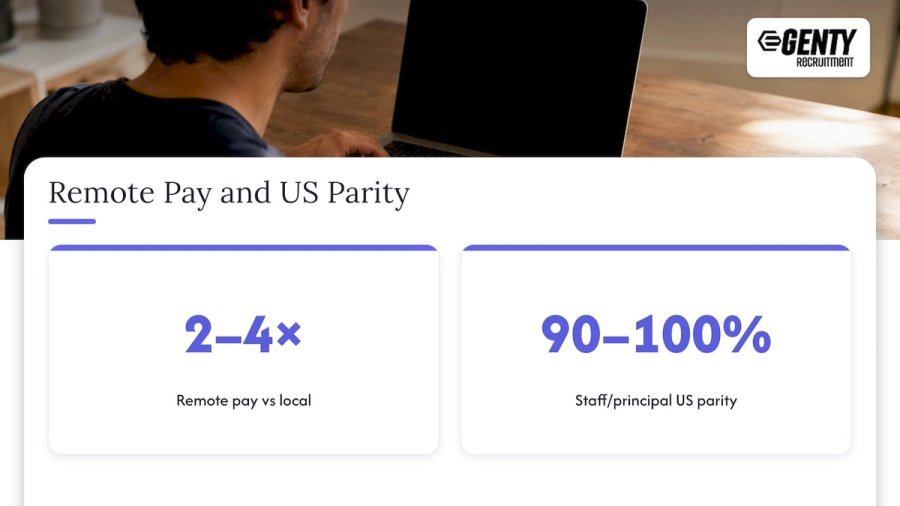
A React developer in São Paulo, Mexico City, Bogotá or Buenos Aires has two broad career paths. One is a local employer, a bank, a retailer, a regional scale-up, paying in local currency. The other is a US or European company paying in dollars. The second path pays 2 to 4 times more in most countries, and that is exactly why strong engineers are reluctant to move for a local-market offer.
The gap also closes with experience. One LATAM remote-work analysis reports that parity with US pay rises with seniority, reaching 90 to 100 percent for staff and principal roles. The practical reading for a CTO: at junior and mid-level you capture a large discount, while at staff level you are buying scarce skill and should expect to pay close to a US rate.
This is the same pattern we describe in our analyses of DevOps salaries in Latin America and Golang developer pay in LATAM: the skill premium compounds with seniority, and the remote-for-US premium sits on top of it.
How seniority changes the offer
Instead of quoting unsourced bands, here is how we structure compensation conversations with hiring managers, so you can fit current market data into it.
Our pricing mirrors this: recruitment fees are fixed per seniority level, starting from $2,999 per hire, so the cost of the search is predictable whatever the final salary.
What moves a React salary inside Latin America
Country and city
The four largest nearshore markets behave differently.
- Brazil has the largest developer population in the region, with hubs in São Paulo and Florianópolis. Local demand from banks and fintechs is intense, so local pay is competitive, but candidates paid in dollars still tend to prefer international employers. Brazilian candidates are usually Portuguese-first, so confirm spoken English early.
- Mexico offers the closest US overlap, with Central time covering most of the US workday. Mexican engineers are frequently already used to working with US product teams.
- Argentina is known for strong engineering education and a deep senior bench. Inflation and currency controls make many Argentine developers prefer dollar-denominated contracts, so offers in US dollars are standard.
- Colombia, with Bogotá and Medellín as the main hubs, is a fast-growing market with Eastern-time alignment and a deep supply of mid-level React engineers.
Stack depth
React alone is a commodity skill in most markets. The premium comes from the surrounding stack: TypeScript, Next.js, server-side rendering, state management at scale, GraphQL, testing with Jest and Cypress or Playwright, and accessibility. Engineers who can also own a design system or a micro-frontend architecture sit at the top of each band. React Native adds a mobile dimension and is priced separately by many teams.
Industry
FinTech, AI and Web3 companies compete hardest for talent, and they set the upper end of the market. If you are hiring in those verticals, our fintech salaries in Latin America guide covers how sector demand lifts compensation.
English proficiency and communication
Spoken English is a pay driver because it is a productivity driver. A React engineer who can run a design review in English with your product lead is worth a premium over one who needs a translator. Treat it as a screening criterion, not an afterthought.
Employment structure
The same engineer can cost different amounts depending on whether you hire as a contractor, through an employer of record, or through a local entity. Contractor arrangements usually show a higher gross figure because the developer covers their own taxes and benefits, while employer-of-record models add local contributions on top of base pay. Compare total cost, not base pay alone.
Reading local currency figures correctly
Salary pages for LATAM often quote reais, Mexican pesos, Argentine pesos or Colombian pesos. Three rules prevent bad decisions:
- Convert at a current rate, and check the date. Brazil, Argentina and Colombia have all seen large currency swings. A figure published a year ago can be off by double digits in dollar terms.
- Separate monthly from annual. Many LATAM employers pay 13 monthly salaries, or add mandatory bonuses, so the “monthly” figure and the annual total are not simply related by a factor of 12.
- Never mix net and gross. Candidates often quote take-home pay. Your cost is gross pay plus any contributions, which is why the same offer can look 20 to 30 percent apart depending on who is speaking.
If a candidate quotes you a figure in local currency, ask whether it is net or gross, monthly or annual, and whether it includes mandatory bonuses. Then restate your offer in dollars so both sides compare the same number.
A worked budgeting example
The arithmetic below uses a placeholder salary, not a market figure, to show how to compare total cost. Replace the salary with the number you validate for your target level and country.
Suppose you budget $60,000 a year in base pay for a senior React developer hired through a fixed-fee search:
- Base pay: $60,000 a year.
- One-off recruitment fee: from $2,999, charged per hire, with nothing paid up front.
- Year-one cost before benefits, equipment and any payroll provider: $62,999.
Compare that to a US hire where a recruiter’s percentage fee is calculated on a much higher base salary. Because our fee is fixed per seniority level, the cost of the search does not rise when the salary rises. Clients save up to 40% compared with US or European hiring, according to our own client results, and the saving usually widens at mid-level, where the market is deepest.
If you prefer not to run payroll abroad, our staffing model starts from $99 per month per employee, which covers the administration layer. Pricing for RPO and executive search is scoped to the project.
Timezone alignment is part of the price
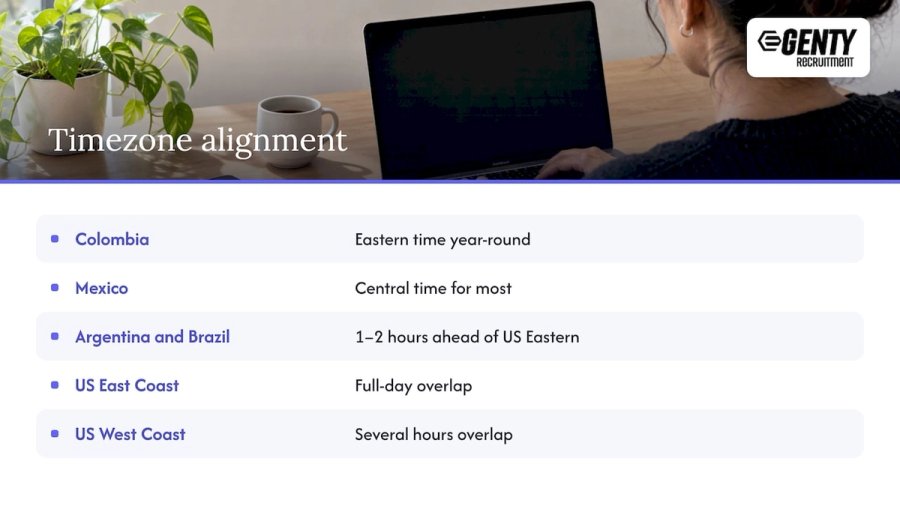
A salary table cannot show what a six-hour offset costs your team in review latency. Latin America sits in or next to US time zones: Colombia is on Eastern time year-round, Mexico is on Central time for most of the country, Argentina and Brazil are one to two hours ahead of US Eastern depending on daylight saving. That gives a US East Coast team a full-day overlap and a West Coast team a workable overlap of several hours.
For a React team this matters in concrete ways: pull requests get reviewed the same day, design questions are answered in real time, and an on-call rotation can share hours with US colleagues. When you compare a LATAM hire to an offshore alternative at a lower rate, include the cost of delayed feedback loops.
How to set the offer so senior candidates say yes
- Anchor in dollars. Offer a clear USD figure, paid on a regular schedule.
- Benchmark before you post. Validate your range against current data for the level and country. See our comparison of salary benchmarking tools to choose a method.
- Add non-salary value. Paid time off aligned with local holidays, equipment budgets, learning allowances and a clear growth path often close gaps that a higher base cannot.
- Move fast. Strong React engineers in dollar-paying roles are usually in several processes. A slow loop costs more than a few thousand dollars of salary.
- Test practical skills. A short take-home or live pairing session on a real component predicts performance better than a trivia interview. Our guide to hiring a React JS developer outlines a skill-first assessment.
Checklist before you open the role
- Target seniority and level of ownership defined
- Country shortlist chosen, with timezone overlap confirmed
- Salary range expressed in USD, gross, with contractor or employer-of-record structure decided
- Required stack split into must-have and nice-to-have
- English level required for stakeholder communication
- Interview loop of no more than three stages
- Budget for the search fee, equipment and payroll administration
Perspective
Most teams that overspend on LATAM React hires make the same mistake: they price the role from a local salary report and then lose the best candidates to a competing offer. The reverse also happens. They anchor on a US salary and discount it by a flat percentage, which gives them no real view of how the market behaves.
At GENTY recruitment we work only on Latin America, with dedicated recruiters per vertical, so we see how offers are accepted and declined. Our view is that the right price for a React engineer is the one that matches the dollar-paying remote market for that seniority and country, delivered through a process that is fast and transparent. That is why we present a triple-vetted shortlist within 7 days and charge a fixed fee with no upfront payment, backed by a 3-month replacement guarantee.
The result we aim for is simple: you hire senior engineers in your own timezone, at a total cost well below a US hire, with a search cost you can predict.
Eugene
Hire React developers in Latin America with GENTY recruitment
If you are ready to turn a salary range into a hire, our IT recruitment service covers React, TypeScript, Node and full-stack roles across Argentina, Brazil, Mexico, Colombia, Chile and more. You receive a curated shortlist of pre-vetted candidates within 7 days, pay a fixed fee from $2,999 per hire, and keep a 3-month replacement guarantee.
If you also need a salary benchmark for a specific role, or you are building a wider team, see our overview of how to hire remote developers and the US tech employer cost breakdown for Latin America. You can start from the GENTY recruitment homepage and tell us the role, country and seniority.
FAQ
Is a React developer in Latin America cheaper than one in the US?
Yes, in most cases, but the discount depends on seniority. Junior and mid-level engineers show the largest percentage savings, while staff-level pay moves close to US rates. Clients of GENTY recruitment report savings of up to 40% against US or European hiring once timezone alignment and total cost are included.
Which LATAM country is best for hiring React developers?
It depends on your timezone and seniority needs. Mexico offers the closest overlap with US working hours, Colombia aligns with Eastern time, Argentina has a deep senior bench, and Brazil has the largest talent pool. Many teams hire across two or three countries to balance cost and coverage.
Should I pay in US dollars or local currency?
Pay in US dollars for remote roles with a US employer. Dollar contracts are the standard in this market and protect candidates from currency swings in countries such as Argentina and Brazil. Confirm whether figures a candidate quotes are gross or net before comparing offers.
How much does it cost to recruit a React developer through GENTY recruitment?
Recruitment starts from $2,999 one-off per hire, with a fixed fee per seniority level and no upfront payment. Staffing starts from $99 per month per employee. A 3-month replacement guarantee applies to placements.
Sources
- US Company vs Local Employer: Where Should You Work
- Remote Internacional 2026: LATAM, USA y Europa
- Software Developer Salary in Brazil: 2026 Employer Guide