

Soft skills are defined as the human-side competencies that determine how work gets done and how teams function, and the role of soft skills in hiring has become a primary differentiator in candidate selection. When two candidates arrive with identical technical credentials, communication ability, emotional intelligence, and adaptability decide who gets the offer. The U.S. Chamber of Commerce identifies these competencies as decisive factors in hiring outcomes. Hiring managers and talent acquisition professionals who ignore soft skills evaluation risk selecting candidates who can do the job technically but fail to perform within real teams.
What role do soft skills play in hiring decisions?
Soft skills are the behavioral and interpersonal competencies that predict how a candidate will perform under real work conditions. They include communication, emotional intelligence, adaptability, teamwork, and problem-solving. Technical skills, or hard skills, tell you what a candidate knows. Soft skills tell you how they apply that knowledge with other people.
The U.S. Chamber of Commerce states that soft skills are the deciding factor when candidates have equal qualifications. That finding carries a direct implication for talent acquisition: your technical screening narrows the field, but soft skills close the decision. Hiring managers who treat soft skills as secondary criteria are making the final call on incomplete information.

The World Bank describes socio-emotional skills as crucial to labor market success, influencing how people manage social interactions and sustain employability over time. This matters beyond the hiring moment. Candidates who score well on soft skills tend to stay longer, collaborate more effectively, and adapt when job requirements shift.
Before you start hiring
Check location, salary, and hiring fit
If you are moving from research to action, start with the market basics so your hiring plan is clearer.
Which soft skills matter most for workplace performance?
The soft skills that carry the most weight in hiring vary by role type, but a core set applies across nearly every position. Hiring managers consistently prioritize the following:
- Communication: The ability to convey information clearly, listen actively, and adjust style for different audiences. For customer-facing roles in SaaS or FinTech sales, this is the primary competency.
- Emotional intelligence: The capacity to recognize and manage one’s own emotions and respond constructively to others. This skill predicts performance in leadership, client management, and cross-functional collaboration.
- Adaptability: The willingness to shift approaches when conditions change. In fast-moving tech environments, rigid candidates create bottlenecks regardless of their technical depth.
- Teamwork: The ability to contribute to shared goals, give and receive feedback, and support colleagues without requiring constant direction.
- Problem-solving: The capacity to analyze a situation, identify options, and act decisively. This skill shows up differently in a developer debugging production code versus a project manager handling a delayed sprint.
Role context shapes which of these competencies to weight most heavily. A customer success manager needs communication and emotional intelligence at the top of the rubric. A backend engineer working in a distributed team needs adaptability and problem-solving as primary signals. Mapping soft skills to specific role requirements before the interview process starts is the step most hiring teams skip.
Soft skills also correlate directly with retention. Candidates who fit the behavioral demands of a role are less likely to disengage or leave within the first year. That connection between soft skill alignment and retention makes the impact of soft skills measurable in business terms, not just cultural ones.
How do you assess soft skills objectively during interviews?
Objective soft skills evaluation requires structure. Gut feelings and unstructured conversations produce inconsistent, legally indefensible results. The most reliable method is the structured interview model documented by Google re:Work, which uses standardized questions and scoring rubrics to compare candidates consistently.
The structured approach works in four steps:
- Define the target competencies. Before writing a single question, identify which soft skills the role requires. A rubric built around vague traits like “good communicator” produces vague scores. Anchor each competency to observable behaviors.
- Write behavioral and hypothetical questions. Behavioral questions ask candidates to describe past situations: “Tell me about a time you had to deliver difficult feedback to a colleague.” Hypothetical questions test reasoning: “How would you handle a sprint where two team members disagree on the technical approach?” Both question types produce evidence, not impressions.
- Score with behaviorally anchored rating scales (BARS). BARS attach specific behavioral descriptions to each score level. A score of 4 on “adaptability” means the candidate described a concrete example of changing approach mid-project with a measurable outcome. A score of 2 means the candidate spoke in generalities. This distinction removes the subjectivity that undermines most soft skill assessments.
- Triangulate across multiple sources. MindTools recommends combining self-assessments, manager observations, and peer feedback rather than relying on a single interview score. A candidate who rates themselves highly on teamwork but receives low peer feedback scores presents a data point worth investigating before an offer goes out.
Pro Tip: Never score candidates after the interview ends. Score each answer immediately after the candidate finishes speaking. Memory degrades quickly and introduces recency bias that distorts the final rubric.
Google re:Work documents that structured interviews improve both predictive validity and candidate experience. Candidates perceive structured processes as fairer, which also protects your employer brand.
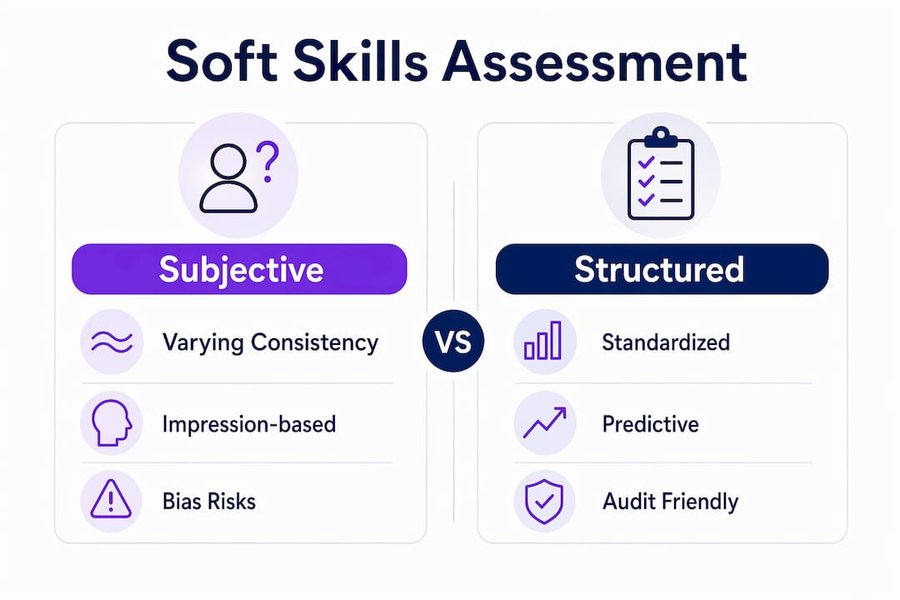
Subjective vs. structured soft skill assessment: which produces better hires?
The gap between subjective and structured assessment methods is not a matter of preference. It is a matter of hiring quality and legal exposure.
“Assessment without objective criteria leads to failures: lack of comparable data, no auditable decision records, and no bias reduction.” — EASEC
Subjective, impression-based assessments rely on an interviewer’s overall feeling about a candidate. Three cognitive biases consistently corrupt these judgments. The halo effect causes interviewers to rate all competencies highly after one strong answer. Affinity bias leads interviewers to favor candidates who share their background or communication style. Contrast bias inflates scores for candidates who follow a weak performer in the interview schedule.
EASEC highlights that psychometrically validated tools produce normalized, auditable scores that support compliance with anti-discrimination legislation. For organizations operating across the US and Europe, that auditability is not optional. Structured soft skills evaluation protects both the candidate and the organization.
The critical operational step that most teams miss is building job-specific rubrics. A generic “communication” rubric applied to every role produces scores that are not comparable across positions. EASEC warns that without objective criteria, structured interviews risk scoring impressions rather than evidence. The rubric is the mechanism that makes the structure real.
How to implement soft skills evaluation in your hiring workflow
Building a reliable soft skills evaluation process requires deliberate design before the first interview takes place. These steps apply whether you are hiring for a single role or building a repeatable process across a talent acquisition team.
- Map soft skills to each role before posting. Identify the three to five competencies most predictive of success in the specific position. A DevOps engineer and a sales development representative share some soft skills but differ significantly on which ones matter most.
- Build job-specific rubrics with BARS. Write behavioral descriptions for each score level. Anchor descriptions to observable actions, not personality traits. “Candidate described adjusting sprint priorities after a client escalation and documented the outcome” is a BARS anchor. “Candidate seems flexible” is not.
- Train interviewers before they enter the room. Interviewers who understand cognitive bias and know how to score BARS consistently produce more reliable data. One-hour calibration sessions before a hiring cycle significantly reduce inter-rater variance.
- Combine methods for higher confidence. Use structured behavioral interviews as the primary tool, add a validated psychometric assessment for senior roles, and collect multi-source feedback when the candidate has a work history you can reference. MindTools confirms that triangulating multiple sources produces more reliable evaluations than any single method.
- Document every decision. Record scores, behavioral evidence cited, and the rationale for hiring or not hiring. This documentation supports audits, appeals, and continuous improvement of your rubrics over time.
Pro Tip: Separate soft skill evaluation from culture fit discussions entirely. “Culture fit” is a subjective label that often masks affinity bias. Define the specific behaviors you want and use competency frameworks to elicit evidence for those behaviors instead.
Gentyrecruitment applies structured vetting frameworks across its LATAM candidate pools, assessing both technical and soft skill competencies before candidates reach client interviews. Hiring managers working with pre-vetted talent can review candidate vetting practices that combine behavioral interviews with documented rubrics for tech roles.
What trends are reshaping soft skill assessment in 2026?
The hiring environment in 2026 has changed the weight soft skills carry in candidate selection. Three forces are driving that shift.
- AI resume screening is producing look-alike applications. As the Economic Times reports, the rise of AI screening reduces resume uniqueness, making behavioral evidence the primary differentiator between finalists. When every candidate’s CV is optimized by the same tools, soft skills become the new hiring currency.
- Authenticity is replacing polish. Candidates who can demonstrate genuine behavioral evidence in structured interviews outperform those who deliver rehearsed answers. Hiring managers who use BARS-anchored rubrics can distinguish between the two.
- Psychometric integration is expanding. More talent acquisition teams are adding validated assessments alongside structured interviews, particularly for leadership and senior individual contributor roles. The combination of behavioral interview data and psychometric scores produces higher-confidence hiring decisions than either method alone.
The ongoing challenge is context-dependency. Soft skills do not transfer identically across environments. A candidate who communicates effectively in a startup setting may struggle in a highly regulated enterprise context. Soft skill assessment should account for the specific environment the candidate is entering, not just the competency in the abstract.
Key Takeaways
Soft skills are the decisive factor in hiring when technical qualifications are equal, and structured evaluation methods are the only reliable way to assess them fairly and consistently.
Why I think most hiring teams are assessing soft skills backward
After working closely with hiring processes across FinTech, SaaS, and AI companies in the US and Europe, the pattern I see most often is this: teams invest heavily in technical screening and treat soft skills as a final gut check. That sequence is backward.
Technical screening filters out unqualified candidates. Soft skills determine which qualified candidate will actually succeed. Running soft skill evaluation as an afterthought means you are making the most consequential part of the decision with the least structured data.
The teams that hire well do the opposite. They define soft skill competencies before the job goes live. They build rubrics before the first interview. They train interviewers before the hiring cycle opens. By the time a candidate reaches the final round, the evaluation framework is already in place.
The other mistake I see consistently is conflating soft skills with personality. Soft skills are behaviors, not traits. You cannot reliably assess “is this person a good communicator” from a 45-minute conversation. You can assess whether they described a specific situation where they adapted their communication style, what they did, and what the outcome was. That distinction changes everything about how you design your interviews.
Gentyrecruitment’s structured hiring approach builds this framework into every search, so hiring managers receive candidates who have already been evaluated against role-specific behavioral criteria. That is not a convenience. It is a meaningful reduction in hiring risk.
— Eugene
How Gentyrecruitment builds soft skill evaluation into tech hiring
Gentyrecruitment integrates structured soft skill assessment into every stage of its recruitment process for US and European tech companies hiring from Latin America. Candidates across Argentina, Brazil, Mexico, and Colombia are evaluated against role-specific behavioral rubrics before they reach client interviews. That means hiring managers receive pre-vetted talent with documented soft skill profiles, not just technical credentials.
For teams building engineering, sales, or product functions, Gentyrecruitment’s IT recruitment service combines behavioral screening with technical vetting to deliver candidates who are qualified and ready to integrate into global teams. For companies scaling sales functions, the sales recruitment service applies the same structured evaluation to SDRs and account executives, prioritizing communication and adaptability as primary competencies. Contact Gentyrecruitment to discuss how structured soft skill assessment fits your next hire.
FAQ
What are soft skills in hiring?
Soft skills are behavioral and interpersonal competencies such as communication, emotional intelligence, adaptability, teamwork, and problem-solving. The U.S. Chamber of Commerce identifies them as the human-side capabilities that determine how work gets done and how teams function.
Why do soft skills matter more than hard skills sometimes?
Soft skills become the deciding factor when candidates have equal technical qualifications. They predict how a candidate will perform under real work conditions, collaborate with colleagues, and adapt when job requirements change.
How can hiring managers assess soft skills objectively?
Google re:Work’s structured interview model uses standardized behavioral and hypothetical questions with scoring rubrics to compare candidates consistently. Adding behaviorally anchored rating scales and multi-source feedback further reduces subjectivity and increases predictive validity.
What is the difference between soft skills and culture fit?
Culture fit is a subjective label that frequently masks affinity bias. EASEC recommends replacing culture fit judgments with defined competency frameworks and behavior-focused questions that produce auditable, comparable evidence across all candidates.
How is AI changing soft skill evaluation in 2026?
AI resume screening is producing more look-alike applications, which reduces the value of CV-based differentiation. Behavioral evidence gathered through structured interviews has become the primary way hiring managers distinguish between equally credentialed finalists.