

The constraint isn't headcount. When the World Economic Forum surveyed more than 1,000 employers, 63% named skills gaps as the biggest barrier to business transformation through 2030, ahead of capital, regulation and technology itself (Future of Jobs Report 2025). That number reframes the purchase entirely.
Tech talent solutions are the outsourced services a company buys to find, qualify, contract and place technical people. Five models sit under that label, and each one removes a different piece of work and a different risk from your team. The question worth settling before any vendor call isn't which partner holds the largest database. It's which model takes work off your engineering calendar, and which risk stays with you afterward.
What Tech Talent Solutions Cover and Which Model Fits
The five models are contingency recruitment, retained or executive search, RPO, staffing and contracting, and direct-hire nearshore sourcing. They differ less in who they know than in who absorbs the cost of an unfilled seat.
Competition for the shortlist explains the urgency. For the first quarter of 2025, the global information technology sector recorded a 37% Net Employment Outlook, the strongest hiring intention among surveyed sectors in ManpowerGroup's Employment Outlook Survey. That volume of requisitions chases the same senior engineers, and the agency you sign is one channel into that queue, not a supply of its own.
Before you start hiring
Check location, salary, and hiring fit
If you are moving from research to action, start with the market basics so your hiring plan is clearer.
The five models side by side
Pick by the work you want to stop doing
The table resolves into a single rule. Choose by the internal work you want to end, not by the fee headline. If screening is the bottleneck, you need technical prequalification. If sourcing is the bottleneck, you need reach into markets you can't search yourself. If contracting is the bottleneck, you need an employer of record.
Stacking is normal at Series B. A fintech might run contingency for one security specialist while building a nearshore direct-hire pipeline for the platform team, because one hire needs speed and twelve need a repeatable funnel. The choice between staff augmentation and outsourcing is the decision sitting alongside this table: capacity you rent by the month versus an outcome you buy by the project.
How to Choose the Right Tech Talent Solution
Two meetings, seven steps, one written baseline. Run the sequence in order and model selection becomes arithmetic instead of taste.
The pressure behind it is measurable. 73% of technology employers said they struggled to find the skilled talent they needed, and 73% of surveyed leaders expected more than half of their new hires to be international by 2026, according to ManpowerGroup's global talent research.
Size the gap in requisitions. Count open roles plus hires planned over twelve months. At four or five hires, contingency pricing usually beats an RPO retainer, because a monthly function fee needs volume to amortize.
Classify each role by rarity and sensitivity. A staff platform engineer or a security lead justifies a retained search and the commitment that comes with it. A QA automation hire belongs in a standard pipeline with a work sample attached.
Name what you want to stop doing. Screening, sourcing, contracting, or all three. That answer, not the price list, selects the model.
Write the funnel baseline before the first call. Qualified candidates per requisition, technical-screen pass rate, interview-to-offer rate, offer-acceptance rate. Without those four numbers you can't separate a good shortlist from a lucky one.
Run a structured intake. Required stack, acceptable adjacent experience, English and communication threshold, time-zone overlap, and evidence of production delivery. Vagueness here returns as resume volume.
Score the first shortlist against a role-specific rubric and a work sample. A candidate who matches keywords but can't debug a failing pipeline has failed the screen, whatever the CV says.
Review at 90 days on time-to-productivity and retention. Time-to-hire measures the agency's speed, not your outcome.</li>
Decision rule: if nobody on your side can name the internal work a partner is absorbing, you're buying activity, and activity is the hardest line item to defend in a budget review.
The prerequisite sits on your side of the table. If demand isn't defined, no model repairs it, and headcount forecasting is the document that turns a vague hiring push into a requisition list a partner can price.
The Services Inside a Tech Talent Solution
A tech talent solution is a capacity purchase. Each line on the proposal carries a different risk: speed on a single role, volume across a funnel, employment liability, or a thin senior pool. Read the document as deliverables. If it never names who owns sourcing, screening, employment, and pricing, you are buying activity that is hard to defend in a budget review.
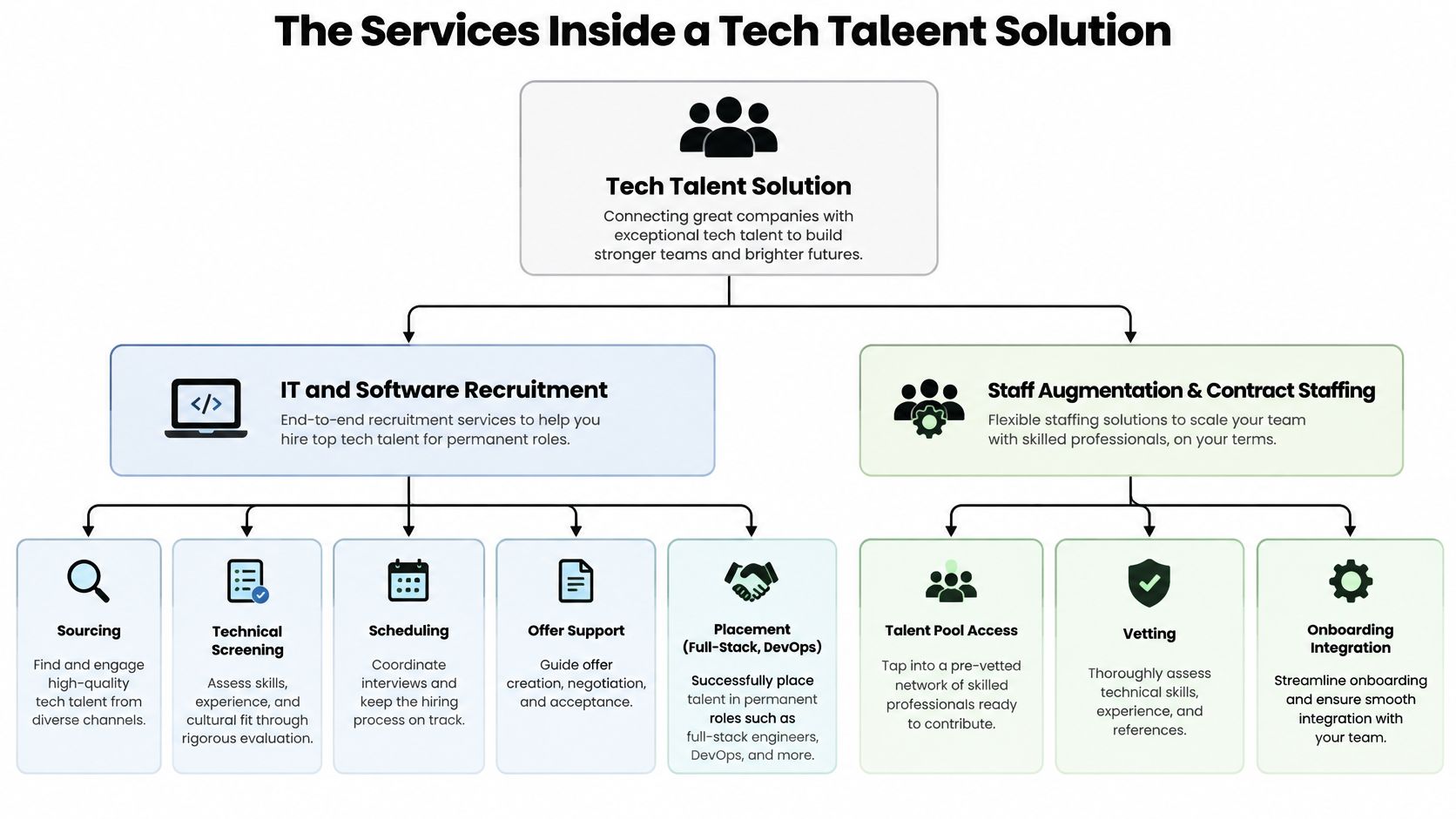
The five lines a proposal should itemize
IT and software recruitment. Sourcing, technical screening, scheduling, offer support, and placement across full-stack, DevOps, QA automation, data, BI, and product roles. The deliverable is a scored shortlist, not a folder of CVs. A narrow brief returns faster. A vague one spends calendar time on mismatches.
RPO. The partner runs the funnel: employer branding, sourcing, interviewer calibration, ATS hygiene, reporting, and candidate experience. It is priced as a function, so it pays off only above a volume threshold. Below that threshold you fund a process you do not feed.
Staffing and contracting. The partner hires, onboards, and manages the professionals, which is how staffing works at GENTY recruitment, so your engineers stay on the product while contracts and payroll sit with the supplier. You trade direct employment control for a shorter path to capacity.
Executive search. Staff, principal, and leadership roles, where the pool is small enough that a staged retainer is what gets calls returned. A contingency fee underprices the outreach those roles require.
Salary benchmarking and talent intelligence. Rate bands by country and level, used to price a requisition before it opens. If you also evaluate compensation data platforms, compare banking talent intelligence tools against the bands your partner quotes, because a benchmark is only as good as its sample.
Drop a line and you have bought a narrower model. Contingency recruitment can still fill one requisition. It will not absorb funnel ownership, payroll, and senior search at the same time.
What the assessment layer must test
Partners are thinnest on the screen itself. 61% of employers said communication, critical thinking, and stakeholder management were harder to source than pure coding skills, and demand for AI risk-governance roles more than doubled, according to ManpowerGroup's tech hiring research. A screen that ranks only languages and frameworks answers the easy half.
GENTY recruitment applies a skills-first hiring model directly: structured assessment plus hands-on recruiting, with technical depth, English, and availability checked before an offer. That is a process choice on the search, not proof that every commercial line uses the same test. Collaboration still has to be scored. Those skills do not appear on a language list.
A DevOps screen should test deployment diagnosis, observability interpretation, rollback strategy, and infrastructure-as-code review. A QA automation screen should test test architecture, flaky-test isolation, API validation, and CI integration. Standardized scorecards make interviewer feedback comparable across countries and time zones, which matters once your panel spans a hiring manager in Berlin and an engineer in Bogotá.
Region is the second filter. Employers across Latin America report persistent difficulty filling IT roles, but available skills and local demand are not uniform. One LATAM rate card hides the differences that decide whether a shortlist arrives in a week or a month. Engineers who work in your timezone and communicate in fluent English still fail the hire if the scorecard never tested how they explain a rollback to a product owner.
What This Looks Like in Practice
Two companies, two capacity problems, two different purchases.

Two capacity problems, two models
Case A: a Series A fintech in Austin. Four backend hires are stuck behind KYC and onboarding-spec work, and the founding engineer reviews resumes after standup. The company buys direct-hire nearshore sourcing for LATAM engineers, keeps both US senior engineers on architecture and code review, and sees a first candidate pool in 3 to 7 days on a fixed fee per seniority level. The risk profile here is concentrated: each hire is a large share of a small team, so the money goes into vetting depth rather than process overhead.
Case B: a Series C SaaS company in Berlin. Fourteen hires are planned across the year, there's no internal recruiter, and two of the roles are staff-level platform engineers. It runs an RPO retainer for funnel volume and a retained search for the two senior roles. Paying for both is the point: the retainer carries throughput, the retained search carries the roles where a wrong hire costs a quarter. The risk is distributed, so the spend is too.
Same market, opposite capacity math. Case A loses money on delayed product work, Case B loses it on an empty funnel, and the purchase that fixes one does nothing for the other.
What the country data changes
The LATAM half of Case A isn't a shortcut. 75% of companies in Latin America and the Caribbean report difficulty finding and hiring workers with IT education, against 50% of firms across the region that can't find candidates with needed skills and 36% of firms in OECD countries, per OECD research on new technologies in Latin America. A nearshore pipeline is a sourcing advantage, not a warehouse of idle engineers.
Country-level mapping is what makes the funnel precise. OECD analysis of 2021-2022 online job postings shows how uneven software demand is across three markets:
Mexico's software-developer share sits well above Colombia's, and Colombia posted the highest overall share of digital, engineering and mathematics roles of the three. One blended rate card flattens that variation and hides where the specialists sit. A buyer hiring backend developers at volume reads the third column; a buyer hiring across mixed digital roles reads the first.
The cost of the hire the model has to beat is measurable. A 2025 engineering-cost analysis estimated that hiring one software engineer consumes about 65 hours of existing engineering-team time across resume review, screens, technical interviews and debriefs, with average US software-engineering time-to-fill at 56 days (engineering cost analysis). Every one of those hours comes out of delivery, which is why a wider funnel without tighter filtering deepens the deficit instead of closing it.
The filtering itself has to cover more than code. Coding ability is the easier half to source; collaboration under constraints is the half that decides whether a remote hire survives the first quarter. In practice that means the assessment layer scores communication alongside technical output: how a candidate writes up a debugging session, explains a tradeoff to a non-engineer, and responds when a spec changes mid-task. A nearshore hire who passes the code screen but can't write a clear status update costs the Austin team the same 65 hours again within six months.
What has to be true before a remote hire produces anything: agreed overlap hours, written decision rights, a manager with regional experience, a 30/60/90 onboarding plan and a visible promotion path. Track time-to-productivity and 90-day retention against those commitments. Where nearshore engineers slot into an existing on-call rotation, the guide to structuring a startup engineering team covers the sequencing.
Common Pitfalls and How to Avoid Them
The most expensive failure in this market isn't a bad hire. It's a partner who forwards thirty profiles with no technical filter and hands the screening cost back to the team that can least afford it.
Five failures and the control for each
Resume overload. Volume looks like effort and transfers work back to you. The control is contractual: a per-role scorecard plus a work sample as the deliverable, agreed before kickoff, with unqualified profiles returned unflagged.
Degree and title filtering. Screening on titles and degrees compounds the skills mismatch instead of resolving it. Research on AI roles found that removing degree requirements increased the median eligible talent pool 7.3x, for candidates with and without bachelor's degrees (Skills-Based Hiring Report). Treat that as a pool-size benchmark, not a hiring guarantee, and compare qualified applicants per requisition before and after you drop the degree gate.
Scorecard rule: every candidate gets the same observable outputs assessed, covering code quality, debugging method, system-design tradeoffs, security awareness and communication under constraints. Otherwise "skills-first" becomes a manager's gut feeling with a new name.
Skills drift. A job description written two hiring cycles ago is a wish list. Re-validate the stack, the adjacent experience you'll accept and the English threshold each cycle, because the tools in your last posting are already several versions behind.
Compliance blind spots. A contractor label doesn't settle anything. Some jurisdictions presume an employment relationship and put the burden of proof on the employer, and cross-border work can involve a worker in one country, a client in another and an intermediary in a third, with genuine uncertainty over which rules govern minimum wage, working time, leave and termination protection (OECD research on platform work). Document who controls the work, how payment flows, where services are performed and which entity holds statutory obligations.
Integration failure. A signed hire with no overlap hours, unclear decision rights and no onboarding owner becomes a 90-day attrition statistic that cost you a fee and a quarter.
Before you benchmark anything, get the rate bands right: salary benchmarking services shows what to price before a requisition opens rather than after an offer is rejected. Then read the replacement clause. The coverage window, the role and seniority it applies to, and whether it restarts on the replacement hire are the terms that price your risk.
How to Evaluate a Tech Talent Partner
Every claim in a sales call should map to a document or a demo you can inspect. Five checks cover most of the exposure.
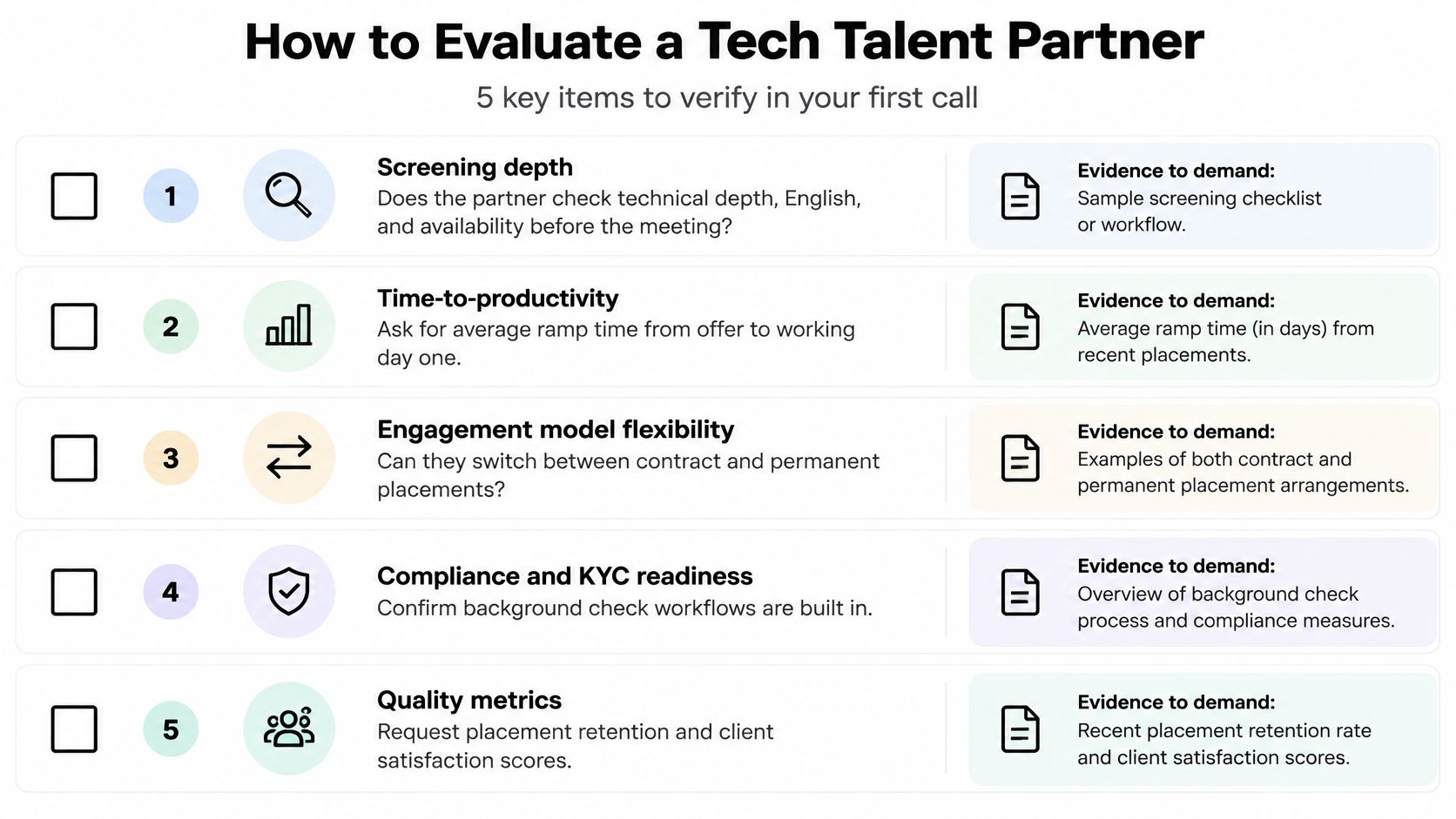
Five checks with the evidence to demand
Screening depth. Ask what gets verified before an offer, not after. GENTY recruitment's recruiters check technical depth, English and availability before an offer is made, and any partner should show a recent scored shortlist with the scorecard attached.
Speed with a definition. "A first pool" and "a first qualified pool" are different commitments. Ask how the clock is counted and from which event. GENTY recruitment helps US and EU startups hire vetted nearshore talent in under two weeks.
Commercials on paper. Fixed fee per seniority level against a percentage of salary, the payment trigger, and the replacement terms. GENTY recruitment's IT recruitment includes a three-month replacement guarantee, and you should still read the clause for scope.
Compliance ownership. Name the employer of record, who runs local checks, and which legal and tax questions sit outside the partner's remit. If the partner uses AI to screen or rank applicants, ask about the framework behind it: the OECD's summary of the EU AI Act classifies certain AI systems used for recruitment, promotion, firing, task assignment and workplace monitoring as high risk, with obligations on risk management, data governance, record keeping, transparency, human oversight and accuracy (OECD Employment Outlook 2023). A vendor's claim that its tool merely supports recruiters doesn't settle the question if it materially shapes who gets interviewed.
Region depth. Country-level rate bands and availability rather than one LATAM number. The questions to ask a recruitment agency list expands each check into what a good answer sounds like.</li>
Nearshore delivery fits where you need vetted engineers in overlapping time zones without opening an entity. Compare on concrete terms: first pools inside 3 to 7 days, fixed fees per seniority level, no upfront payment, and English proficiency tested before the shortlist rather than at the offer.
Shortlist rule: put two partners in front of the team whose weakest dimension is different. If both are weak on screening, the comparison tests nothing but price.
Your Next Step in the Next Two Weeks
Write two documents before you contact anyone. The first is a requisition scorecard for your most urgent role: required stack, acceptable adjacent experience, English threshold, overlap hours and the work sample you'll accept as evidence. The second is the funnel baseline from step four of the selection procedure, covering qualified candidates per requisition, technical-screen pass rate, interview-to-offer rate and offer-acceptance rate.
Those two documents decide which model is defensible. Contingency or retained search for one or two roles. RPO once eight or more hires are planned. Direct-hire nearshore for team build-out across LATAM, where a repeatable funnel beats a per-hire scramble.
For the nearshore route, book a free consultation to scope the roles and see a first candidate pool against a live requisition, and read the direct hire page before the call so the intake is done in one pass. Hold the partner to three checkpoints at 90 days: first qualified pool inside the agreed window, offer-acceptance rate, and 90-day retention.
A tech talent solution is bought to remove capacity from the engineering calendar and risk from the hiring process. Any option that does neither is a cost with a better name.
GENTY recruitment builds nearshore engineering and go-to-market teams for US and European companies, with a skills-first process that verifies technical depth, English and availability before a candidate reaches your calendar. If you're weighing a staffing model against direct hires in Latin America, GENTY recruitment will scope a live requisition, show you a first candidate pool, and quote a fixed fee per seniority level with no upfront payment and a three-month replacement guarantee. Start with the free consultation and bring the scorecard you've already written.