

Latin America is one of the deepest places outside the US and Europe to build a fintech engineering team. Brazil and Mexico hold the largest startup ecosystems, Argentina and Colombia supply senior backend and data engineers, and most of the region works within a few hours of US Eastern and Pacific time. The hard part is not finding people. It is finding the few who combine payments or lending experience with production-grade engineering, then employing them correctly across borders. GENTY recruitment places pre-vetted LATAM engineers, data specialists and sales hires with US and European tech companies, with IT recruitment from $2,999 one-off per hire.
TL;DR
- LATAM fintech grew from 703 startups in 2017 to 3,069 in 2023, and Brazil and Mexico hold the most ventures, so the candidate pool is large and domain-experienced.
- Backend, full-stack, mobile, data and cybersecurity roles are the most contested, so budget for 2.5 to 3 times of spread between junior and senior pay.
- Colombia and Mexico offer US-hours overlap in Eastern and Central time; Brazil and Argentina cover Eastern mornings and the early afternoon.
- Employer on-costs (bonuses, social security, severance) matter as much as base salary, and the hiring model (employee or contractor) changes them.
- GENTY recruitment delivers curated shortlists within 7 days at a fixed fee per seniority level, with no upfront payment and a 3-month replacement guarantee.
What “fintech talent” means in Latin America
For a hiring manager, fintech talent is not one profile. It is a stack of roles that share regulated-money experience: payments, lending, remittances, banking-as-a-service, compliance and fraud.
The Fintech en América Latina study by PageGroup, reported by La República, found that 48% of IT talent in the region works in fintech or startups across more than 2,482 companies. That tells you two things: the pool is real, and your competitors for it are local unicorns as well as other US companies.
The profiles most in demand in that study were:
Need help hiring?
See the next step after this guide
If this topic is relevant to your team, these are the most useful pages to check next.
- Full-stack developers (REST APIs, .NET Core, Spring Boot)
- Mobile engineers (Flutter, Kotlin, React Native)
- Software architects (.NET Core, microservices, Kubernetes)
- Scrum masters and hybrid profiles who can both develop and structure a product
A separate report from the Uruguayan technology chamber Cuti, covering more than 100 selection processes in Uruguay, LATAM and the US in Q3 2025, shows demand concentrated in Fullstack, Backend, Mobile and Data, with fintech, cloud and technical leadership as the recurring keywords. Roles such as a Senior Backend Developer with a fintech background in Java, or a Senior Data Architect working remotely for a US employer, appear among its featured searches.
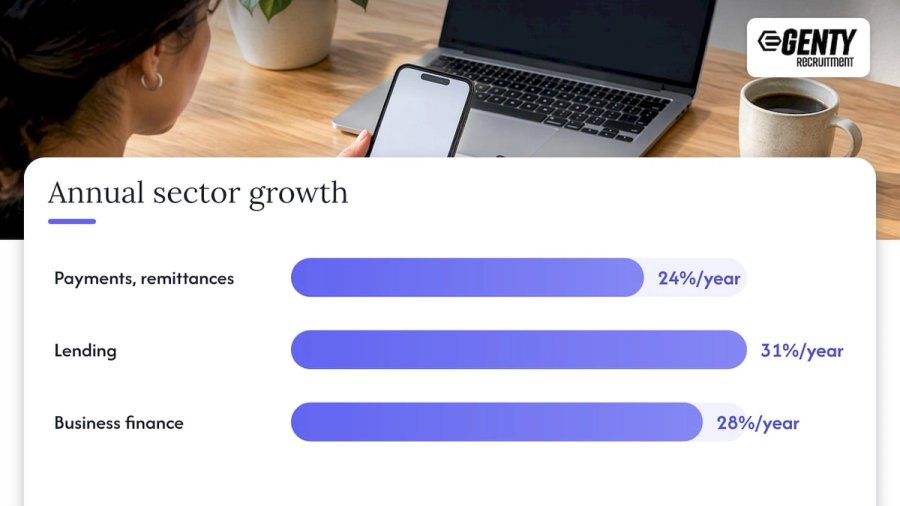
Cybersecurity and data analysis are the other two categories to plan for. According to TyN Magazine, citing the BID/Finnovista report, LATAM fintech startups grew 340% between 2017 and 2023, Brazil and Mexico account for 24% and 20% of ventures, and backend and full-stack developers, cybersecurity specialists and data analysts are the most sought-after roles. Payments and remittances, lending and business finance were growing at 24%, 31% and 28% a year.
Country by country: where to look
Each market has a different strength. Match the country to the role rather than defaulting to the cheapest or the best known.
Here is what the data says about concentration. In Argentina, the CAF fintech employment report of July 2025 shows that Buenos Aires province (57.6%) and the city of Buenos Aires (24.1%) hold 81.6% of sector jobs, followed by Córdoba at 8.8%, Santa Fe at 3.7% and Mendoza at 1.7%. If you want Argentine fintech engineers, you are recruiting from Buenos Aires and Córdoba first.
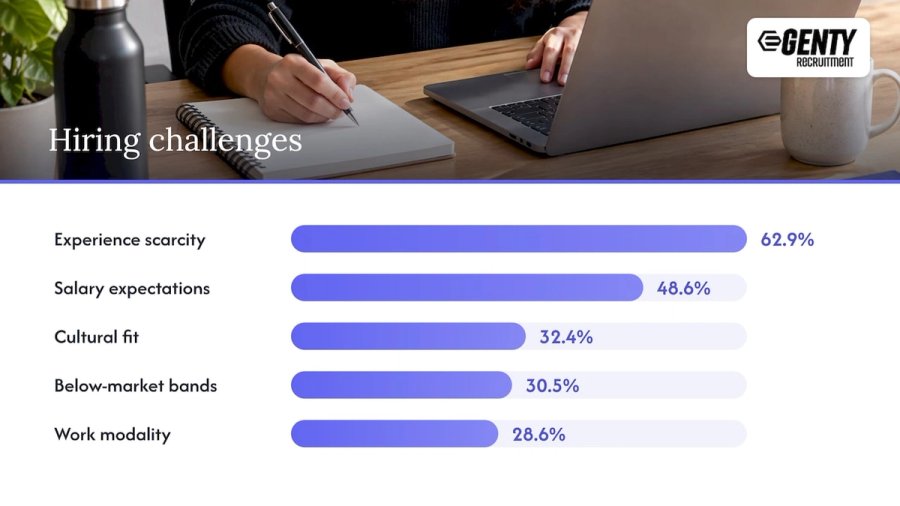
The same report names what employers there find hardest: scarcity of candidates with the required experience (62.9%), candidates’ salary expectations (48.6%), cultural fit (32.4%), salary bands below market (30.5%) and the work modality offered (28.6%). Salary bands below market and modality are the two you control. Pay in line with what US-funded companies already offer, and be clear on remote versus hybrid from the first message.
Funding momentum points to where the next wave of hiring will come from. Mexico’s venture activity is covered in Mexico’s lead in Latin America VC mega-deals in H1 2026, while Kapital’s $125M round in Argentina and Global66’s $3.5B in transactions out of Chile show how much local employers are scaling their own teams.
Time zone overlap: the practical advantage
Time zone alignment is the main operational reason fintech CTOs choose LATAM over other remote regions. Fintech work is incident-driven: a failed payment batch, a reconciliation mismatch or a compliance question cannot wait for the next morning.
- US Eastern teams: Colombia sits on the same clock as Eastern Standard Time, so standups, code reviews and on-call handoffs happen in real time. Brazil and Argentina share most of the Eastern working day, with a one-hour gap during US daylight saving time.
- US Pacific teams: Mexico and Colombia still leave a workable overlap from mid-morning Pacific time, which is enough for planning, pairing and incident response if you set core hours.
- European teams: Overlap shrinks to the European afternoon, so ask for an agreed daily window rather than assuming availability.
Set core hours of 10:00 to 15:00 Eastern as a rule of thumb for a mixed team. Everything outside it can be asynchronous, with written design docs and pull request reviews as the default.
What fintech engineers cost
Base pay is only the first number. The second is the cost of the structure you hire through.
The PageGroup data reported by La República gives a floor and ceiling for the best-paid fintech roles in Colombia: from COP 10 million a month for a data engineer up to COP 26 million for marketing and architecture directors and back-end or front-end developers. Those are local-market figures. US-funded remote roles typically pay above local averages, which is why compensation benchmarking matters before you open a search. GENTY recruitment’s guide to fintech salaries in Latin America, its analysis of US employer hiring costs in Latin America and its page on AI engineer salaries in the region give role-level ranges to calibrate against.
Two rules of thumb hold across markets:
- Senior pay runs roughly 2.5 to 3 times junior pay. Budget by seniority, not by headcount.
- Compare total employer cost, not salary. A lower base in one country can carry a heavier benefits load than a higher base in another.
GENTY recruitment’s own claim is that clients save up to 40% compared with US or European hiring, while keeping nearshore time zone alignment and strong English proficiency.
On-costs to model before you offer
- Mexico: the Federal Labor Law requires a Christmas bonus (aguinaldo) of at least 15 days of salary, plus IMSS social security contributions, profit sharing (PTU) and a vacation premium for employees.
- Colombia: the prima de servicios (a mandatory bonus) and cesantías (a severance fund), plus social security and pension, are paid on top of base salary.
- Argentina: a mid-year and year-end bonus (SAC) and mandatory severance on termination change both the real cost and the exit cost.
Have local counsel or your recruiting partner confirm current rates for the exact country and structure before you send an offer, as the percentages change with the contract and risk class.
Employee or contractor: what to compare
Most US fintechs start with one of three models: an employer of record (a local entity that employs the person on your behalf), your own local entity, or an independent contractor agreement. The choice depends on five factors:
- Permanence and control. If the engineer works your hours, uses your tools and reports to your managers for a long term, local authorities can treat the relationship as employment regardless of what the contract says.
- Regulatory exposure. Fintech teams touch customer data and money movement, so clean employment and IP assignment terms matter in diligence.
- Total cost. Contractors have no statutory bonuses, but senior candidates often expect a premium to cover their own social security and benefits.
- Retention. Strong engineers weigh benefits and stability. A contract with no benefits is easier to lose to a local employer.
- Exit. Severance obligations differ sharply by country, so plan this before hiring, not at termination.
Argentina shows why the law deserves attention. DLA Piper’s summary of the 2024 Bases Law describes it as the most significant change to Argentine labor legislation since the 1990s, and notes that workers hired through contractors or intermediaries may ask the company they serve to withhold amounts owed to them. If you use intermediaries, that joint exposure is part of your risk model. For a contractor-focused view, see GENTY recruitment’s developer contractor rates in Argentina.
For a fintech, a US lawyer and a local labor lawyer should sign off on the structure. A recruiter’s role is to source and assess talent and to tell you what the market expects, not to replace that review.
A fintech vetting checklist
Generic coding tests miss what fails in financial software. Use a checklist that tests domain judgment:
- Money handling: Can the candidate explain idempotency, double-entry ledgers and how to avoid floating-point errors in amounts?
- Reconciliation and failure modes: Ask how they would design retries for a payment provider that times out.
- Compliance awareness: Look for hands-on experience with KYC, AML or PCI controls, even in a supporting role.
- Production ownership: Ask about an incident they handled and what changed afterwards.
- English in context: Have them walk through a design in English, not only answer questions.
- Overlap commitment: Confirm they can work your core hours consistently, including on-call.
- Compensation fit: Confirm expectations early, because candidate salary expectations are one of the leading hiring difficulties in the CAF data.
For each candidate, score these on a simple 1 to 4 scale and decide the bar before the first interview. It keeps seniority decisions consistent when you hire in several countries at once.
How fintech hiring in LATAM is run in practice
A typical in-house search takes weeks because the best candidates are already employed and passive. The steps that matter:
- Define the role by outcome. Name the product (cards, lending, cross-border payments), the stack and the first six months of work.
- Set the band by seniority and country. Use benchmark data, then decide whether to pay at local rates or at US-remote rates.
- Source actively. Fintech engineers rarely answer job ads. Outreach to people at local fintechs and banks is where shortlists come from.
- Assess in two stages. A technical screen on money-handling scenarios, then a team interview on collaboration and overlap.
- Close fast. Strong candidates hold several offers, so decide within days of the final interview.
- Plan the first 90 days. A buddy, clear on-call expectations and documented architecture reduce early attrition.
The active sourcing step is where a specialist agency earns its fee. GENTY recruitment runs dedicated recruiters per vertical, and its process delivers triple-vetted, curated shortlists within 7 days. For the sales side of a fintech, such as SDRs and account executives who sell into LATAM or US markets, the same process runs through sales recruitment.
How GENTY recruitment hires fintech talent
Fintech teams that need an engineer, a data specialist or a first sales hire in Latin America can work with GENTY recruitment’s fintech recruitment service. The pricing is a fixed fee per seniority level, starting at $2,999 one-off per hire, with no upfront payment and a 3-month replacement guarantee. For ongoing roles, staffing starts at $99 per month per employee, and RPO covers companies that need a recruiting function across several hires. For leadership, there is executive search.
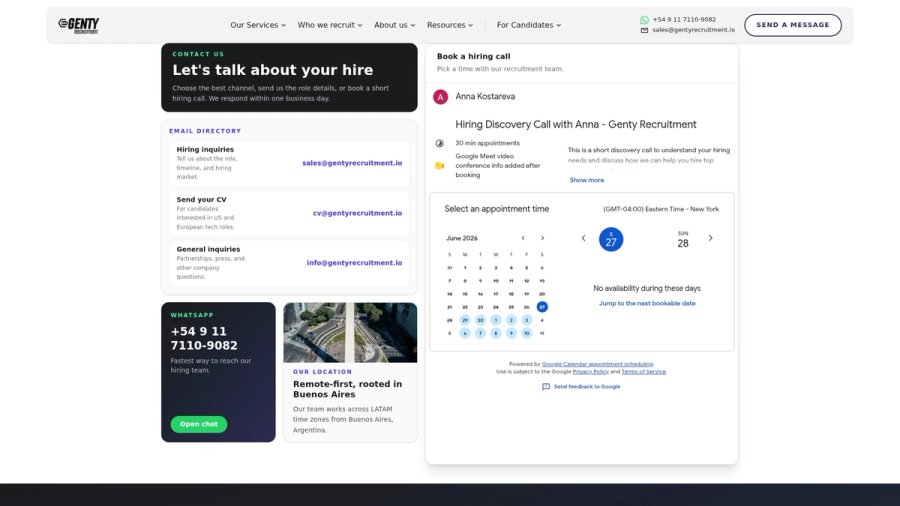
You can see the kinds of roles placed on the Who We Hire in LATAM page, or start from the GENTY recruitment home page to discuss a role and a salary benchmark.
Our view
Most fintech hiring plans we see in Latin America fail on the same two points: the search is run like a job-ad campaign, and the salary band is set without checking the country.
The engineers you want are not scrolling job boards. They are shipping at local banks and payments companies, and they respond to a recruiter who understands the stack, the regulation and the seniority levels. That is why we recruit exclusively in Latin America and assign dedicated recruiters per vertical rather than spreading generalists across every market.
A fixed fee per seniority level, with no upfront payment and a 3-month replacement guarantee, keeps the cost of a hire known from the start. Combined with Eastern and Pacific time overlap, strong English and savings of up to 40% against US or European hiring, a LATAM fintech team is a practical way to scale reliably.
Eugene
FAQ
Which Latin American country is best for hiring fintech engineers?
It depends on the role. Mexico and Brazil have the largest fintech ecosystems, with 20% and 24% of the region’s ventures respectively. Colombia gives the cleanest overlap with US Eastern time, and Argentina is strong for senior backend and data profiles concentrated in Buenos Aires and Córdoba.
How long does it take to hire a fintech developer in LATAM?
With an active-sourcing agency, GENTY recruitment delivers a curated shortlist within 7 days. The total time then depends on your interview cycle and notice periods, which vary by country. Moving from final interview to offer within a few days improves acceptance rates.
Do I need a local entity to hire fintech talent in Latin America?
Not necessarily. Companies commonly use an employer of record or an independent contractor agreement before opening an entity. The right structure depends on the country, the length of the engagement and how closely you direct the work, so get legal review before the first contract.
What do fintech roles cost compared with the US?
Base pay is lower, but on-costs such as bonuses, social security and severance vary by country and structure. GENTY recruitment says clients save up to 40% compared with US or European hiring. Use a salary benchmark by seniority and country before you set an offer.
Sources
- Fintech en América Latina study by PageGroup, reported by La República
- Cuti: most in-demand IT profiles in Q3 2025
- TyN Magazine: most sought-after roles in the fintech ecosystem
- CAF fintech employment report, Argentina, July 2025
- DLA Piper: Argentina enacts its Bases Law and Tax Measures Law