

A remote Python developer in Latin America typically earns somewhere between the mid-$40,000s and the low $80,000s a year, depending on country, seniority and who the employer is. The published figures disagree because they measure different things: local payroll, contractor invoices, job-posting ranges or US-company contracts. This guide shows which numbers to trust for which decision, how the five main hiring countries compare, and how to turn a salary figure into a real budget for a US or European team.
TL;DR
- Job-posting data puts the median annualized Python compensation in Latin America at $77,568, with a 25th to 75th percentile spread of $43,200 to $165,000, so the spread matters more than the midpoint.
- Deel’s 2026 contract data puts median software developer pay at about $66,000 in Brazil, $56,000 in Mexico and Chile, $46,000 in Argentina and $43,000 in Colombia.
- The US benchmark is a $135,980 median wage for software developers, so base pay in these five countries runs roughly half to one third lower.
- Colombia sits on US Eastern time and the other hubs are within a few hours, so real-time collaboration with a New York or San Francisco team is workable in all of them.
- Budget for salary plus employer-of-record or contractor costs plus recruiting, not salary alone.
What the published Python salary numbers actually measure
Before comparing countries, separate the data types. Three kinds of figures circulate, and mixing them is the most common reason a budget is off by 30% or more.
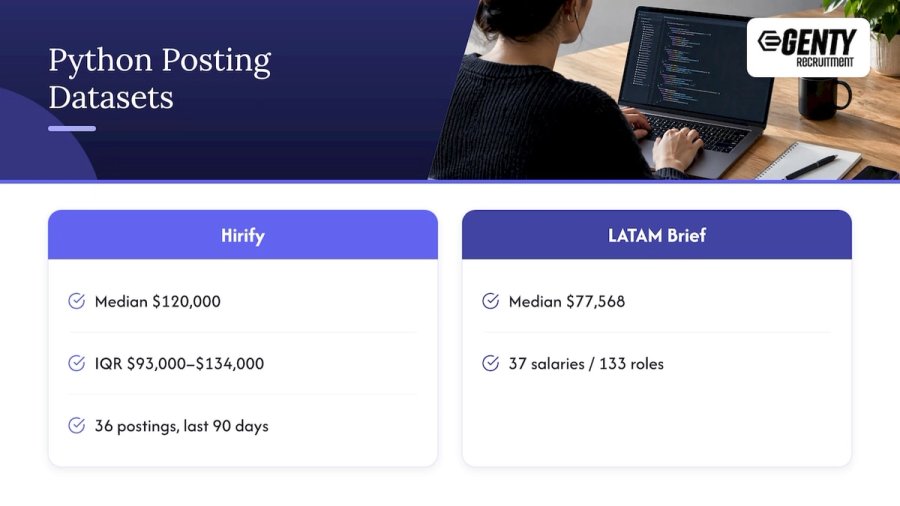
Job-posting medians. These come from salaries stated in active ads. Hirify’s aggregate reports a $120,000 median for Python roles across Latin America from 36 postings with a stated salary in the last 90 days, with an interquartile range of $93,000 to $134,000. That is a small sample skewed toward roles that advertise US-level pay, mostly senior. The LATAM Tech Market & Compensation Brief 2026 draws on 37 disclosed salaries out of 133 active Python roles and lands at $77,568. Two datasets on the same region, a gap of over $40,000: this is what small, self-selected samples do.
Contract data. Deel’s report covers contracts managed in the first half of 2026 between Latin American workers and companies outside their countries, limited to roles with at least 50 contracts and excluding executives. This is the closest public proxy for what a US or European company pays a remote hire, which is your situation.
Planning a hire?
Talk through the best hiring option
This article usually leads to one practical question: should you use it recruitment or country guide? We can help you choose quickly.
Simple next step
Start with it recruitment and we will help you pick the best hiring setup.
Benchmark platforms. Get on Board says its reports use real salary ranges and candidate expectations from active hiring processes rather than self-reported surveys, anchor on medians and refresh quarterly. Its methodology also makes a point worth copying: compare countries only after normalizing by seniority and technology, because the mix of applicants and roles distorts raw averages.
The practical rule: use contract data for the country-level anchor, use posting ranges for the ceiling, and fix seniority and stack before you quote any number to your finance team.
Python developer pay by country
Deel’s figures are for software developers in general, not Python specifically, but Python engineers sit inside that group and the country ordering is a reliable guide. The table adds the gap against the US median and what that gap means in base pay terms.
Deel’s developer and all-remote medians are from the 2026 Global Compensation Report as reported in August 2026. The US figure is a BLS-based May 2025 benchmark of employer-reported wages, with a 25th percentile of $105,210 and a 75th of $171,980. It excludes benefits, payroll taxes and equity, so the true US cost is higher than the wage, which makes the real gap wider than the table suggests. The percentages are our own arithmetic on those two sources.
Brazil
Brazil is the highest-paid of the five and the deepest pool. Python is widely used there in data engineering, fintech back ends and ML, so you will find strong candidates, but you will also compete with Brazilian banks and unicorns for them. Expect to pay near the top of the regional range for senior engineers and plan for Portuguese as the team’s day-to-day language outside your own channels. Verify English early in the process. Brasília time sits one to two hours ahead of US Eastern depending on the season, so a 10 a.m. to 6 p.m. Brazil schedule gives a full morning overlap with New York and a partial one with the West Coast.
Mexico
Mexico’s developer median matches Chile’s at $56,000, while its all-remote median is only $26,000. That wide gap tells you software roles are paid at roughly double the average remote worker there, and that the market rewards technical skills heavily. Mexico City operates on Central time, which makes it the easiest fit for teams in Austin, Chicago or Denver and a comfortable two-hour offset for Pacific teams.
Chile
Chile combines a developer median of $56,000 with an all-remote median of $42,000, the narrowest developer premium of the group. The pool is smaller than Brazil’s or Mexico’s, so searches take careful sourcing, but candidates tend to have strong English and experience with US-style product teams. If you are weighing a smaller market for quality of fit, Chile is the one to price carefully.
Argentina
Argentina’s $46,000 developer median reflects a market where currency volatility pushes engineers to prefer dollar-denominated contracts. For a US employer that is useful: you can quote in dollars and hold the offer steady. Argentine engineers often have deep backgrounds in backend and data work, and the country follows a UTC-3 schedule, so overlap with US Eastern hours is strong.
Colombia
Colombia has the lowest medians in the group ($43,000 for developers) and the best timezone match for the US East Coast, since Bogotá runs on the same offset as Eastern Standard Time. For a startup that needs daily standups at 9 a.m. Eastern with no one working late, Colombia is the default choice, and it has been growing as a Python and data hub.
Junior, mid-level and senior Python salaries
Public sources rarely split Python pay cleanly by seniority for Latin America, and the ones that do rely on small samples. The best approach is to read the spread inside the data rather than trust a single junior or senior label.
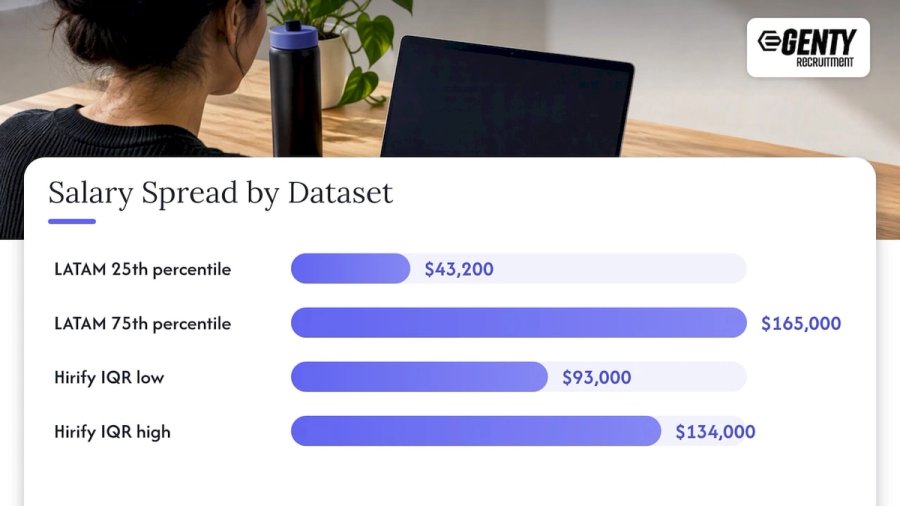
The LATAM Tech Market & Compensation Brief reports a 25th percentile of $43,200 and a 75th percentile of $165,000 for Python roles. Read the lower end as junior to mid-level pay in the region’s local-market-linked roles, and the upper end as senior and staff engineers hired by US companies at near-US pay. Hirify’s tighter $93,000 to $134,000 interquartile range describes mostly senior roles that publish a salary.
For planning, use this framework instead of a guessed number:
- Start from the country median in the table above for a mid-level engineer.
- Move down for juniors who need mentoring and a shorter scope, and move up for engineers with production ownership of services, strong English and experience in your domain.
- Add a premium for specialization. Python engineers who work in ML, data platforms or fintech compliance sit toward the top of the spread. Our guide to fintech salaries in Latin America covers that segment.
- Check the final figure against live candidate expectations, which is what a recruiter running active searches sees every week.
From salary to total cost of a hire
A $56,000 developer salary is not a $56,000 cost. The full cost depends on how you employ the person.
- Contractor. The engineer invoices you in dollars. There are no local employer payroll contributions on your side, but you carry misclassification risk if the arrangement looks like employment, and candidates at senior level often ask for a premium to cover their own benefits.
- Employer of record (EOR). A local entity employs the engineer on your behalf and charges a monthly fee on top of salary and mandatory contributions. It is the cleaner route for long-term hires.
- Your own entity. Cheapest per head at scale, with the heaviest setup burden.
A simple budgeting checklist:
- [ ] Base salary at the country median for your seniority
- [ ] Mandatory local contributions and the 13th-month or equivalent bonus where the country requires it
- [ ] EOR or contractor-platform fees per month
- [ ] Equipment and co-working stipend
- [ ] One-time recruiting fee
- [ ] Overlap-hour premium if you need work in US Pacific hours
Our breakdown of the cost to hire in LATAM and the analysis of what US tech employers pay when hiring in Latin America walk through each line with worked numbers. GENTY recruitment’s own claim, based on the engagements we run, is that clients save up to 40% compared with US or European hiring once these costs are included, which is more conservative than the base-pay gap alone.
Timezone alignment: what the overlap really buys
Salary is only half of the nearshore case. The other half is working hours. Colombia shares the US Eastern offset, Mexico City follows Central time, and Brazil and Argentina run one to two hours ahead of Eastern. That gives you:
- US Eastern teams: a near-complete workday overlap with Colombia, and four to six hours with Brazil and Argentina.
- US Pacific teams: a solid afternoon overlap with Mexico and Colombia, thinner with Brazil and Argentina unless the engineer shifts later.
- European teams: a morning-only window, best suited to engineers who can start late.
For Python roles with on-call duty, pair programming or tight product iteration, specify the required overlap hours in the job description. It narrows the candidate pool slightly and sharply raises the success of the hire.
How to screen Python candidates from Brazil and the region
The same resume reads differently across markets. Brazilian CVs commonly include personal details and a longer summary, and employer names may be local companies you have never heard of. Asking candidates to submit in a standardized format makes comparison easier; a free Brazil resume template builder shows the structure Brazilian applicants typically work with. Then screen on what predicts success, not on brand names:
- Production Python ownership: which services, what scale, what stack (Django, FastAPI, Celery, data pipelines).
- Testing and code review habits, shown in a take-home or live exercise scoped to two hours.
- Spoken English in a technical conversation, not only written.
- Salary expectation in USD, and whether it is gross for a contractor or net of local contributions.
Promo: hiring Python engineers in Latin America with GENTY recruitment
GENTY recruitment places pre-vetted Python and other software engineers from Argentina, Brazil, Mexico, Colombia, Chile and neighboring markets. Our process is skill-first: dedicated recruiters per vertical, a curated shortlist delivered within 7 days, fixed-fee pricing by seniority with no upfront payment, and a 3-month replacement guarantee. IT Recruitment starts from $2,999 one-off per hire, and Staffing starts from $99 per month per employee.
If you want a salary benchmark for your specific stack and seniority before you open the role, talk to us through the GENTY recruitment site. Related role guides: DevOps salaries in Latin America and QA engineer salary in LATAM.
Perspective
We see the same pattern in nearly every Python search we run for US and European teams. The first budget is built from a single headline salary, and the second, correct one is built from a country, a seniority and a required overlap window.
The gap with US pay is real and large, but it is not the whole advantage. A Python engineer in Colombia on Eastern time or in Mexico on Central time ships with your team, not after it. That is why we focus exclusively on Latin America and assign dedicated recruiters to each vertical: the engineers who match a fintech data platform differ from those who match a SaaS back end, and the salary expectations differ too.
Our advice is to fix your stack and seniority, choose the country by overlap and depth of talent, and price the role with a fixed-fee recruiter so the hiring cost is known before the search starts. The shortlist arrives in 7 days, and the 3-month replacement guarantee covers the early risk.
Eugene
FAQ
What is the average salary of a Python developer in Latin America?
There is no single reliable figure. Job-posting datasets report medians between $77,568 and $120,000, while Deel’s contract data puts software developer medians between $43,000 (Colombia) and $66,000 (Brazil). For a US employer hiring a mid-level engineer, the country medians are the safer anchor.
Which Latin American country is best for hiring Python developers?
It depends on your priority. Brazil has the largest pool and the highest pay, Mexico fits Central and Pacific teams, Colombia matches Eastern time at the lowest median, Argentina offers strong engineers on dollar contracts, and Chile suits teams that value a smaller, English-fluent market.
Are published salaries the same as what I will pay?
No. Deel’s figures reflect contracts between Latin American workers and companies abroad, which is the nearest match to a remote hire, but they exclude executives and do not include recruiting, EOR or equipment costs. Add those lines before you commit to a budget.
How much less does a Python developer cost in LATAM than in the US?
Comparing medians, base pay in Brazil is about 51% below the US software developer median of $135,980, and in Colombia about 68% below. Once benefits, fees and recruiting are included, GENTY recruitment’s own figure for client savings is up to 40%.
Sources
- LATAM Tech Market & Compensation Brief 2026
- Python Developer salaries in Latin America, Hirify
- Mexico’s Remote Salaries Lag Regional Leaders, Deel finds, Mexico Business
- Software Developers Salary, Office Blues
- Precision data for your LatAm talent strategy, Get on Board
- Identifica los trabajos remotos mejor pagados de Latinoamérica, Quadratin