
Nearshore staffing services place engineers, DevOps specialists, data people and sales reps in countries close to yours, in practice Latin America for a U.S. company, so they work your hours and join your stand-ups live. The best fit for a tech startup is a specialist that sources, vets and delivers a shortlist for a fixed fee, then stays accountable after the start date. That is how GENTY recruitment works: fixed-fee recruitment from $2,999 per hire, a shortlist within 7 days, no upfront payments and a 3-month replacement guarantee.
This guide explains what a nearshore staffing agency actually does, which engagement model fits which situation, what the real cost components are, and how to build both engineering and sales teams in Argentina, Brazil, Mexico and Colombia.
TL;DR
- Nearshore staffing means hiring professionals in a nearby country with overlapping working hours. For U.S. companies, that is Latin America, with Eastern, Central and Pacific overlap that makes daily collaboration realistic.
- There are three practical models: recruitment (you hire directly after a placement), staffing (a monthly fee per employee) and recruitment process outsourcing (a recruiter team embedded in your hiring).
- Cost is more than salary. Budget for statutory benefits, worker classification, payroll and the agency fee, which is why a fixed fee per seniority level is easier to plan than a percentage of salary.
- Sales teams work nearshore too: SDRs and AEs in Mexico, Colombia, Argentina and Brazil can cover U.S. calling hours and Spanish- or Portuguese-language markets.
- Choose a partner on vetting depth, role specialization, speed, guarantee terms and country-level compliance knowledge.
What nearshore staffing services include
Staffing Industry Analysts defines nearshoring as work performed in roughly the same time zone, with less than a day’s travel between the parties. For a U.S. buyer, Latin America fits that definition: the same source, citing SGF Global, describes a region of more than 33 countries and a workforce of about 370 million, with advantages in cultural fit, time-zone alignment and competitive wages.
A nearshore staffing agency turns that large, uneven talent market into something a hiring manager can use. The work typically covers:
What do you need?
Choose the hiring path that fits
After reading "Nearshore Staffing Services: How U.S. Tech Teams Hire in LATAM", most teams compare these options before deciding how to hire.
- Market selection. Deciding whether your stack and seniority needs point to Brazil, Mexico, Colombia, Argentina or Chile.
- Sourcing and vetting. Reaching passive candidates who are not answering job ads, then testing skills and English.
- Shortlisting. Presenting a small number of candidates who match the brief.
- Employment structure. Placing the person on your payroll, through an employer of record, or on a monthly staffing arrangement.
- Salary benchmarking. Pricing the role against the local market so your offer is competitive without overpaying.
The same Staffing Industry Analysts article quotes SGF Global’s managing director saying that finding talent “in your backyard” is not hard with the right partner, and lists visas, Latin American labor-law compliance, country choice and cultural guidance as areas where partners help. That breadth is the reason a specialist beats a job board: the hard part of nearshore hiring is rarely finding a résumé. It is finding the right résumé in the right country under the right employment structure.
Which roles work best nearshore
Deloitte’s work on software engineering nearshoring reports that Brazil and Mexico together have more than 2.2 million software engineering professionals and graduate over 350,000 engineering students every year. It also says the best nearshore fit is scope that benefits from real-time interaction: front-end development, real-time data pipeline work and collaboration between ML engineers and data scientists.
That matches what U.S. engineering leaders look for in practice:
For a closer look at where each skill concentrates, our guide to the top tech hubs in Latin America covers the major cities. Deloitte also advises weighing talent supply, English capability, graduate pipeline, risk, business climate and operating cost when choosing a location, which is the checklist a good agency works through with you before it sources a single candidate.
Timezone alignment: the reason to choose nearshore
Most of Latin America sits within a few hours of U.S. Eastern and Pacific time, and several of the largest markets share your clock almost exactly. Colombia is on a fixed UTC-5 offset, which lines up with U.S. Eastern Standard Time year-round. Mexico City is on Central time. Argentina and Brazil sit a couple of hours ahead of Eastern, which still leaves a full working-day overlap for a New York team and a solid half-day for a San Francisco one.
The practical effect for an engineering manager:
- Stand-ups, sprint planning and retros happen live instead of through recorded video.
- A blocked pull request gets answered in minutes, not the next morning.
- Production incidents can be handled by someone who is awake.
- Candidates can interview with your leadership during your normal day.
Our breakdown of time zone alignment in LATAM shows overlap by country for both EST and PST teams. For a deeper comparison with distant offshore locations, see offshore vs nearshore.
Three ways to staff nearshore
The right model depends on whether you want the person on your own team, want someone else to carry the employment, or need to scale hiring volume.
Recruitment: you hire, the agency finds
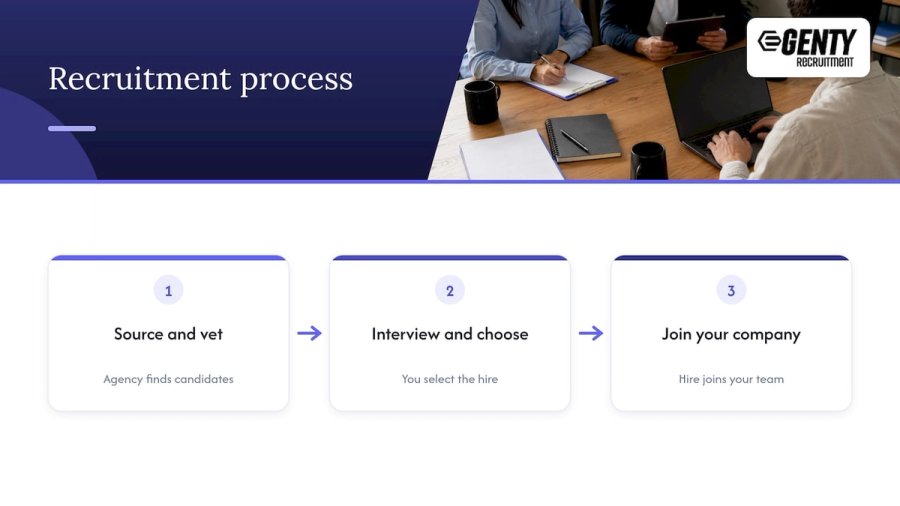
The agency sources and vets candidates, you interview and choose, and the hire joins your company. This suits startups that want long-term team members and control over culture and equity. At GENTY recruitment, this is IT recruitment or sales recruitment from $2,999 one-off per hire, with a published fixed fee per seniority level rather than a percentage of salary.
Staffing: monthly fee per employee
The person is placed through a staffing arrangement and you pay a monthly fee. Staffing at GENTY recruitment starts from $99 per month per employee. This model suits teams that do not have a legal entity in the candidate’s country and want the employment side handled for them.
RPO: a recruiting function on demand
Recruitment process outsourcing puts a dedicated recruiting team to work on a continuing hiring plan, for example ten engineers across two quarters. RPO fits when you are scaling faster than an internal recruiter can cope with. Our note on offshore recruitment process outsourcing explains how it differs from one-off placements.
What nearshore staffing really costs
Headline salaries are only the first line. A realistic nearshore budget has four layers:
- Base compensation. Set by local market rates for the role, seniority and stack. Candidates in Brazil’s or Mexico’s largest tech hubs price differently from those in smaller cities, and a U.S. employer often pays more than local companies to win a strong engineer.
- Statutory employment costs. Each country has its own rules on fixed-term contracts, termination and mandatory benefits such as extra monthly pay, vacation accrual and social security. These add to base pay and differ by country.
- Employment structure. If you have no legal entity in the country, an employer of record or a staffing arrangement carries the payroll and compliance for a monthly fee.
- Recruitment fee. One-off per hire or monthly, depending on the model.
We publish our own saving claim plainly: clients save up to 40% compared with U.S. or European hiring while keeping timezone alignment and strong English. Your own figure depends on role and seniority, so build it from a country-specific benchmark. Our cost to hire in LATAM breakdown and the hiring costs guide for U.S. tech employers walk through each layer, and LATAM salary benchmarking gives role-by-role ranges before you open a requisition.
Why fixed fees are easier to plan
A percentage fee rises with every salary negotiation. A fixed fee per seniority level lets you model a hire before the offer: you know the agency cost on day one, and a senior candidate’s fee does not climb because you improved the package. No upfront payments means you pay when a hire is made, not for a search that may not conclude.
Compliance and contracts you need to settle early
The Staffing Industry Analysts report flags legal regulation, worker classification and infrastructure as the main challenges in the region. Three decisions come before the first offer letter:
- Classification. Contractor or employee? Rules differ by country, and misclassification is the most common nearshore mistake. Decide with legal advice from a qualified employment lawyer in the relevant country.
- Employer of record, own entity or staffing arrangement. Each fits a different stage: pilot hire, small team, or established operation.
- Intellectual property. Make sure code written by your team belongs to your company. Our guide to IP assignment in Latin America covers what to put in the agreement.
For contract and tax specifics in a given country, ask your own counsel or accountant: the rules differ between Mexico, Colombia, Argentina and Brazil, and they change.
Building a nearshore sales team: SDRs and AEs
Sales leaders use the same nearshore logic. SDRs and AEs in Mexico City, Bogotá, Medellín, Buenos Aires or São Paulo can cover U.S. business hours, run outbound in English, and open Spanish- and Portuguese-speaking markets that a U.S.-only team cannot reach credibly.
What to define before you hire:
- Coverage window. Which U.S. time zones must be live for outbound and for demos?
- Language mix. English only, or English plus Spanish or Portuguese for LATAM accounts?
- Seniority split. SDR volume with an AE or sales manager who can coach, rather than a team of juniors with no lead.
- Compensation design. Base plus variable, set against local market norms so quota plans are credible.
- Ramp plan. Tooling access, call shadowing and a 30-60-90 day target set before day one.
We run sales recruitment with dedicated sales recruiters, from $2,999 one-off per hire. For leadership roles such as regional sales director or country manager, executive search is the right route.
How to choose a nearshore staffing partner
Use this checklist when comparing providers:
- Specialization. Do recruiters focus on your vertical, such as FinTech, AI, SaaS or Web3, or on everything?
- Vetting depth. What is tested before a candidate reaches you: technical skill, English, culture fit?
- Speed. How long until a first shortlist? Ours is 7 days.
- Fee structure. Fixed per seniority level or a percentage of salary? Any upfront payment?
- Guarantee. What happens if a hire leaves? We offer a 3-month replacement guarantee.
- Country knowledge. Can they explain statutory benefits and classification in Argentina, Brazil, Mexico and Colombia?
- Process. Active outreach to passive talent, or reposting a job ad and waiting?
If you want to see how screening is being automated across the industry, this overview of AI agents in recruitment is a good place to start. Automation helps with volume, but the shortlist a hiring manager sees still depends on recruiters who know the local market.
The broader advantages of the nearshore approach are laid out in 8 benefits of nearshore outsourcing, and nearshore or near shore explained clears up terminology if you are briefing a team.
A first-90-days plan for your first nearshore hire
- Week 0: Write the role scorecard: stack, seniority, overlap hours, English level, budget.
- Week 1: Select the country and employment structure. Benchmark the salary.
- Weeks 1 to 2: Review a shortlist, run technical and team interviews in your own working hours.
- Weeks 3 to 4: Offer, contract and IP assignment signed; equipment and access arranged.
- Month 2: Pair the new hire with a buddy on your team, give a scoped first project and set a weekly one-on-one.
- Month 3: Review against the scorecard. The replacement guarantee period gives you a defined window while the hire settles in.
Promo: fixed-fee nearshore hiring from GENTY recruitment
GENTY recruitment is a specialized IT and sales recruitment agency for U.S. and European tech companies hiring pre-vetted talent in Latin America, with dedicated recruiters per vertical across FinTech, AI, SaaS and Web3. You get a curated shortlist within 7 days, a transparent fixed fee per seniority level starting at $2,999 per hire, no upfront payments and a 3-month replacement guarantee.
Tell us the role, the stack and your overlap hours, and we will start from there on the GENTY recruitment site.
Our perspective
Most failed nearshore hires we hear described come down to one thing: the search was designed around a job post, not around the person. Strong engineers in Brazil, Mexico, Argentina and Colombia are usually employed and not browsing boards, so the recruiter has to reach them, test their skills and explain your company in the first conversation.
That is why we built GENTY recruitment around dedicated recruiters per vertical and a skill-first process. A recruiter who works only on DevOps or only on SDRs knows what good looks like, and your shortlist is triple-vetted before you spend an hour on interviews.
We price the same way we work: a fixed fee per seniority level, no upfront payment and a 3-month replacement guarantee, so you can plan a hire before you start it. Add the timezone overlap with EST and PST and a nearshore team stops being a compromise and becomes a way to scale reliably.
Eugene
FAQ
What is the difference between a nearshore staffing agency and an offshore one?
A nearshore agency places talent in nearby countries with overlapping working hours, such as Latin America for a U.S. company. Offshore usually means distant locations with large time gaps. Nearshore teams can join live stand-ups and respond within the same day.
How fast can a nearshore staffing agency deliver candidates?
It depends on the role and the agency’s process. At GENTY recruitment, a curated shortlist arrives within 7 days of the brief. Interviews then run in your normal working hours.
Can I hire nearshore sales reps, not just developers?
Yes. SDRs, AEs and sales leaders in Mexico, Colombia, Argentina and Brazil can cover U.S. calling hours and Spanish- or Portuguese-language accounts. We recruit them through our sales recruitment service from $2,999 per hire.
Which Latin American country should I hire from first?
Start from the roles and overlap you need. Brazil and Mexico offer the largest engineering pools according to Deloitte, Colombia matches Eastern time, and Argentina is strong in front-end and product engineering. Salary benchmarking by country narrows the choice quickly.
Sources
- Nearshoring gains traction for US talent needs, Staffing Industry Analysts
- Software Engineering Nearshoring, Deloitte US